
a collection of notes on areas of personal interest
- Introduction
- Arabic / Islamic design
- Arabic / Islamic geometry 01
- Arabic / Islamic geometry 02
- Arabic / Islamic geometry 03
- Arabic / Islamic geometry 04
- Islamic architecture
- Islamic urban design 01
- Islamic urban design 02
- Islamic urban design 03
- Islamic urban design 04
- Islamic urban design 05
- Arabic / Islamic gardens
- Gulf architecture 01
- Gulf architecture 02
- Gulf architecture 03
- Gulf architecture 04
- Gulf architecture 05
- Gulf architecture 06
- Gulf architecture 07
- Gulf architecture 08
- Infrastructure development
- The building industry
- Environmental control
- Perception
- The household on its lot
- A new approach – conceptual
- A new approach – principles
- A new approach – details
- Al Salata al jadida
- Public housing
- Expatriate housing study
- Apartment housing
- Pressures for change
- The State’s administration
- Society 01
- Society 02
- Society 03
- Society 04
- Society 05
- Society 06
- History of the peninsula
- Geography
- Planning 01
- Planning 02
- Population
- Traditional boats
- Boat types
- Old Qatar 01
- Old Qatar 02
- Security
- Protection
- Design brief
- Design elements
- Building regulations
- Glossary
- Glossary addendum
- References
- References addendum
- Links to other sites
The Gulf’s strategic position
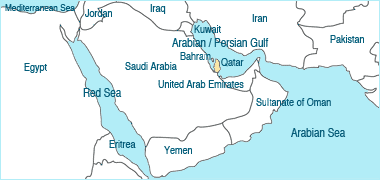
The Gulf is one of the two direct routes through this region by which passage from the Far East could be gained to the West. Its security has been perceived to be vital to those seeking to move materials through it, and has been the reason for the interest shown in it by a number of European, Arab and Ottoman powers. It was or is bounded on its east side by Persia – present day Iran, and on the west by the Arabian peninsula containing Saudi Arabia and the various Emirates including the associated islands of Bahrain. Iraq has access to the north end of the Gulf through the port of Basra.
As I mentioned on another page I generally refer to the Persian Gulf – its officially recognised name – as the Gulf though, to those on the Arabic side of that body of water, it is commonly referred to as the Arabian Gulf.
A particular characteristic of the Gulf is the relatively small marine passage at the Straights of Hormuz – between the United Arab Emirates and Iran – that allows marine traffic access from the Indian Ocean via the Arabian Sea to the Gulf.
The Gulf was the setting for the development of both strong maritime and land empires, attracting interest not only from the land masses adjacent to it, but also from further afield such as Europe to its west and the Indian sub-continent to its east. In fact it formed the western edge of the British Indian Empire from which its interests were controlled or administered rather than from Britain. It enjoyed a strong maritime economy based on the city states developed on its littoral though it might be considered that there were four arenas which governed development alongside it:
- urban,
- tribal,
- agricultural, and
- maritime.
These played a part alone or in concert in the urbanisation of the region with the pressures from tribal expansion resulting in the development of urban settlements.
Pre-history
The earlier historical importance of the Gulf was due to its being situated at the south end of the eastern tip of the fertile crescent – that part of the Middle East which formed the cradle of so many civilisations. It stretched from present day Syria north and east through Turkey, then south along the valleys of the Tigris and Euphrates rivers, ending at Basra at the head of the Gulf. There is evidence to demonstrate that interest in this area goes back at least five thousand years, and arguments have been put forward that not only was the island of Bahrain the location of the legendary civilisation of Dilmun but, more tenuously, that it might also have been the location of the Garden of Eden. Dilmun was contemporary and traded with the great civilisations of the region now situated in the modern states of Syria, Iraq and Iran. These relationships, along with those it established with other trading partners, are recorded in the Code of Hammurabi (1792-1750 BC) – a product of Mesepotamian legislation which was designed to ensure honesty in trading. There is considerable evidence that trading on boats within the Gulf goes back at least to the third millenium BC, and that there is the probability of shipping in the region long before this date.
Although there is no evidence that Qatar was directly involved in the activities of Dilmun, it is certainly evident that there were people living on the Qatar peninsula thousands of years ago with evidence in a number of parts of the peninsula.
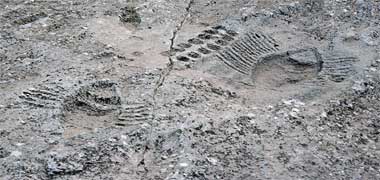
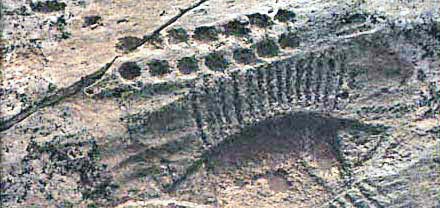
It has been suggested that one of the more visual areas of evidence can be seen on the low limestone outcrops situated at al-Jassassiyah where a variety of petroglyphs have been incised into the rocks running adjacent to the foreshore. However, it can’t be said with certainty that these carvings are related to or of a similar age to that of Dilmun, though there are some who believe them to be of a considerable age. They might best be thought to be representative of a traditional way of life, and it is unlikely that they are any more than a couple of centuries old. The petroglyphs are of two types – a combination of both recording or illustration as well as, most probably, a game played with small stones, both of which are illustrated in these two photographs. There seems to be no rationale to their placement on the outcrop.
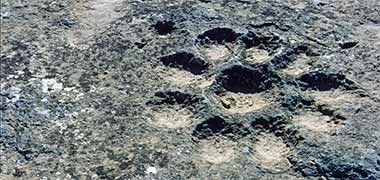
A common sight in the clubs around the peninsula in the 1970s and 1980s, there are modern games played with stones and holes such as this, known as al aa’ilah and al haluwsah. It is thought they are likely to have developed from these carvings which would have been constructed for an earlier form of those games. This photograph shows a circular form of the game, compared with the lineal one above. They are similar to manqala, a traditional game which goes back thousands of years to the Nabataean civilisation.
Having said that, the arrangements are peculiar in that they occur with different numbers of holes, some are carved in unusual locations and it might be thought odd that so many have been carved when logic suggests a smaller number might be re-used.
There is not a great deal of variety in the subjects of the carvings on the rocky outcrops at al-Jassassiyah, but what there is is interesting. Above are photographs of holes carved for what are generally considered to be board games, and it has been assumed that these might have been carved by herders to while away their time.
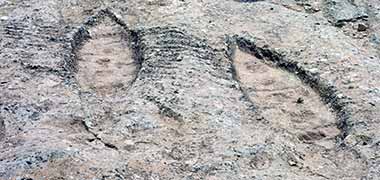
Evidence of structures added to the outcrop at al-Jassassiyah and designed to channel and hold water – illustrated below – suggest that there may have been a more permanent residential component to life in this part of the peninsula. The outcrop with its elevation above the general plain of the adjacent desert would have been a natural place to sit and look out both at the land and animals roaming there, or at the sea, in order to watch for those using the sea for industry of trade or, perhaps, for marauders. It might, therefore, be consistent that the majority of figurative carvings, using the term to distinguish them from those associated with games, suggest in the first of these six photographs, rowed boats – which look as if they might be a reference to pearling craft – and, as in some of those below, camels and horsemen.
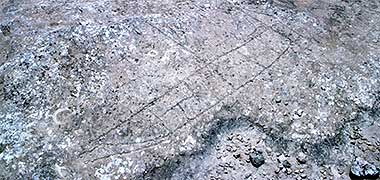
Regrettably I didn’t take many photographs of the carvings but there is only a small variety in the depiction of both the boats and animals. What is evident is that there are a number of different craft shown both being rowed, at anchor and, in this case, with a suggestion of their layout or decking. The manner of their representation suggests that they are not more than a couple of centuries old though it is likely that these craft will not have changed greatly over a long period of time. Camels are shown, some in considerable detail, but there are also mounted warriors.
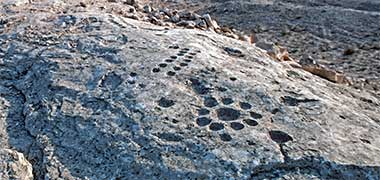
The third of these photographs shows the most common types of petroglyphs at al-Jassassiyah, a series of holes that are either arranged in two parallel rows or in a circular pattern with the holes around a single central hole. Both types are illustrated here in a photograph looking south-west from the top of the low-lying jebel. A little more is written about them above.


The three photographs in this next group are radically different and were located not at al-Jassassiyah or Fuwairat in the north-east of the peninsula, but on a shallow rocky outcrop just north of Doha and opposite the island of Safliyah.
The first two show what appears to be a horseman holding a spear above his head. It is interesting that the weapon appears to be a spear rather than a sword, suggesting a less valuable, but more available, weapon. The only condition under which this would normally be seen would be in some form of warfare. We know that there have been battles and skirmishes across the peninsula for centuries, perhaps this is a record of such an event or activity. I have only two photographs of these figures.
The lower photograph clearly illustrates a female camel. The site of these three photographs has now been encompassed by development of the New District of Doha. My best guess is that they would have been located somewhere in the region of what is now West Bay Beach. In the late 1970s, some of the petroglyphs were cut out of the rock and taken to and displayed near the entrance path within the Qatar National Museum. I have no idea where they are now but would be grateful for any advice.
Mapping

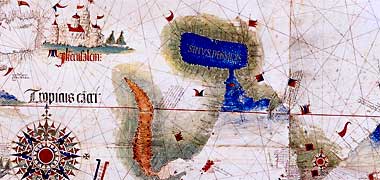
The Persian Gulf was initially mapped almost two thousand years ago by Ptolemy. This first illustration is a copy of that map though it was made some time during the fifteenth century. You can see that the Gulf is shown as an almost land-locked body of water with a small number of islands shown at its north-east shore. The Straits of Hormuz are shown as being relatively wide and the Gulf itself has an amorphous shape to it. The map clearly illustrates the important position which the Gulf enjoys in its relationship with the Red Sea and Africa to its west, and the Indian sub-continent to its east. This pattern is replicated in the second illustration which is a detail of the Cantino world map of 1502 which appears to be heavily influenced by the upper map, though the Aden coast and India are represented differently.
The Greek geographer, Strabo, producing his work ‘Geography’ around the turn of the first millennium – perhaps as late as 24 A.D – also showed the enclosed nature of the Gulf but, like the maps above, gave no hint of the Qatar peninsula.
Reflecting the interests of Sultan Muhammad II, a map was produced in 1606 of the Qatif Oasis. It showed a more accurate delineation of the shores of the Gulf, but again did not show the Qatar peninsula, though did have two large islands and a small number of smaller ones similar to the next illustration.
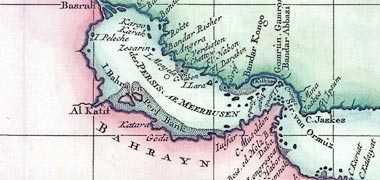

Part of a map created by the French cartographer, Jacques-Nicolas Bellin in 1740, this illustration focusses on the coast rather than the hinterland of the Gulf, paying particular attention to the pearl banks, a major area of importance at that time. As can be seen, the map is not that accurate, showing the Bahrain islands oversized and suggesting that Qatar – written as ‘Katara’ – was a part of the Saudi hinterland and not the strongly modeled peninsula it really is. Like the map below, this may have had something to do with the difficult navigable character of the shallow waters between Saudi, Bahrain and Qatar. But is should also be noted that the mainland of the Saudi peninsula is named ‘Bahrayn’, a term referring to the baharnah, said to be shi’ite arabs related to the traditional tribes of the Saudi peninsula and the Qatif oasis – here written as ‘Al Katif’. The lower photograph has been added to illustrate something of the character of the shallow water in this part of the Gulf, and the possible difficulties associated with access to it for the purposes of mapping.
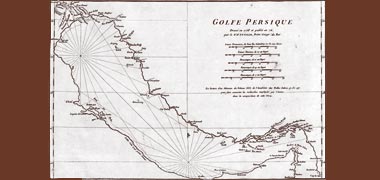
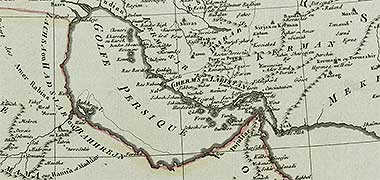
Here are two later maps, the first made by Jean Baptiste Bourguignon, and published in Paris by J.B.B. D’Anville in 1776. Although there were maps around this time which showed Qatar with varying degrees of accuracy, it is notable that this map omits it stating, though you can’t read it at this scale, that the eastern shore is ‘unknown’. But it clearly shows the islands of Bahrain, with the general shape and configuration of the Gulf being more recognisable, even if it is narrower than other maps illustrated and, of course, reality. By this time badu tribes were using the pensinsula regularly and, with the British and Indian interests being focussed in Bahrain, it might be thought unusual that the Qatar peninsula was not mapped at that proximity from Bahrain, and with Bahrain having an interest at least in Zubara. The second map, published again in Paris, but in 1797, is very similar to that shown a little way above but omitting the name ‘katara’. The width of the Gulf is here shown to be a little wider.
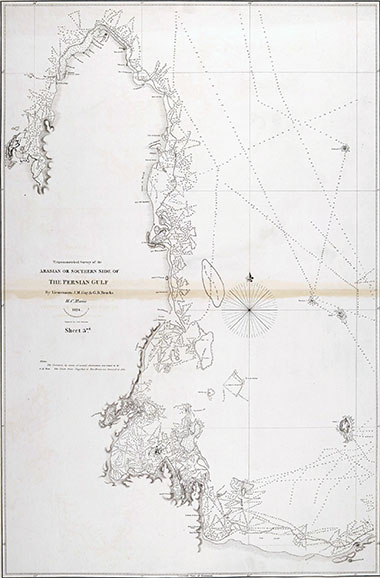
Following the production of these maps, and working between 1820 and 1829, mapping of the Gulf continued under the auspices of the East India Company producing, in 1824, this map of the Qatar peninsula by Lieutenants Guy and Brucks. The west coastal area was not fully covered due, presumably, to the relatively shallow waters in this part of the Gulf between Qatar, Bahrain and the Saudi Arabian peninsula’s east coast and the surveying being carried out from the sea.
While trigonometric readings were made from the sea, at this time mapping was based in great part on interviews with local Arabs, and it is not surprising that important features and relationships were omitted or given undue prominence. The peninsula of Qatar seems to have been used as a marker of territories, its western coast marking the early understanding of Bahrain which was seen to be the area from Qatar in its east to Kuwait in its west; and its eastern coast marking the early understanding of Oman which was seen to be the area from Qatar in its West to the Oman in its east.
The British were slowly creating maps of the areas in which they had interests around the world, and the Gulf was one of those areas mapped from the sea. A number of maps were produced of the Gulf at the beginning of the nineteenth century on which subsequent maps of Qatar for the next century appear to have been based, and annotated. The map illustrated below can be usefully compared with those above. One particular map of the area reads:
Memorandum
The Coast from Ras Mossendem to Abothubbee was surveyed by Lieuts. J.M. Guy G.B. Brucks and R. Coogan in 1821 and 1822; from Abothubbee to Cape at Ras Reccan, by Lieuts. J.M. Guy and G.B. Brucks in 1823 and 1824; from the latter point to Core Abdullah, by Lieuts. Guy, Brucks and W.E. Rogers, in 1824 and 1825, from Ras Tuloop to Bushire, in 1825-26, and the remainder of Coast, Islands &c. by Lieuts. G.B. Brucks and S.B. Harris from 1826 to 1829.

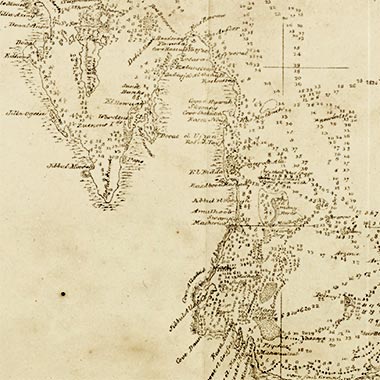
That map was superseded by a map presented in 1830 by Captain Brucks at the direction of the East India Company, and which is shown here. The 1823 map was drawn by M. Houghton, and both maps, now in the British Library, give an indication of the length of time some ships of the Indian Navy, or Bombay Marine, spent in the Gulf carrying out their duties. One of the most important of these being the surveying of the coasts. Bear in mind that the French were significantly ahead with their cartographic work through the work of the Cassini family, and that accurate maps are necessary not just to navigate safely, but in times of war. Captain Guy of the ‘Discovery’, Captain Cogan of the ‘Psyche’, Captain Brucks of the ‘Teignmouth’ and Lieutenant Haines of the ‘Benares’ were the officers responsible for much of this mapping.
The lower illustration is a detail of the map above showing how the characteristic shape of the Qatar peninsula was first seen and noting the conurbation of ‘El Bidda’ on the east coast. The islands of Bahrain can be distinguished top left of the illustration, and paid a more prominent rôle in the operations of the East India fleet at that time. Bear in mind that the waters off the west coast of the peninsula are relatively shallow and may have been considered too dangerous to record in any great detail at the time.
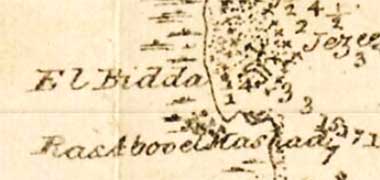
The maps are interesting in that they specifically do not record Doha but only illustrate a single urban settlement on the east coast, that of ‘El Biddah’. However, other associated maps give more detail of the this area, the only mapped urbanisation of the east coast, but under the general title of ‘El Biddeh’ and with ‘stony hills, 40 or 50 ft high’ rising behind them. A number of headlands or vertical features are identified, notably ‘Ras Mutbach’, immediately above the entrance to Khor – labelled ‘Core Shedeitch’ – and ‘Ras El Nouf’ below it, ‘Ras Eeh Tayfahn’ midway between Khor and Doha, ‘Ras Aboo El Mashuit’ which appears to be Ras Abu Aboud, and ‘Jibbul El Wokrah’.
There are a number of spelling difficulties with the Arabic which appear side by side with the English names, but I do not know which would have come first in the drawing of the map. Transliteration is always difficult, for instance, ‘Bid’a’ appears as ‘Bidda’, ‘Biddah’, ‘Bidder’, ‘Bidd’a’ and ‘Budee’ on these maps and descriptions.


This graphic is of the chart, held in the British Library, entitled ‘Trigonometric Plan of the Harbour of El Biddeh on the Arabian side of the Persian Guf by Lieuts. J.M. Guy and G.B. Brucks. H.C. Marine. 1823’. The coloured sketch below was developed from it and shows a part of the chart illustrating two groups of development, those of Doha and Bid’a, each having both a qala’at at their centre as well as a taller watch tower. That at Bid’a is adjacent to and east of the qala’at, that at Doha is on the south edge of the development. Both qalaa’a are square in plan with their axes approximately aligned west-north-west. The qala’at at al-Bid’a’ has three circular abraaj at its corners with a square burj on the south-west corner. The qala’at at Doha has a similarly located square burj, two circular abraaj on its north-west and south-east corners, but nothing on its north-east corner. There is also a structure, named as a qala’at on one of the plans, at ‘al-Nessa’ or ‘al-Nesseh’, which appears to be on what became feriq al-Salata. An elevational sketch by Lieut. F. Powell, at the top of the map, made from the anchorage towards the land just over a kilometre away, suggests that this might be a burj rather than a qala’at. There is also a reference to a ‘Tower near wells’ around 1,800 metres south of Doha.


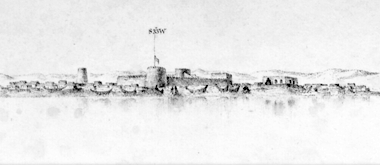
These first three elevational sketches are taken from a relatively small image at the top of an early map of the bay illustrating the location of Doha and Bida. The first shows the elevational detail, the second and third show, first, Bida and the second, Doha.
An enlargeable image of the first of these three images of the two urban developments of Bida and Doha can be found by clicking on the image. It should be noted that on the enlarged image it is possible to see a round tower to the south of Bida which does not appear on the ‘Trigonometric Plan of the Harbour of El Biddeh on the Arabian side of the Persian Guf by Lieuts. J.M. Guy and G.B. Brucks. H.C. Marine. 1823’ above.
In the elevational sketch, the qalaa’a appear to be significant structures in terms of their height, and are certainly shown as dominating the residential buildings around them which would have been mostly, if not all of single storey. The structures at Doha appear to be larger than those at Bid’a and there are local craft drawn up on the foreshore at Doha but not at Bid’a. Four of these craft are shown under lateen sails, one of them being identifiably a single-masted bateel.
Depth soundings were taken into the shore at Doha but not to Bid’a, which suggests that Doha may have had the deeper draught for its sailing craft. This was certainly the case in the 1970s and prior to the dredging of what became known as the West Bay. Incidentally, the lettering in the sky are nautical bearings.
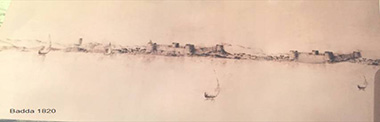
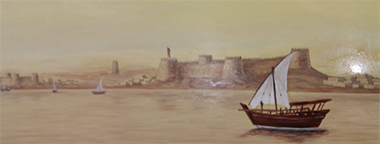
Here are two sketches showing the urban development of al-Bida made by a visiting British naval squadron from the sea in the early part of the nineteenth century. Clicking on them should take you to the site, in Arabic, on which I found them, and that site refers to ‘Selections from the records of the Bombay Government’, but the originals I have not yet been able to find.
The images are said to show the fortress of Sheikh Salmeen bin Nasser al-Bidaa in the years 1820 and 1822 respectively, surrounded by 300 houses of the tribe of Sudan, and with the flag of Qatar above the right tower of the palace. The commentary of that site also states that the British Resident and Commander of the English fleet mentioned al-Bida in the year 1801; and that al-Jarif mentioned al-Bida as being the first capital of Qatar in 1863.
From the same source as immediately above, Palgrave, in his 1867 report mentioned that al-Bida had 6000 inhabitants. Its inhabitants were from the tribe of Sudan, who established the area and had it carefully fenced. This wall and its foundations remained until the nineteen-thirties, and he understood from conversations that the wall extended from behind the present Diwan al-Amiri to the Guest Palace near the Rumailah Hospital and from there down to the beach. The height and character of the wall is not mentioned.
It is interesting to note the positioning of the two settlements of Bida and Doha demonstrated in the illustrations above. It is a reminder of that part of the history of the peninsula when there was considerable movements in the balance between the different tribes and families now settling on the peninsula, as well as their relationship with the British operating out of India. A little more on this issue is looked at below.
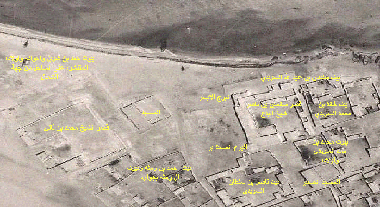

From that same source, I have included images for which I have not been able to find the originals anywhere. The first oblique aerial photograph shows some of the buildings of al-Bida adjacent to the West Bay in, I would guess, the nineteen-forties or nineteen-fifties. I realise the script is small but clicking on the image should take you to the source page where the image is larger and more legible.
The second image is of the same photograph but has an English translation of the Arabic script. Again the notation may be a little difficult to read at this scale, but will open to a larger image by clicking on it.
I can recall talking to families who still lived adjacent to this area in the early 1970s, and who told me something of their tribal and family histories and the earlier importance of al-Bida compared with al-Doha.
The significant development on the mid-right of the two oblique aerial photographs is that of ‘Salmin bin Nasr Sheikh of al-Bida’, and that to the left – and in a significantly more ruined state – is that of ‘Sheikh Muhammad bin Thani’. Immediately to its right are the ruins of a comparatively large masjid. A smaller masjid is marked in the lower right corner of the photograph.
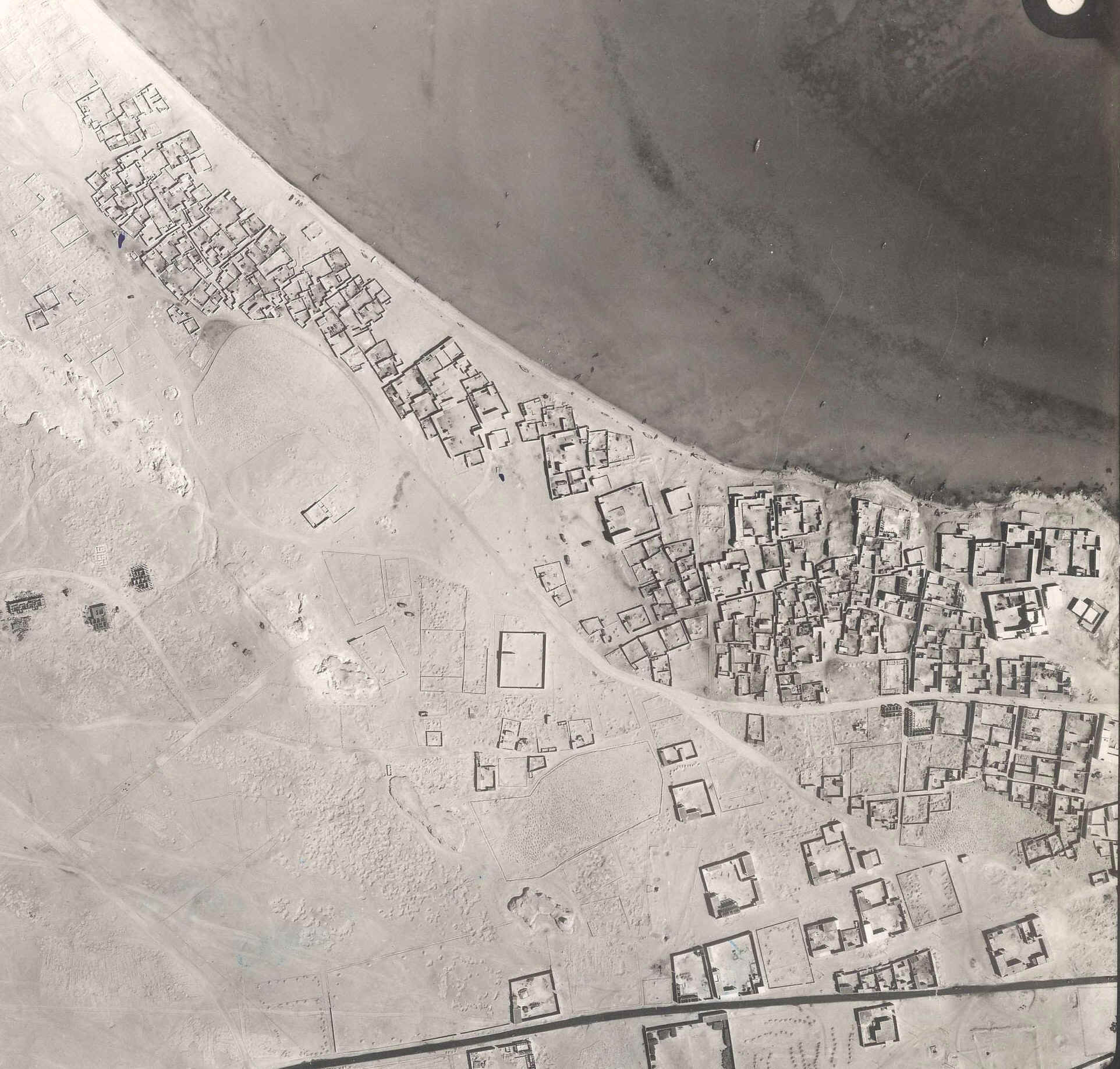
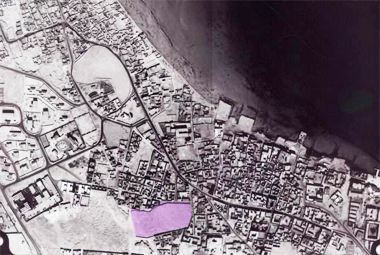


The third image is another aerial photograph which appears to have been taken at an earlier date, and gives a more comprehensive view of the west of Doha and Bida. The area shown in the first two of these three images is illustrated in the lower photograph as a darkened rectangle. I believe that the road running along the bottom of the photograph is the road leading to Rayyan.
The fourth aerial image was made of al-Bida in 1959. Taken at a slightly different angle from the aerial photograph above it, the road leading through al-Bida and circling a maqbara can be seen in both images to give some indication of the development which took place in al-Bida as the economy brought more wealth to the country. There appear to be more than one maqbara in the photograph. I am unsure which is the Sudan maqbara which was demolished early in the twenty-first century in readiness for the redevelopment of the entire Bida and Rumaillah neighbourhoods.
The maqbara of the Sudan family was established by the founders of al-Bida. It is shown in the coloured map, and is distinguished from the other maqaabir in being coloured purple, compared with the pink of those maqaabir. The al-Bida maqbara is the smaller site to the right, or east, of the Sudan maqbara.
Not only was it one of the oldest maqaabir in Qatar but it was considered to be important given that the area was one of the oldest settled sites in this part of the peninsula.
However, the site was bought by the government in 1987 when it was evident that the whole of al-Bida would be incorporated in the near future due to its important location adjacent to the Corniche and West Bay.
The maqbara was eventually demolished between the 2nd July and 14th August 2004 with the remains of those buried there being removed with care and interred some way to the south of Doha at Abu Hamour maqbara, now re-named the Mesaimeer cemetery. These four photographs must therefore have been taken prior to 2004 and show the normal surrounding wall of a maqbara with ‘Sudan graveyard Bida’ written in Arabic on it.
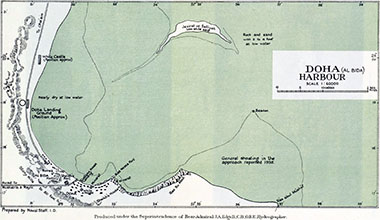
Prepared by naval staff in the Admiralty’s Naval Intelligence Division, a map was published in January 1937 of the bay at Doha and al-Bida at 1:60,000 scale. While the map illustrates something of the safe approach for boats and ships – its dotted line marking the approximate position of two to six feet of water – its primary interest here is that it shows a number of features on land that would have been significant at the time, and are now interesting historically.
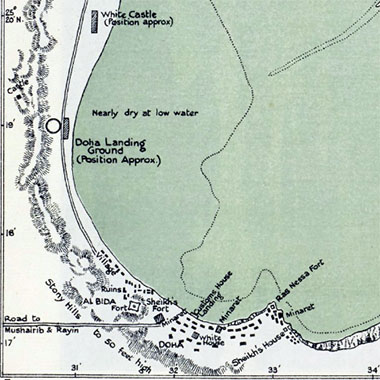
This enlargement of the left hand side of the above map shows the features that were of interest to the marine cartographers and, presumably, to the British government in the years leading up to the Second World War. It shows the small developments of Doha and al-Bida situated on ‘stony hills up to 50 feet’ high.
At the top of this enlargement is approximate position of what is termed the ‘White Castle’ which would have been a construction of note at that time. There is a note on this structure on one of the pages dealing with old developments on the peninsula. Another ‘Castle’ is noted south-west of the ‘White Castle’, presumably a structure of note, although I’m not sure what it might have been other than, perhaps, a watch tower. It is certainly too near the shore to be al-Markhiyah.
A little lower is an approximate marker for a landing ground, presumably for small aircraft. The Royal Air Force had overflown the country in 1937 looking for suitable locations for an airfield to accommodate aircraft passing through the Gulf.
The map distinguishes al-Bida and Doha with, between them, two forts – one on high ground noted as ‘Fort’ and one to its east, apparently on lower ground, noted as ‘Sheikh’s Fort’, adjacent to a minaret which is assumed to be the Sheikh’s masjid. It appears there is some confusion in the identifications. Ruins in this area are also noted.
The Customs House and Landing are shown with a minaret to its east, perhaps the manara of the al-Qubib masjid, shown here, and between them a ‘White House’ is noted. It is not clear if this is a house of one of the merchants such as the Darwish family, but it is unlikely to be the Turkish fort which would have been readily distinguishable and probably south of the boundary of this map.
There is a fort shown on Ras Nessa, this area soon to be covered by the new port, and then the Sheikh’s house with, to its north, the manara of his masjid. The house referred to would be Sheikh Abdullah’s complex at feriq al-Salata, now the setting for the new museum but which had, in the 1970s been converted into Qatar’s first National Museum. There is more on the original building here.

Reflecting its growing strategic importance, the nineteenth century saw maps illustrating the Gulf appearing with the Qatar peninsula illustrated, this one published in 1903 showing something of its characteristic shape. Bear in mind that this was published a hundred and fifty years after the more recent activities and urbanisation within the peninsula. In this the maps reflected the interest, or lack of it, shown by those using the waters of the Gulf, but surprising when the importance of this region at that time is considered.
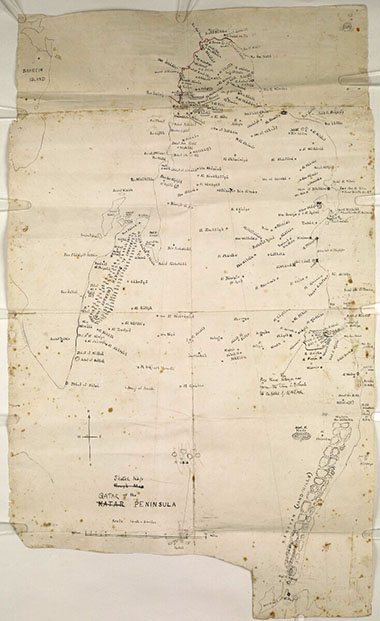
One of the more interesting maps of Qatar, is a very crude sketch map entitled ‘Rough Map of the Katar peninsula’, drawn around 1937, that appears to have been a deliberate attempt to locate all the fixed settlements in the peninsula.
Although at least in its outline it can be seen to be obviously inaccurate, its value lies in the number of settlements it identifies and, particularly, their pronunciation. Note the preponderance of villages at the north of the peninsula, as well as the lack of roads or tracks.
This sketch map, accompanying a note of the 4th July 1937 from the Political Agent in Bahrain to the Political Resident in Bushire, relates to the conflict between Bahrain and the al-Na’im with Qatar. The note mentions that eleven places are ‘incorrectly given’ and, although I do not understand in what manner they are ‘incorrectly given’, I list them here for future research with the caveat that they will need to be checked at a later date:
- al Thaghab,
- Fureiha,
- Ain Muhammad,
- Umm al Sheweel,
- al Zubarah,
- Qala Umm Rear,
- al Rabaija,
- Halwan,
- Lisha,
- Masuchhi, and
- al Maharaqa.
The places listed are all underlined in pencil, and it appears that they all fall in the region of Zubara; but it is unclear from the statement in the covering letter if it means they are not in their correct locations, or that their names are associated with other correspondence relating to the Bahrain claim on this part of the peninsula. It is also curious that a note being sent on the subject of Zubara should include naming the whole of the peninsula.
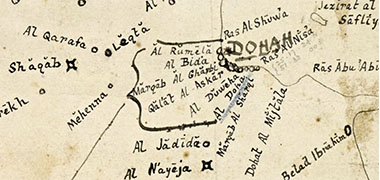
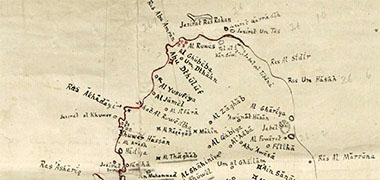
The illustration above, made from the original, has been given a little more contrast in order to increase its legibility. A larger version can be seen by clicking here, which will open in a new window. Clicking on the map above will take you to the original which can be enlarged and read in more detail.

This first detail shows something of the area around Doha bay, a note in a different hand grouping the different villages as their now being the capital, ‘Dohah’.
This lower detail shows a significant number of settlements in the north of the Qatar peninsula compared with the south, a result of the interactions with Bahrain and the quality of the grazing compared with the south of the peninsula.
Notice on both details the addition of diacritics to assist in the correct pronunciation of the names.
Doha, Bida and Wakra
Please note that there are a number of alternative spellings of the names of individuals and places in this section. For instance, ‘Esai’ would now be transliterated as ‘Isa’, and ‘Bidaa’ or ‘Biddah’ as ‘Bida’. Generally they have been left as quoted, and should be understandable.
For much of the nineteenth century Bida was regarded as being superior in size to Doha, and more important. A Gazetteer of the Persian Gulf, published in 1904 records Doha as being a:
Town to east of Bidaa and connected with it by village of Doha-as-Saghira. Partly walled round and has several towers. Sheikh’s house is at large round tower on beach about centre of town, and west of tower is small bight where boats are hauled up for repair. According to Palgrave (1863) Doha is half size of Bidaa and is situated in small deep bay with cliffs behind 60 to 80 feet high; houses lower and meaner than at Bidaa and market-place narrower and dirtier. Ross (1882) appears to include Doha in his description of Bidaa.
Related to one of the illustrations above a note published by the Bombay Government in 1856 has a record of Bida, Wakra and Udeid made by Lieutenant Grubb in 1822 which makes interesting reading. Of Bida it says:
Biddah, inhabited principally by the Soodan Tribe, is situated on the south side of a bay, formed by two dangerous reefs running out to the sea, and approaching at their extremities so near to each other as to leave little more than room for a ship of the size of a sloop of war to be warped through. Once inside, however, the anchorage is safe, and a vessel of war can lie within something less than a mile from the town which contains about three hundred houses, and could muster six or seven hundred fighting men.
Lieutenant Grubb, I. N., in 1822, described Biddah ‘as a most miserable place: not a blade of grass nor any kind of vegetation near it; the water good, procured, they said, at some distance. The anchorage in the inner harbour very good, four fathoms, being about one-eighth of a mile from the shore, surrounded by a reef nearly dry, which forms a complete basin, the entrance to which is very narrow, but deep, and free trom danger. Not so in approaching it, as the water is very shoal about seven miles out, there being two and a half fathoms, sand, and a good deal of sea in a north-wester.’
A later report – a Persian Gulf Gazetteer Part II – published in 1904 and referring to accounts from 1845, 1863 and 1882 has a fuller description of Bida in the latter part of the 19th century:
Large town in lat. 25° 17’ north and long. 51° 31’ east situated in deep bay on east coast of Katar promontory, about 65 miles south by east of its extremity at Ras Rekkin. Reefs off the bay make it a natural harbour, but the entrance is shallow and somewhat difficult, and vessels of more than 15 feet draught cannot pass. Land on west side of bay is stony desert, 40 or 50 feet above sea-level. South-east point of bay is quite low. Harbour basin is 3 miles in extent with regular soundings of 3 to 5 fathoms, bottom white mud or clay. Bidaa is built up the side of the rising ground and there is a fort in the town. There are two towers on high land above town and 1½ miles south-east of town another tower near the wells, where there is a little vegetation, the rest of tbe country being desert. Other accounts place the water supply 3 miles from the town. Doha-as Saghira immediately adjoins Bidaa on east and beyond it, without interval, comes town of Doha. The three places together cover a mile of sea front and contain population of about 5,000 of mixed tribes, always at feud with Bedouins. No large baghalas but many pearl-boats; and inhabitants are all employed in pearl-fishery. Little can be obtained in way of supplies. Water is dear and indifferent, best being brought in skins from desert. Firewood comes from interior and from Clarence Strait (Gulf Pilot, 1898). Kemball (1845) says that inhabitants are mostly Soodan, and that there are 300 houses and 600 to 700 fighting men. Palgrave (1863) describes town as consisting of mass of small and dingy houses separated by irregular lanes, with a long, narrow and dirty market-place; population 6,000 including Bahrain shop-keepers and artisans and immigrants from Hasa. Palgrave describes male population as over-engrossed and shattered in health by pearl diving. He mentions two mosques, one in simple Wahabi taste, the other smaller and more handsome in semi-Persian style. According to Ross there were here in 1882 no less than 250 pearl boats working under the Chief: but, from his remark that Bidaa had been formed by recent coalescence of 2 small villages, it would seem tbat he meant to include Doha and Doha-as-Saghira (?). He mentioned Sheikh’s residence as at extreme south end and Turkish fort and garrison as in centre of town (of Bidaa proper ?). Most of Indian traders were only visitors coming with borrowed capital to trade at Bidaa and visit the islands for 4 or 5 months in the pearl season. In 1882 there were only 3 settled Banyans who were cloth-sellers$#58; 2 of them were bakers as well.
With regard to the settlement at Wakra, the first note goes on to say:
The town of Wukra did not exist at the time of the survey, having been since erected by the present Chief, Ali bin Nasir, who, with his tribe (the Boo Ejman) formerly resided in Biddah, but having offended the Uttoobee Shaikh, the dwellings of himself and followers were destroyed by that chief, who contemplated their forcible transfer to Bahrain. To avoid this offensive arrangement, Ali bin Nasir and his tribe took possesion of the site of their present residence, at the foot of Jubbul Wukra. The town is situated upon the open sea beach, which, however, cannot be approached nearer than three miles by our vessels of war in consequence of the coast being lined by a shallow and dangerous reef. Its fortifications consist of a small square fort, flanked by three towers, in the centre of the town, which is surrounded on the land side by a wall, with a tower on either side. Beyond the walls are two others detached, one of which, upon a slight elevation, commands the wells which supply the inhabitants with water. The place contains about 250 houses, and, including the pearl fishers and the Bedouins occasionally residing there, can collect upon emergency between five and six hundred fighting men.
Another reference, made in 1856, records events at Wakra, this time in 1838:
The whole of the Boo Eyeneen tribe, numbering about three hundred families, inhabiting Wukra, vacate and destroy that place, and take up residence at Aboothabee.
though a record published in 1904 has a reference to Wakra in 1845 stating:
Rising town on east coast of Katar, south of Bidaa. In 1845 numbered 250 houses and 500 to 600 fighting men. Inhabitants were Boo Ejman emigrants from Bidaa. Is close to beach; has now 12 towers, many boats and perhaps 1,000 inhabitants. One mile to south is Jebel Wakra 85 feet high. Native boats run close up to town at high water, either over or through reef. Vessel, even of small draft, cannot anchor nearer town than 2 miles. Palgrave (1863) described Wakra as independent of Bidaa and other towns; and as thriving and more cheerful in appearance than Bidaa, to which it was equal in size. Distance was less than 10 miles from Bidaa and coast road, which passed through bleak and barren country, was safe for travellers. Several small traders and artisans were settled here.
The note on Bida and Wakra continues with regard to Udeid:
Adeed, on the Guttur Coast, situated on the eastern side of the entrance of the breakwater, and at the foot of the hill of that name cannot bo approached by our vessels of war within a distance of between three and four miles. Its defences consist of a small square fort, with two towers in the centre of the town. On the right is a line of four towers, at some distance from each other, running towards the foot of the hills. Within these, again, and near the beach, are two other detached towers, which, with one at the back of the town, complete the defences on this side. The other is protrected only be a sort of square block-house, which, situated upon a small elevation, commands the wells from which the place is supplied with water. In point of appearance it would, perhaps, be difficult to select a more wretched, desolate, and barren-looking spot in the whole of the Gulf.
The distinction between the two settlements of Bida and Doha is important as it reflects some of the issues in the peninsula at that time. The 1856 document from the records of the Bombay Government records something of the movement of people between Bahrain and Qatar, particularly with some of them settling at Bida.
In 1828, a little while after the above chart was drawn up, the ‘Chief of Biddah’ was arrested by his ‘feudal superior’ following his stabbing a person in Bahrain. He and the inhabitants of Bida were removed to Fuwairat and Ruwais where they were more directly under his control, and the fort at Bida destroyed.

This portion of a map, drawn in 1824, shows Fuwairat as ‘Afeeraat’ and was then an important settlement on the east coast of the peninsula. Home to around a hundred-and-fifty men of the al-Kuwari and al-Uttobee families in 1820; Lorimer, in his ‘Gazetteer of the Persian Gulf’, later confirmed that the al-Kuwari and al-Qubaisi families were established there.
It is noted that Esai bin Tarif of the al Ali tribe:
and Bushire bin Ramah, after their successful attack uipon Bahrain, removed with their dependents to Biddah, a dependency of that island, upon the Guttur coast.
Esai and his tribe, numbering about a thousand men capable of bearing arms, possess three large Buggalows (one copper bottom), which trade to India; five Buteels, each from eighty to a hundred tons; elevent large Bateels and Buggalows; and about a hundred and thirty pearling boats.
a significant number of people and boats. It is also significant that Bida is referred to as being a dependency of Bahrain, though Esai bin Tarif later goes on to attack Manama. His removal to Bida was in 1843.
However, by the end of the 1830s Bida had become a haven for disaffected individuals for which the British held the sheikh, Salemin bin Nasir al-Suwaidi of the Sudan tribe, responsible.
In 1836 Jasim bin Jaber Raqraqi, Soheel bin Ateesh and an Ali Howly, each in a single boat with between twelve and eighteen men, had been on a ‘systematic course of plunder’.
In November 1839 an individual named Ghuleta, having been outlawed from Abu Dhabi for attacking a Basra boat off Bandar Dillam on the Persian coast, had taken refuge in Bida. The Commander of the HMS Clive, A H Nott, arrived off Bida and demanded the sheikh surrender both Ghuleta as well as the pirate Jasim bin Jabir Raqraqi and his men who had attacked a Ras al-Khaimah boat.
The sheikh imprisoned both Ghuleta and Raqraqi, but refused both to hand them over or to pay a fine of 300 German Crowns levied on him by the Resident and, in February 1841 a British squadron of the HMS Coote, HMS Sesostris and HMS Tigris under the command of Commodore G B Brucks arrived off Bida causing considerable alarm. The sheikh declined, characterising the British demands as unfair as he had not been responsible for the actions of Ghuleta and Raqraqi. On the 26th February 1841, the squadron shelled al-Bida, when the sheikh gave way. Another reason for refusing to pay the British is that the sheikh did not have the money. In lieu the British were given 42 silver bracelets, one sword, a silver hair ornament, four pairs of gold earrings, two pairs of silver earrings, two daggers and nine bead necklaces.
It is evident that Brucks’ action was looked on approvingly by the British government, a letter from the Political Department to the Residency, no. 27 of 1841 and dated the 25th March reads, in part:
…Adverting to my two letters to your address Nos. 11 and 12 in this Department under date the 12th and 13th respectively I have very great satisfaction in forwarding for the information of the Honourable the Governor in Council the enclosed Copy of a Communication from Commodore Brucks I was yesterday’s date together with it several accompaniments detailing the successful performance of the duties trusted to him in regard to the settlement of the claims existing against the Sheikhs of Biddah and Debaye.
The firmness temper and zeal with which Commodore Brucks has executed this important service will not I am satisfied be overlooked by the Government while the circumstance that the objects contemplated in his instructions have been fully attained without bloodshed will I doubt not be considered highly gratifying by his Honor in Council.
The letter goes on to include comments on the translation of a report from the intelligent (sic) agent at Shargah, Moollah Houssein
…whose opinion of the very beneficial effects likely to be produced by the demonstration thus lately made thus entirely coincides with my own – the trifling degree of opposition exhibited both at Biddah and Dubaye arose I am convinced by the surprising nature of the squadron under Commodore Brucks commands. It is true that the objects in view might have been accomplished by a small of force but setting aside the increased risk of failure the probability is that in such a case many lives might have been lost by a futile attempt at resistance on the part of the Shaiks of the places above mentioned
The note above goes on to state a general relief that Esai bin Tarif relocates to Bida, hoping it would stabilise the town whose sheikh, Salmin bin Nassir Sooedan, whom it was suspected of profiting from piracy now that he was, apparently, deposed by Esai bin Tarif:
Esai bin Tarif, to whom it had been intimated that so long as he continued to reside in Kenn he could not, for obvious reasons, be permitted to exercise any further interference in the affairs of the opposite coast, evacuated that island, agreeably to his expressed intention, on the termination of the pearl fishery, and proceeded with his tribe to Biddah, on the Guttur Coast, – an arrangement considered in every respect highly satisfactory, as bringing him within the limits of the restrictive line, and placing that port (exceedingly difficult of access) in the possession of a chief in whose sincere wish to put down irregularities at sea, of a piratical nature, every confidence was placed, – inclinations very different to those entertained by Salmin bin Nassir Sooedan, the former Shaikh of Biddah, whose proceedings, as already detailed in these sketches, left room for the suspicion that he secretly protected and encouraged predatory characters, in whose ill-gotten spoils he did not scruple to participate.
However, towards the end of 1847, Esai bin Tarif having suddenly changed allegiances, permission was given by the Resident for hostilities to be opened between him and Sheikh Mahomed bin Khaleefa of Bahrain.
November 1847 saw news in Bahrain that Esai bin Tarif along with Moobarak bin Abdullah bin Ahmed had landed with four hundred men and taken possession of Fuwairat. Ali bin Khalifa wrote to his brother, Mahomed, asking him to join him overland with all the infantry and horsemen at his disposal. Immediately, Sheikh Mahomed loaded seven small boats and two bateels with twenty horses and camels with their riders, marching them to Fuwairat from Zubarah. It was believed that the total forces of Esai bin Tarif and Moobarak bin Abdullah numbered around six hundred, but were greatly outnumbered by the Bahrainis who were being reinforced from Lahsah and Kuteef with other potentially interested parties being warned off from reinforcing Esai bin Tarif.
The action took place near Fujairat – or Umm Suwayyah – where Esai bin Tarif was killed with eighty of his men and his forces routed. The Bahrainis lost ten principal men and the wounded Bida men returned to Bida which surrendered to Sheikh Mahomed who offered clemency to all ‘except those of the family of ab ali of the tribe of Esai’. The British notes suggest that, while they regretted the ‘death of a person of such superior energy and character’ as Esai bin Tarif, it was hoped the action would ‘tend probably to the maintenance of the peace and tranquility of this Gulf’.
Historians regard this battle as marking the turning point in the modern history of the peninsula, allowing the al-Thani to develop their dominance and become rulers of Qatar, and for Bahrain to lose its perceived rights on the peninsula. So, the end of the 1840s saw Sheikh Muhammad al-Thani based at Fuwairat, Salemin bin Nasir al-Suwaidi at Bida, and Ali bin Nasir of the al-Bu Ainain tribe at Wakra – with the British monitoring the area in order to safeguard shipping in the Gulf and its approaches.
more to be written…
Constraints on the Qatar peninsula

Originally, the Qatar peninsula differed from much of the hinterland in having a population that was mainly transient, tribes bringing their animals into the peninsula only during the winter months to benefit from the plants brought on by the winter rains in their dirah – the areas of land over which they claimed a right to graze. Here, to the right, two badu drive part of their tribe’s herd into the peninsula, an operation that takes place rapidly. I came across this group a long way from any track, and they passed and were out of sight in minutes.

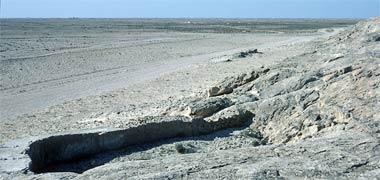
The harsh environment of the peninsula was not a total bar to people settling there permanently. Much of the interior saw movement of its tribes not just into and out of it, but also settling on its coastline as well as on areas of rawdha where it was possible to grow a small variety of plants throughout the year. But those who used the peninsula on a cyclical basis also established a degree of permanence by their ability to collect water to support themselves and their animals, not just from the wells of the interior. Here, at jabal Fuwairat, this west-facing dam was created from desert stones and juss to take advantage of the rains falling on the rock outcrop immediately adjacent to the coast and channelling the rainwater to a small reservoir where it would be used to water the herds as well as supply a relatively clean and salt-free source of water.
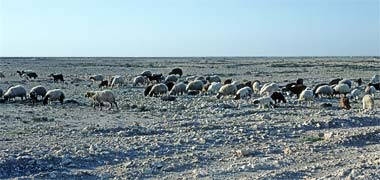
Generally the winter rains would fill the wadi systems where some of it would percolate through to the underlying aquifers and replenish the wells, and some would provide growth to the dormant plants providing food for wild life as well as the animals belonging, in the main, to the badu. At that time of year the herds would be able to take advantage of the new growth and would be moved around to enable continuing growth to benefit returning flocks. Here a small group of sheep and goats crop the sparse grasses, their shepherd moving them on as needed.
The transient nature of migration placed constraints on the Ruler of Qatar whose strength was, in large measure, derived from his ability to control those living on the lands over which he claimed sovereignty. Customarily his control extended over tribes upon whom he could enforce the payment of zakaat or taxes and, as many of these owed their primary allegiances to the Wahhabi, the Ruler of Qatar had to have a finely developed political sense. Only two tribes could really be considered to be resident in the peninsula in the early days: the large tribe of the Bani Hajir with its roots in the Hasa district of what is now Saudi Arabia, and the smaller Kaban with its relationships in Bahrain.
But the peninsula had additionally been used on its littoral as an important trading base within the Gulf, and this seems to have been operating at the same time as badu moved around the peninsula, sometimes in conflict with the more settled littoral developments. This maritime tradition goes back centuries if not millennia.
Population of the peninsula

With time a degree of settlement was attained in the peninsula though, due to the lack of records, it is difficult to be accurate with regard to dates until the eighteenth and nineteenth centuries when British, Egyptian and Ottoman interests in the region created more documentation relating particularly to the strategic and political issues that were of concern to their respective governments.
Conceptually it has been difficult to state ownership of the peninsula until relatively recently. The legal definition of the peninsula has only lately been settled and there has always been a difference in describing both boundaries as well as the extent of influence of those with an interest in the region. However, the first recorded ruler of Qatar was noted in 628 as belonging to the al-Musallam, a tribe that was part of the larger al-Tamim and based at Furaiha, a town two miles north of Zubara. Ottoman sources also confirm that the al-Musallam were still in charge of the peninsula in 1555, and based at al-Huwaylah.
It seems to be agreed that the principal badu tribes who migrated to the Qatar peninsula were the Al Murrah and Al Ajman from Hasa; the Al Manasir from Trucial Oman; and the Na’im, fluctuating between Bahrain and Trucial Oman. The dispersed pattern of these tribes’ origins, and their annual migratory patterns, demonstrates the degree of difficulty that was inherent in attempting to maintain control of the peninsula.
The most populous of the hadhar, or settled people, in the peninsula were the Sultan, Mahandah, Sudan, Al Bu Kawarah, Hamaydat, Huwalah, Al Buainain and the Al bin Ali. There were also a few Shia Arabs known as Baharinah, and Huwalah Arabs – Sunni Muslims who had lived on the Persian side of the Gulf and returned at a later date. In addition to the Persians there were also a number of Africans brought in as slaves but who were manumitted and assimilated within the Qatar society.
I have written a little more about the badu tribes on the population page, which include a couple of graphic illustrations to show where the families came from and where they settled. I should also state that I have made these notes from verbal sources as well as four or five written sources, the most important of which are the three books by Zahlan and that by Habibur Rahman which I particularly recommend to anybody wishing to learn more.
Trade and occupation of the peninsula
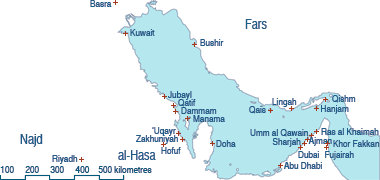
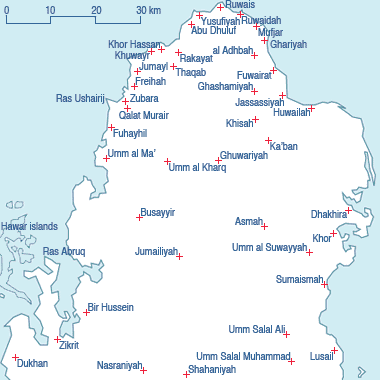
This simplified map and that a couple of paragraphs lower down the page have been placed here for rapid reference even though some of the locations of interest or importance on both sides of the Gulf, as well as those further down the coast, may be missing. Many of the locations are difficult to locate accurately, are relatively small, no longer exist or have had their names changed. A slightly more accurate map and accurate locations of places within Qatar are given on the geography page but if anybody could point me to a more accurate map suited to this page, I would be grateful.
The late 18th and early 19th centuries saw settlement around and within the peninsula with the development of what were, effectively, city states on the littoral of the Gulf. Kuwait at the head of the Gulf, Manama on Bahrain, Zubara and Bid’a on Qatar, Dubai, Abu Dhabi and Ras al Khaimah at the east end of the Gulf were all established as, perhaps, tribal outposts and settlements from which to maintain control on the increasingly lucrative pearling trade.

The pearling fleets of Qatar and Bahrain were significant in their sizes, each supporting around six hundred to eight hundred boats in season, slightly more than the third largest area, that on the Shibkuh coast on the Persian side of the Gulf. Smaller fleets were based in Abu Dhabi, Dubai and Sharjah, and at Lengeh on the Persian shores. Small fleets also sailed from Ras al Khaimah and Umm al Quwain at the east end of the Gulf, and Qatif, the latter north-west of Bahrain on the Saudi littoral. This sketch, based on an illustration by Lorimer, shows the location of the main pearl banks, with Qatar obviously well placed to have access to them. Lorimer wrote, apropos the banks off Zubara, ‘In this bay are the best, the most copious pearl-fisheries of the Persian Gulf’.
This development of tribal power brought those on the peninsula into varying degrees of conflict with those empires having an interest in the area, particularly the Safavid, Mughal and Ottoman, though not perhaps to the same degree, with the British who, with their control of the sea routes to the Indian sub-continent were in a stronger position to make their presence, and policies, felt.
Strong maritime trade had developed over time with Basra, particularly, playing an important rôle at the head of the Gulf. But increasing urbanisation on the littoral saw the development of entrepôts at Bashir, Lungi and Bandar Abbas on the north side of the Gulf, and Kuwait, Manama, Zubara and Dubai on the south side. This, combined with a very relaxed attitude to duties – effectively a free port system – saw the weakening of Basrah’s importance compared with the newer ports. This was reinforced by Persian occupation of Basra in 1775 which had the effect of merchants leaving Kuwait and Basra and establishing themselves in Zubara.

Qatar was originally considered to be established by segments of the bani Utbah who had emigrated from the region of Kuwait – the Al Khalifah and Al Jalahimah settling in Zubara, situated in the north-west corner of the peninsula, in 1766, a settlement there having been established there in the early seventeenth century. Zubara was a larger settlement than its closest neighbours, Huwailah and Ruwaidhah. Being excluded from Zubara, they established a fort some distance beyond the outer wall of Zubara, at Murair in 1768. However, prior to this it is likely that clans of the Al Aniza tribe stayed a short time before moving on to settle in Kuwait in the sixteenth century. In 1766 there were only three fishing villages in the peninsula – Huwaylah, Fuwairat and Doha, dominated by the Al Musallam, the Sudan and the Ma’adhid and Al bin Ali tribes respectively. The Ma’adhid, were a branch of the Bani Tamim, and the Al bin Ali a branch of the Ma’adhid, tradition having that they came to the Qatar peninsula in the late seventeenth century from the Jibrin oasis, a hundred and fifty miles inside the Arabian hinterland. This aerial photograph shows something of its size and character, the photograph having been taken in the 1960s. There is a little more written about Zubara on one of the Gulf architecture pages.

Conquering Bahrain in 1783 the ’Utbah moved into Bahrain and became known as the Al Khalifahs – the name of the present Rulers of Bahrain. The Al Jalahimah originally settled in Zubara on the north coast of Qatar but had difficulties with their kinsmen, the Al Khalifah and moved on to Ruwais. In settling on the mainland of Qatar it is likely that they would have had some form of agreement originally with the bani Khalid who had a general presence on the peninsula, but who were relatively weak. At that time there were a number of small villages on Qatar, most of them associated with the sea, but having a general air of impermanence about them. The largest of these settlements was at Huwaylah. A number of the Al qabila living there, as they did at the two smaller littoral settlements of Doha and Fuwairat on the east of the peninsula. The Al Jalahimah and the tribes already settled within the peninsula enjoyed an uneasy co-existence and it was not long before those living at Zubara felt the need to construct a wall around three sides of the town, the sea forming the protection on its north side.
I should mention here that the Al Khalifa claimed to have given permission for the Dowasir to settle on Hawar in 1800, though this was disputed in the International Court of Justice case, convened in 2000, when it was held that Lorimer stated that the Dowasir only arrived in Bahrain in 1845 from Najd via Zakhuniyah.
At that time, the al-Khalifa on Bahrain held sway over this part of the Gulf, a position that was strengthened by their relationship with the Amirs of the Najd and the Imams of Muscat and confirmed in the tribute system. This was a characteristic of the Arab world and, in respect to the al-Khalifa, saw them obtaining tribute from tribes in the area while paying tribute to Najd and Muscat. The tribute system was designed to give tribes the assurance of a degree of protection in exchange for a fee or toll which would be paid in variety of forms ranging from money to dates, animals or even men providing military service. By this means, the al-Khalifa exerted a degree of control on those living in the region, particularly the Qatar peninsula where they claimed a number of the tribes to be their tribute dependants.
Here is a listing of the al-Khalifa’s dependants and dependencies in Qatar around 1766-1871.
The pre-eminence of Zubara lasted until the 1790s when the rise of the Wahhabi in the Arabian peninsula saw them overcome al-Hasa. Having concern for both the commercial importance of Zubara as well as a belief that pluralism was being practised there, a Wahhabi army attacked and overcame Zubara in 1795, other tribes in Qatar as well as Bahrain having failed to support the inhabitants in Zubara for a number of reasons. By 1802 the Wahhabi had overcome Bahrain as well, thus extending their influence the length of the coast from the Shatt al-Arab to Muscat, their presence having been invited by the al-Khalifa to counter attacks by Sayyid Sultan, Imam of Muscat, aggrieved by the al-Khalifa not paying taxes for safe passage through the Straits of Hormuz. Three years later, they were requesting assistance from the new Ruler of Muscat to reverse the Wahhabi presence…
This pattern was typical of the region for some time, the al-Khlalifa even, unsuccessfully, attempting to obtain protection by the British Resident in Bushire. At the end of the eighteenth century, Zubara had been the main settlement of the Qatar peninsula with Khor Hassan the second most important, but the destruction of these two settlements not only relieved the pressure on the Gulf’s coast from the maritime threat posed by forces based at these two towns, but removed the political centre of gravity to al-Bid’a on the east coast.
As mentioned above, al-Bid’a was now the most important urban development on the east coast of the peninsula. Protected by low reefs and the juzur of Safliya and ’Aliya the bay in which al-Bid’a developed occupied a relatively natural defensive position. Incidentally the ‘Bay of Bid’a’ is translated as ‘Dohat al-Bid’a’ which may be the origin of the urban development of Doha, originally developed slightly south of al-Bid’a.
Generally settlements were established in locations where there were accessible pearl banks and the ability to provide safe anchorage for shipping. They were, in this sense, an urban expression of socio-political and economic necessity. They were also established at points which were relatively easy to protect through the medium of shoals and sand banks making approach difficult for those not knowing their location, or for those using craft with deeper draught as, generally, did the British. But they were still assailable by the traditional craft used by raiding parties from along the coast.
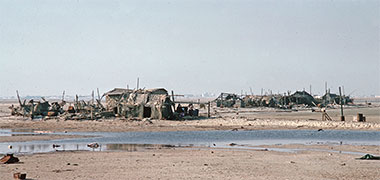
The next four photographs have been selected to give a suggestion of the dwellings that might have characterised the villages of the peninsula in the past couple of centuries, particularly those on the littoral. Three of them are illustrations of stone constructions, but it is highly probable that there would have been a number of more temporary structures of barasti construction. This first photograph is of a temporary fishermen’s encampment photographed north of Umm Said in 1974. While some of the construction materials might be modern, it is highly probable that coastal villages may have had much in common with these impermanent developments.
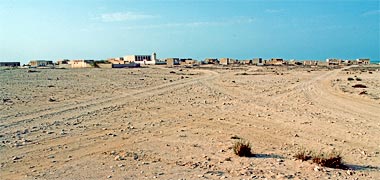
Here is a view of the approach from the south-east to the village of al-Khuwayr, taken in 1978. This development might be considered representative of many of the littoral villages in the north of the peninsula at that time, providing settlement and a degree of protection mainly for those who had work at or on the sea. The buildings are all single storey with only the masjid standing out by virtue of its manara, and there is no watchtower nor protective structure guarding the settlement.
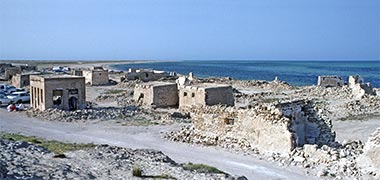
Al-Ghariyah was another littoral village, photographed in the 1970s and here shown in considerable disrepair. Generally the housing was in single rooms within small courtyards, most of them facing the north and sea but, as can be seen on the left, with at least one of them having its openings facing south. Interestingly two of them, in the centre, have battered walls with raised corners illustrating a small degree of sophistication.

Although this photograph is not of the same village, this dispersed arrangement of houses is typical of small villages with each house standing alone and not joined with its neighbours – though, with time, this might be a possibility as families grew. loose scattering of buildings would have been characteristic of these settlements for centuries, perhaps some of them using barasti construction for their roofs, but with their walls generally of the traditional hasa or hasa bahri and juss construction.
The early years of the nineteenth century saw considerable political movement in the region. Much of this revolved around the resolution of leadership in Bahrain and the activities of the Wahhabi.
Britain, at this time, regarded Qatar as a dependency of Bahrain, falling under the operation of the Maritime Truce of 1835. For this reason the British did not deal with Qatar when treaties were signed with Bahrain and the other Gulf Sheikhdoms. However, Qatar and other areas of the Gulf including Bahrain, had come under the influence of Muhammad Abdul Wahhab (1703-1787) and despite their claim on Qatar, the Bahraini Al Khalifahs paid tribute to the Wahhabis whom they recognised as having possessions in Qatar.
1835 also saw the Bahraini ruler sending troops to attack al-Huwaylah whose strength was now beginning to worry him. The Bahrainis landed at Zubara, abandoned in 1811 and then moved to establish themselves at Fuwairat, close to al-Huwaylah. Despite being reinforced by a small number of Wahhabi horsemen and infantry, the chief of al-Huwaylah sought mediation which was successful in keeping the status quo but required the demolition of al-Huwaylah and the moving of its inhabitants to Bahrain.
However, members of the Bahraini Ruler’s family induced some of the al-Kuwara of Fuwairat to attack al-Huwaylah, in the process killing a member of the chief’s family. Moving to Abu Dhabi and intent on continuing his disagreement with Bahrain, Isa bin Tarif of al-Huwaylah found himself constrained by the British who refused to allow them to continue warfare against Bahrain. The British also brought pressure to bear on the inhabitants of al-Bid’a and Wakra who, too, were engaged in what were considered by the British as unlawful activities, though it is evident that the British were using their power unjustly.
There then followed considerable negotiations between Isa bin Tarif, the British, the Sultan of Muscat and Egypt, the latter of whom wished to expand their interests in the region. Isa bin Tarif’s wish was to return to al-Huwaylah or al-Bid’a along with certain guarantees of protection from the British. In the event he asked, and was given permission, to move to Wakra which had been deserted by the al-bu ’Ainain. This failed to come about and, following more negotiations with the British, Isa bin Tarif settled on the Persian island of Qais in 1840 where he was considered to be no threat to the stability of the region.
The following year the British again shelled al-Bid’a in a successful attempt to deal with outlaws from Abu Dhabi who had taken refuge there. 1841 was also the first time that the Al appear in the various records as having significance on the peninsula.
Sheikh Muhammad bin Thani
Thani bin Muhammad bin Thani bin Ali of the Ma’adhid tribe moved to Fuwairat from Furaiha where they formed a confederation with the al Bu-Kawara of the Bani Tamimi. In 1839 the al Bu-Kuwara moved to the Persian island of Kharg, having fallen out with Bahrain over the latter’s treatment of their tribe in Bahrain. Sheikh Muhammad bin Thani, who had been born at Fuwairat, appears to have been recognised by Bahrain and the British as having pre-eminence in Qatar as the British wrote to him, through Sheikh Abdullah of Bahrain, requesting he did not allow unlawful elements to settle in Fuwairat.
In 1841 Bahraini succession problems spilled over to Khor Hassan resulting in its being abandoned and the rebuilding of Zubara begun. In 1843 a contingent left Qatar with the backing of Sheikh Muhammad bin Thani and Isa bin Tarif, and faced Bahraini forces at Rifa and beating them back to Dammam on the mainland. Instead of returning to Qais or remaining on Bahrain, Isa bin Tarif moved to al-Bid’a, requiring the al-Suwaidi to move to Lingah on the Persian coast. Some members of the Ma’adhid and al Bu-Kuwara tribes also moved to al-Bid’a though this appeared to have no effect on the authority of Muhammad bin Thani, both he and Isa bin Tarif now enjoying friendly relations with the new regime in Bahrain.
This lasted only a couple of years as Isa bin Tarif, becoming alarmed at what he considered interference by Bahrain in the north of the peninsula, changed allegiances in 1847 and moved troops up to Fuwairat. Bahraini forces landed at Zubara and marched on Fuwairat, another group following and landing at al-Khor. The battle of the 17th November 1847 saw the death of Isa bin Tarif and eighty of his men. The Bahraini force then sailed to al-Bid’a and demolished it, sending its inhabitants to Bahrain. What is interesting is that no Qatari tribes took part in the battle of Fuwairat but continued to administer their parts of the peninsula almost regardless of the outcome of the battle, the Al in Fuwairat, the al-Suwaidi in al-Bid’a, and the al-bu ’Ainain in Wakra.
The position of Sheikh Muhammad bin Thani was further strengthened when, in 1851 he supported the Wahhabi Amir, Faisal bin Turki, who moved from Najd to take control of al-Bid’a as a step in his campaign to overcome Bahrain.
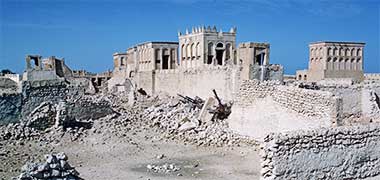
But with the removal of the al-bu ’Ainain to Wakra in or around 1828, headed by Sheikh Ali bin Nasser al-Nasser al-bu ’Ainain, the opportunity to assume control of Doha while retaining Fuwairat was taken by Sheikh Muhammad bin Thani, who probably moved to Doha in 1850. This also gave him the opportunity to develop his commercial interests in the pearling banks and other areas in association with merchants operating in these fields. Pearling, as noted elsewhere on this page, came to an end with the introduction of Japanese cultured pearls in the 1930s.
The al-bu ’Ainain are a branch of the Bani Tamim, one of the largest badu tribes in the Arabian peninsula and consequently of considerable importance. They are now associated particularly with the United Arab Emirates as well as Jubail in Saudi Arabia, and their name remains linked with Wakra. It seems they were originally settled in Yusufiya on the northern coast of the peninsula where they were connected with the al-bu Hussain family. They moved in the late eighteenth century, Sheikh Mohammed bin Khamis al-bu Hussain al-bu ’Ainain settling them at al-Bid’a. But as noted above they also settled at other locations. With interests in pearling they were credited with having as many as two thousand members living in Wakra by 1908. However, the following year, 1909, Sheikh Tawq al-Tawq al-bu ’Ainain and Sheikh Jabr bin Ali al-bu Hamoud al-bu ’Ainain emigrated from Wakra to Jubail in Saudi Arabia following discussions with the British and Ottomans, both Sheikhs having strong links with Sheikh Isa bin Ali al-Khalifa of Bahrain. In common with the political and tribal alliances of the times, the fortunes of the tribe fluctuated and, in 1922 Sheikh Mohammed bin Rashid Al-Rashid al-bu ’Ainain followed, moving to Jubail as a result of disagreements with Sheikh Abdulrahman bin Jassim Al Thani.
The British squadron and its presence in the Gulf brought considerable stability to the region, though their main interest was in maintaining the sea routes through the Gulf rather than involving themselves in activities on land. However, in this case the British warned Faisal and placed ships at Bahrain to intercept a naval attack, and blockaded al-Bid’a and Doha. In addition, the port of Qatif was also blockaded in order to prevent assaults on Bahrain from the direction of the mainland. This blockading fleet was attacked and routed and this, together with the support of the British emboldened the Bahraini ruler who refused to discuss the peace now requested by Faisal. By now there was increasing concern in the region for the continuing presence of Faisal in al-Bid’a and many initiatives were begun to reach a peace agreement. By July 1851, this was concluded under number of conditions with most of those involved agreeing. An exception was the chief of Wakra who left to Fars on the Persian coast.
In 1859 he returned, establishing himself at Wakra, to the annoyance of the Ruler of Bahrain who considered there to be a continuing threat to him. In 1863 he captured Muhammad bin Said Bu Kuwara and scattered many of Wakra’s residents. The Bahraini Ruler seems to have been the instigator of much of the disruption in the region. His main concern appears to have been to resist what he considered to be Wahhabi interest in Bahrain, but it is also evident that he had his eye on all of the Trucial coast including the Qatar peninsula. Another factor may have been his poor governance of Bahrain, his overseas policies attempting to focus his people’s attention outside Bahrain.
This may well have been a factor when, in 1867, he imprisoned Jassim bin Muhammad bin Thani who had travelled to Bahrain as an emissary to discuss Bahrain’s capture of a badawi. The demand for his return saw Bahrain, backed by Abu Dhabi who regarded al-Bid’a as harbouring outlaws, attack Doha, al-Bid’a and Wakra, causing significant damage. Qatar appealed to the Wahhabi Amir who threatened the Bahraini ruler, though to no effect. Because of this Qatar attacked Bahrain in 1868, a thousand men being killed and sixty ships sunk in the marine action. Bahrain released Jassim bin Muhammad bin Thani on the return of the captured Bahrainis, particularly Sheikh Ibrahim bin Ali al-Khalifa, this exchange being claimed to have been effected by members of the al-Khater family of Wakra who belong to the al-Bu’ainain of the Banu Tamim.
The breaking of the Anglo-Bahraini treaty prompted the British to deal with Sheikh Muhammad bin Khalifa of Bahrain but, to avoid this, he fled to Khor Hassan. The British Resident, Pelly, then travelled to Wakra and met all those involved. The result of listening to their complaints about the Bahraini ruler led Pelly to depose Sheikh Muhammad, fining the new ruler, Muhammad’s brother, Ali bin Khalifa, a considerable sum and obtaining his agreement to hand over Muhammad bin Khalifa should he return to Bahrain. More significantly, Muhammad bin Thani agreed not to assist Muhammad bin Khalifa in any way, nor put to sea with hostile intent and to recognise the new ruler of Bahrain. In particular, the 1868 agreement recognised Qatar as a separate political entity, and Muhammad bin Thani as its head.
The following year, agreement was reached for Bahrain and Qatar to provide tribute annually to the Wahhabi and Na’im tribe in order to safeguard the inhabitants of Qatar during the pearling season when houses could not be protected by the men out in the pearl fields.
Meanwhile Muhammad bin Khalifa returned to Bahrain intent on assuming power. This was resisted and he was exiled to Kuwait. A civil war saw Ali bin Khalifa killed and his son, Isa bin Ali bin Khalifa, take his place.
The treaty of 1868 served to stabilise the peninsula. One of the effects of this was to permit the relatively normal development of urban settlements which were, in effect, the establishment of the dynasties now governing the west littoral of the Gulf.
This stability was not absolute. Many of the families who had won or imposed their rule on their part of the Gulf felt the need to protect themselves with fortified structures of varying degrees of effectiveness such as at Zubara mentioned previously, al-Bid’a and at Ras al Khaimah where, later, their fortified position was destroyed by British naval guns. Watch towers were also constructed, generally circular, with their entrances high above the external level. There may have been such towers in Qatar, but I don’t recall seeing them or their remains, though this may not be surprising as, without continuous maintenance, they might be expected to fall within about thirty years due to the normal action of the elements.
Generally it was not possible to protect settlements with city walls as the shore-dependent location of the urban developments made this difficult. So the Rulers of the Gulf states such as Qatar developed their residences as relatively secure developments, generally a little way away from the shoreline where their greatest economic interests lay, though sometimes in the interior. Around them time saw the development of a spatial arrangement mirroring the relationship of the Ruler with merchants and others dependent upon him. This socio-political pattern was not dissimilar to that of the tribal interior, but its significant difference was that he and many of those around him enjoyed a co-dependency based on pearls, commerce and trade. At the same time, however, he had to maintain his position as a tribal leader. It must have been a difficult balance to maintain.
In establishing settlements an important element to be constructed would have been a Customs House where goods would have taxes levied on them, and around which trade would be effected including necessary concomitant activities such as money changers, scribes and porters. These were not necessarily popular, of course. Many settlements also contained offices for those claiming some form of control over the country, or that part of it. The Turks, for instance, had administrative posts sometimes strengthened by a small detachment of armed police or troops.
It has to be remembered that many of those working in the urban developments would not have been Qataris but would have come from Saudi Arabia, Persia, Africa and the Indian sub-continent, the latter having been agreed following the 1868 Treaty when the British Resident required Indian residents to be allowed to settle in Wakra. The Ruler needed much of this for his people to prosper, and the foreign workforce needed the Ruler to provide them with security and work.
At the same time, the wealth to be derived from trade and pearling subjugated the other industry of the peninsula, agriculture, creating poor conditions for its workers though still requiring the food produced – albeit necessarily supported by the increased importation of many other foodstuffs impossible to cultivate in the peninsula and required for an expanding population. In some parts of the Gulf this led to the system of land tenure being altered to the disadvantage of the workers who became increasingly impoverished.
An early description of Qatar
Considered to be one of the more important reference works of the early twentieth century, E.J. Brill’s First Encyclopaedia of Islam, 1913-1936, was a nine volume work containing, among many other essays, an interesting description of Qatar. Relying on earlier, European scholars, he wrote:
Al-Katar, a peninsula on the east coast of Arabia on the Persian Gulf. It has an area of about 2,000 square miles and 2,600 inhabitants. The cape at the end of the peninsula, which runs northwards, is called Ras Rikken and forms a fairly steep tongue of land surrounded by rocks; it is an obstacle not without danger to navigation. The summit is crowned by an old fortress which belongs to a village situated in an adjoining ravine. The coast of the peninsula is steep everywhere, but not high, and is dotted with fishing villages. Its appearance is rather depressing. The soil is poor, nothing but gravel and marl with sand. A few springs provide water for wells, which have been dug with difficulty in the heavy soil. The climate is remarkably dry and the air unhealthy as a result of the stagnant sea-water along the coast. The few gardens are small and yield but little. There are no extensive cornfields or palm groves; only here and there do we find a few palms and bare crops. For miles low, bare hills parched by the sun rise from the muddy strand covered with driftsand and seaweed. Inland beyond these eminences stretch barren dunes which are scantily covered with vegetation; behind them lie groups of low miserable huts made of earth and palm leaves. These villages are surrounded by walls to protect them from the raids of robber Beduins of the tribes of Menasir and Al Murra; the dunes have towers on them and here and there is a building of some size that has been fortified.
In contrast to this poverty is the almost inexhaustible wealth yielded by the bay on the Persian Gulf surrounded by al-Katar, in which lie the islands of al-Bahrain celebrated for its pearl-beds. Food and sustenance is amply supplied by the sea, on which the inhabitants of the bay spend half the year seeking for pearls, while the other half is devoted to fishing and trading. Zabara is the largest place on the peninsula and al-Beda is regarded as the capital. The latter, like all the places on the peninsula, is chiefly inhabited by fishermen, but in the long narrow, dirty market place there are also a few merchants and artisans from al-Bahrain.
The houses of the town are huddled together in narrow, dirty, irregular streets; two mosques and the ancient castle are the only buildings of any importance in al-Beda, which may have about 6,000 inhabitants. Dawha, which lies north of al-Beda, is but half as large; it lies in a deep little bay which affords a rather picturesque view through the cliffs 60 – 80 feet high in the background. The houses of Dawha are still more unprepossessing and poorer than in al-Beda and the market place even smaller and filthier. Two forts command the town – one on a rock beside it and the other in the town itself. Al-Wakra is more pleasing and stands higher. It also shelters a number of merchants and artisans from al-Bahrain. The town has, on the whole, a prosperous appearance.
The peninsula was of some importance even in the ancient times on account of its important situation commanding the Gulf of al-Bahrain. A Sprenger has sought to identify the Cataraei of Pliny (Natural History, vi. 28, § 147) with the inhabitants of al-Katar. The peninsula used to belong to the Sultanate of Oman. From 1872 till 1914 it is under the suzerainty of the Turks, who had a garrison in al-Beda down to October 1914, and belonged to the province of al-Ahsa, forming the kada of the same name in the sandjak of Nadjd. Since 1913 ’Abd Allah Al Thani has been lord of the peninsula. But parts of it became independent earlier. For example, in 1882 Dawha made a treaty with England accepting her protectorate; in 1892 and in 1914 other places followed this example. Al-Katar is now under the control of the ruler of Central Arabia, Ibn Sa’ud, who has thus regained the position once held by the Wahhabi kingdom to the peninsula, which the Turks had for a time usurped.
Bibliography: W. Gifford Palgrave, Travels n Arabia, London 1865, ii. 232-235; A. Sprenger, Die alte Geographie Arabiens, Bern 1875, p. 116; E. Glaser, Skizze der Geschichte und Geographie Arabiens, ii., Berlin 1890, p. 75, 281; F. Stuhlmann, Der Kampf um Arabian (Hamburgische Forschungen, i., Braunschweig 1916, p. 177, 203, 204; Handbooks prepared under the direction of the Foreign Office, N° 76, Persian Gulf, London 1920, p. 45-47, 72, 75; L. Massignon, Annuaire du Monde Musulman, i., R.M.M., 1922/23, liii. 69.
You may notice there are a number of errors, inconsistencies or inaccuracies, nevertheless the account is still interesting for its snapshot taken around ninety years ago.
Ottoman interests

It is important to understand that the history of the peninsula, indeed the history of the Gulf, has much to do with the Ottomans who were in the ascendancy over large areas of the Middle East for centuries. At the beginning of the sixteenth century the Turkish Sultan Selim I led his armies into northern Iraq in 1514, moving on to take Syria and Palestine from the Eqyptian Mamelukes and, by 1517 had overrun Egypt and the Hijaz. These conquests continued under his successor, Sultan Selim II who, in 1520, obtained Algeria through the activities of the self-declared vassal, the pirate Khair al-Din Barbarossa. This was formalised with Turkish administrators being established in 1533. By 1532 the Ottomans had taken the Yemen and moved onto the Red Sea coast of Somalia. In 1551 they seized Tripoli and 1574, Tunisia. But it wasn’t until 1638 that they took Iraq from the Persians, then moving on to take al-Hasa.
Thus, by the middle of the seventeenth century the Turkish Porte had occupied most of the Middle East with the exception of Morocco in the West and Oman and the interior of the Arabian peninsula – though they had failed to capture Malta in 1565. Despite this, they were able to dominate the Mediterranean, facilitating their trading capabilities between the north African coast and Europe.
While the imposition of their authority was extensive, it was not always complete, many of the areas developing discrete identities, though within the Ottoman Empire. In settling, the Porte generally accepted the system of land ownership existing in the Arab countries and developed a system of taxes and entitlements in the main based on this, with the exception of land owned by religious establishments.
But in attempting to reorganise the systems of land which were in communal ownership, they created rancour in areas where none previously existed. This generally related to lands that badu tribes used as pasture. In redefining this land as being state-owned and generally given to the heads of tribes, the Porte attempted to turn the obligations of the tribe leaders into hereditary duties requiring the administration of Porte interests. This met with considerable resentment and resistance leading to ambiguities in the ownership of the land as tribesmen rebelled against the heads of tribes to whom the Porte had granted the land.
In addition to socio-cultural discontent the Porte had other difficulties in maintaining its hold over the lands it had acquired. A number of factors militated against it. Developments in war and armaments in Europe surpassed the standards of the Porte and her janissaries were less willing to fight than they had been, and other countries sought to improve their own industrial and commercial interests. The end of the seventeenth century saw her having to cede lands to Austria, Russia, Poland and Venice by the Treaty of Carlowitz in 1699. Then the Treaties of Passarowitz – 1718, Belgrade – 1739, Kuchuk-Kainarji – 1774, Jassy – 1792 and Bucharest – 1812 saw her lands in the north greatly diminished with neighbouring countries attempting to obtain access to warm water, Russian wanting to be able to move through the Dardanelles and Bosphorous to the Mediterranean, and Austria to the Adriatic Sea. Nor were these the only countries seeking benefit at the expense of the Porte, Britain and France particularly wished to expand their influence in the area.
The difficulties the Ottomans were experiencing, sketched above, were located mainly in the north of their dominions. In the southern area of their influence, they occupied the littorals of the Red Sea and Persian Gulf of the Arabian peninsula, the interior being both immense with its massive desert, and sparse in its population which had a different character from the more sophisticated northern regions. It was the disunity of the tribes and settled peoples of the peninsula that had made it easy for the Ottomans to impose themselves on these littorals. But in this they found themselves in conflict with the British, Dutch and Portuguese in the sixteenth century and, in the eighteenth century, with the Persians who moved into Bahrain, the Oman and al-Hasa, to the east of Qatar.
The rise of the wahhabi in the eighteenth century added to the Ottomans’ troubles. The strict doctrines espoused by the followers of Muhammad ibn ’abd al-Wahab developed into a determination to create a single Arab entity, not only bringing together the tribes of the peninsula, but enforcing true Islamic principles. In this they were in conflict with Ottoman Islam which was characterised by the Wahhabis as, in the main, polytheistic. Thus, at the beginning of the nineteenth century they had moved into al-Hasa, Bahrain, Kuwait and the Oman – previously occupied by Persia – together with the other littoral states as well as moving against Syria and Iraq, though unsuccessfully. All this brought them into conflict with the East Indian Company and, particularly, British interests.
The difficulties the Ottoman Porte had within their Empire were compounded by the extent and physical characteristics of their lands. While they were engaged in continuous conflict in the north, Wahhabi initiatives moved north from the Najd to Iraq and west to the Hijaz. In 1802 Wahhabi forces attacked Karbala, desecrating the Shia tomb of Husayn bin Ali, and massacring the inhabitants of the town. This was followed in 1803 by the Wahhabi forces, led by Saud bin Abdulaziz, capturing the cities of Mecca and Medina and barring Ottoman Muslims from pilgrimage. As much of the Porte’s religious legitimacy was based on their guardianship of the holy cities, it was imperative that this new state of affairs was reversed. But, as mentioned above, the central Arabian peninsula was a difficult area to move around, particularly with its extended lines of supply and communication, and the Porte was unable to persuade the governors of Cairo, Damascus and Baghdad to undertake such a military campaign as they had problems of their own to deal with.
In the meantime it is also important to understand something of the relationships between the European powers of Britain and France and that of Egypt. Britain and France were struggling for ascendancy in the Indian sub-continent with the French intent on securing for themselves the route between the Mediterranean and the Arabian Sea. At the end of the eighteenth century, a British fleet approached Alexandria with the warning that the French intended to attack the Ottoman domains there. However, Britain and France were considered to be significantly inferior to the Porte and the warning was dismissed. A few weeks later a large French force landed and, led by Napoleon, moved on to route the Mamluk army defending Cairo, and occupy it and Alexandria.
Napoleon brought with him not just his military to secure the route to the Indian sub-continent, but a considerable number of scientists and scholars intent both to learn more of what they might find there, but also to pass on to the Egyptians something of the French culture that was grounded in the Enlightenment. Essentially a humanitarian culture, this did not sit well with Muslim thought, and the French military, scientific and cultural initiatives were both resented and resisted by the Egyptians, although it was a brief experience that unsettled their sense of superiority.
A month later, in August 1798 Nelson descended with a British fleet on Aboukir Bay and destroyed the French fleet, only two ships-of-the-line and two frigates escaping from the seventeen-strong fleet. The result was that the French army was now trapped in Egypt. This isolation was completed when, in August 1799, Napoleon abruptly left Egypt to rejoin his armies in France and continue his wars there. Two years later, a British force combined with an Ottoman army to force the surrender of the dispirited French troops in Cairo and Alexandria. The British now had a firm hold on the route between the Indian sub-continent and the Mediterranean.
British interest in the Gulf
Great Britain had considerable interest in the Persian Gulf. However, it considered the areas as being comprised of two distinct entities, the northern shores comprising Persia and Iraq and the southern of Western Arabia. The first to be developed was the northern element in 1616, a base being established at Jask, later transferred to Bandar Abbas, for controlling the associated commercial interests. A number of factories were established in the following years, and brokerages in Kirman and Muscat in 1720 and 1750 respectively. But Muscat was the exception, the British having little economic interests along the southern coast of the Gulf, and there being considerable piracy which led to trading ships avoiding this coast. Trade and navigation was almost entirely in the hands of local Arab, Persian and India traders. But by the beginning of the nineteenth century, this began to change.
The East India company, established by Queen Elizabeth, had developed its commercial interests over time to become a powerful organisation, one that gradually moved away from commercial pursuits to administrative and military governance. Following the Battle of Plessey in 1757, the Company became the effective rulers of the sub-continent, a situation that was amended in 1858 with the Government of India Act when the British government took over the responsibilities.
The practice had developed in the Gulf for Arab craft to raid and levy tolls on passing vessels, a practice similar to badu raiding along desert routes. Although this was essentially based on, or evolved from the traditional practice of huwah, this was considered to be piracy and extortion so, in order to safeguard the Company’s commercial and British nationals’ interests in Arabian waters, the British imposed an anti-piracy treaty in 1820 on the Rulers of what was termed the ‘Pirate Coast’, effectively the present day United Arab Emirates, but including Bahrain at its own request. As noted above, this was something that the al-Khalifa had been requesting for some time. The post of Political Agent for the lower Gulf was created and based on the island of Qishm close to the Persian coast in the Straits of Hormuz. In 1822 the post was moved to Bushir on the Persian Coast and amalgamated with the post of Bushir Resident. In the 1850s this was expanded to cover the whole of the Gulf.
To support the Resident, a Gulf naval squadron was created based first on Qishm island from 1821 to 1863 and 1869 to 1879, and then on neighbouring Henjam Island from 1879 to 1935.
Following the treaty of 1820 the British imposed a number of treaties on the area, the most important of these being the first Maritime Truce which was signed in 1835 with the rulers of Abu Dhabi, Dubai, ’Ajman and the Qasimi empire which consisted of Sharjah, Umm al-Qawain, Ras al-Khaimah, Rams, Dibba, Khor Fakkan, Fujairah, Kalba, Mughu, Lingah and Qishm. These culminated in the Perpetual Maritime Truce of 1853, the co-signatories being referred to as the ‘Trucial States’ and to which the states of Bahrain and Qatar were respectively invited to join in 1861 and 1916.
The emphasis on trade was consolidated in 1862 with the establishing of a regular navigation line between Basrra and Bombay. This was later developed to link the ports of Muscat in 1862, Manama in 1869, Qatif in 1874, Kuwait in 1874 and Dubai in 1903.
As mentioned above, the British had an interest in the Gulf that had much to do with its wider interests in the Indian sub-continent. For some time the government of India was effectively the chief administration system for the region. In this it seems that their concern was for political stability in order to safeguard their particular interests – successful commercial activity and the security of their nationals. This concentration on the Indian trade links is seen by some as a method the British used to consolidate their interests with the Gulf sheikhdoms, the latter trading with the East Indian interests, but this being a relatively small percentage of the overal trade passing through the region.
On the other hand the Turks saw themselves protecting their own sphere of interest, particularly their fellow Muslims though, even here, there appears to have been divisions between Constantinople and local administration that are generally recorded as being compounded by deceit, admittedly for the most part, in British records.
First treaty with the British
From earlier notes it can be seen that Qatar’s history in the first half of the nineteenth century was a continuing struggle between tribes for dominance of both trade, pearling and land areas, the conflict encompassing not only Bahrain and the Qatar peninsula, but also the Arabian hinterland and both island and land based settlements on the Persian shore. In many ways the focus was on the interests of those on Bahrain and those on Qatar, a problem that continued until recently with the resolution of the boundary dispute between the two countries. It was not until 1868 that the British were able to force through a form of truce.
The Pax Britannica continued to provide a semblance of normality, if not peace, in the region, though the transition from tribal communities to urban developments based on trade was not necessarily straightforward. This was particularly so in Qatar which had not seen much urban development until the late 18th century, and that not particularly associated with trade but of guarding and developing the resources of pearls and arable land.
Difficulties continued between Bahrain and Qatar over the years, coming to a head in 1867 with a confrontation at Wakrah where Bahrain dispatched its forces to crush the Qataris. This act violated the Anglo-Bahraini treaty of 1820 for which the British censured Bahrain.
Negotiations began between the two parties – a process which implicitly recognised Qatar as a sovereign entity – under the aegis of Colonel Lewis Pelly, the British Resident in the Gulf. The subsequent official relationship between Qatar and Britain and, therefore, its recognition as a State, began with the peace treaty signed between Colonel Pelly and Sheikh Muhammad bin Thani on the 12th September 1868. Sheikh Muhammad had, by that time, become the pre-eminent leader within Qatar.
I should mention here that previously the British, being settled in Bahrain, were thought to have had little interest in Qatar, rarely visiting it, and then, only when absolutely necessary. Bahrain certainly appeared to be a more pleasant place in which to be based. It is, perhaps, for this reason that the British appeared to take a relaxed attitude to the provocative occupation of the peninsula by the Turks.
Turkish occupation
Despite the treaty of 1868, the Turks extended their interest in the region, occupying Najd and occupying Qatar several times in the eighteen seventies, and warning Britain not to interfere with Qatar which they regarded as being their property. Sheikh Jassim bin Muhammad bin Thani accepted Turkish sovereignty and, in 1871 a Turkish detachment was sent to al-Bid’a. 1873 saw Bahrain attempt to re-establish its claim on Zubara. The Government of India considered that the Ruler of Bahrain had no rights in Qatar and that he should be restrained from pursuing his interests there. The Ruler of Bahrain, while informing the British Government that he would abide by their decision, did not give up his claims to Qatar, in particular continuing his association with the Na’im who occupied the north-west corner of the Qatar peninsula.
The acceptance of Turkish sovereignty by Sheikh Jassim bin Muhammad did not please all in Qatar. The al Bu Kawara took exception to it and moved from al-Bid’a to Fuwairat in 1879. This lack of respect was mirrored by members of the Bani Hajir tribe who, in 1880, attacked Doha and the next year, along with members of the Na’im, carried off camels. The Turks notably refused to support Sheikh Jassim in many of the initiatives he now embarked upon to settle issues with Bahrain and Abu Dhabi, as well as refusing to have a Customs House established in al-Bid’a, but resisted his attempts to resign as Qaim Maqam, an administrative position given him in 1872 by them.
In 1883 the British formally warned the Turkish Ambassador in London about their activities in and attitude to Qatar. This they reinforced in 1888 by conferring upon Sheikh Jassim the title of Kapucibasi for services to the Turkish empire though this year and 1889 saw him skirmishing with Abu Dhabi forces over lands he believed belonged to Qatar. In this fighting, one of his sons, Ali bin Jassim, was killed.
Turkey appeared to take a more serious interest in Qatar by planning to establish two administrative posts at Zubara and Khor al Udaid, fully staffed with administrators and a policing element. The British were concerned both by this initiative as well as by their location and requested clarification from the Turkish Ambassador in London. 1893 saw a strong rebuttal from the Turkish Government to Lord Roseberry claiming that Qatar was ‘a Turkish sub-governership’ and ‘a dependency of the Najd’ and that Sheikh Jassim was a Turkish citizen and government official. Moreover the Turks claimed sovereignty of the whole of the region and claimed to have no knowledge of the 1853 Maritime Truce, refusing to acknowledge its legitimacy even when given a copy.
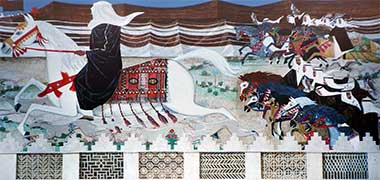
In the course of implementing their administrative plans, the Turks landed troops at al-Bid’a in 1893, sending to Kuwait for additional troops to augment their military initiative. Sheikh Jassim had again submitted his resignation, refused to pay taxes, and moved, first to the north at al-Dh’aayen, then west to al-Wajbah gathering around him men of the Manasir and Bani Hajir tribes together with four hundred men from other Qatari tribes, a force totaling between three and four thousand men. The Ottomans, led by the governor of Basra, Mehmed Hafiz Pasha and increasingly irritated by the intransigence of Sheikh Jassim, took as hostage a number of important Qataris including Ahmad bin Muhammad, Sheikh Jassim’s younger brother and the negotiator and emissary of Sheikh Jassim, holding them on their corvette, the Merrikh.
Sheikh Jassim offered to pay a ransom for the Qataris’ release but the Ottomans rejected the offer and, despite having significantly less troops, moved on the 23rd March 1803 – the 5th Ramadan 1310 – against the Qatari force at al-Wajbah with forty cavalry and a hundred gendarmes accompanied by a three-pound cannon.
Note that there are conflicting estimates of the size of the Ottoman force with their number being given as high as 300, and of the number killed 117 in one account and, in a Turkish account, that there were 230 infantry including 30 men from the 4th platoon of the 43rd Regiment, 100 mounted gendarme and 100 mounted camels as well as some marines from the corvette Merrikh together with one of its three-pound cannon.
There is also disagreement between the various sources where most believe that Ahmad bin Muhammad and the Qatari hostages were imprisoned on the Merrikh, and a Turkish source stating that they were held in the fort, and that they were set free on the 31st March 1893.
A day-long engagement saw the Ottomans beaten back, first that night to the nearby decayed fort at al-Shabaka then, lacking urgently-required support, to al-Bid’a. The lighter armed Qatari forces lost 400 men, women and children in the engagement; the Turks lost 11 killed and 55 wounded. It was only when they were close to their fortified position on the coast between Doha and al-Bida that the Ottoman corvette, the Mirrikh – on which the Qatari hostages were housed – was able to use its guns to assist the Turks’ retreat and to bombard Doha.
A Turkish source gives the total number of Ottoman soldiers killed as 117 with 55 wounded in the uprising.
Despite using their warship and fortified position to fire on and kill some of the inhabitants of Doha, the victory of the Qataris at al-Wajbah had been decisive. Following the blocking of communications between the Ottomans in al-Bida and their headquarters at al-Hasa, as well as cutting the water supply to the Ottoman position, the Turks freed Ahmad bin Muhammad in return for Sheikh Jassim permitting the Turkish cavalry free passage in their retreat by land to Hofuf.
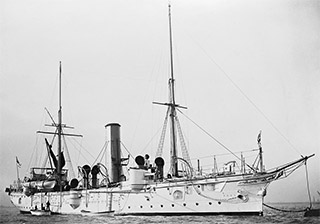
The British, concerned to retain some degree of influence in the Gulf, attempted to intervene in the dispute between the Turks and Qatar. A British ship arrived on the 14th April 1893, though was prevented from entering the port. The Archer class torpedo cruiser HMS Brisk, operating out of the East Indies Station, arrived at al-Bida on the 25th April 1893 and, unable to enter the port, moored alongside the Mirrikh. A Turkish source refers to HMS Brisk as being a ‘British pirate ship’, indicating something of the attitude of the Ottomans to the perceived British attempts to improve their strategic position in the area.
Due to difficulties with competing resources, the British found themselves unable to take up Sheikh Jassim’s offer to place Qatar under British protection at that time. Consequently the Turks were able to make their peace with Sheikh Jassim. He, however, moved away to live peacefully at Lusail, ostensibly leaving the running of the country to his brother, Sheikh Ahmad bin Muhammad.
Regrettably, at the end of 1905, Sheikh Ahmad was murdered by one of his own servants, a Bin Mu’ammam, from the Makhadhdhaba section of the Bani Hajir tribe, who made his escape via Bar al-Dhahran to the Ajman encampment. Sheikh Jassim met elderly members of the Bani Hajir demanding that they be banned from Qatar until the murderer had been killed but, as the meeting was taking place, slaves of Sheikh Ahmad bin Thani shot and killed Sheikh Salim bin Shafi, chief of the Makhadhdhaba in Sheikh Ahmad’s camp. Sheikh Jassim immediately exiled them. Captain Prideaux, the Political Agent in Bahrain in his memorandum of the 30th December 1905 to Major Cox, the Political Resident in Bushire, drily noted that if
this is actually the case, there would seem to be a probability of considerable unrest in the Katar peninsula…
Bin Mu’ammam was welcomed by the Bani Ajman who were nursing a collective grudge against the late Sheikh Ahmed for an actual or perceived slight. The welcome also caused the Bani Hajir to feel politically stronger as they had previously believed themselves to be at the mercy of Sheikh Jassim. Now that the two tribes were allied, a large party of them made its way to Bar al-Dhahran. Despite Sheikh Jassim having been said to have taken a relaxed position with regard to revenge, this was actively pursued by the sons of Sheikh Ahmed.
Sheikh Jassim was now considering whom he should appoint as the Chief of Doha. Sheikh Ali bin Ahmed, the oldest of Sheikh Ahmed’s sons seems to have been his preference. Though the public view seems to have preferred Sheikh Khalifa bin Jassim, however Khalifa believed that, in some quarters, he was thought to have been involved in the murder of Sheikh Ahmed, and that this might cause difficulties. Sheikh Abdullah bin Jassim was then proposed but he had competing and personal interests that caused him to decline, Sheikh Jassim establishing an interim agent, Ibrahim bin Saleh bin Baker, Sheikh Ahmed’s former clerk, as the ‘Amir of the Bazar’ to keep order and look after small cases while he, Sheikh Jassim, would deal with tribal issues.
In the meantime the sons of the late Sheikh Ahmed were potential problems to Sheikh Jassim as even though he had initially tried to hunt down Bin Mu’ammam, they resented his relaxed attitude to the murder of their father as well as the Sheikh Jassim’s handling of their father’s pearls and property. Because of this he was thought, in February 1906, to be a likely choice for the post of the Amir of Doha.
A little while later, a young man named Bashir of the Bin Shafi family brought a letter from Sheikh Muhammad bin Nasir bin Mubarak, a grandson of Sheikh Jassim, confirming that he had killed Bin Mu’ammam at Bar al-Dhaharan. Delighted at the news, Sheikh Jassim gave a mare and a dress coat to Bashir and assumed that the blood feud was closed.
While this might have calmed events in the peninsula, the succession of Sheikh Jassim was still open. By March 1906 Sheikh Khalifa of Bida and Sheikh Abdulrahman of Wakra had been separately approached but wanted to continue their interests in their towns, while Sheikh Abdullah was only interested in pearling. Sheikh Ahmed’s sons, rightly or wrongly, were considered too young. Additional pressure was placed on Sheikh Jassim by the Turks who wished to see stability in Doha. The protection of the suq was effected through the support of friends of Sheikh Ahmed together with the Turks funding an increased number of watchmen.
The peninsula continued to witness difficulties, in the main between different family groups. In 1910, for instance, the al-Bu’ainain of Wakra who were mainly involved in the pearling industry, left Wakra, which was governed by Sheikh Abdulrahman bin Jassim Al Thani, and moved to Jubail in Saudi Arabia where many of their descendants still remain. In addition piracy was a continuing issue while activities between the British and Turks continued to provide to reflect on the balance of power in the peninsula.
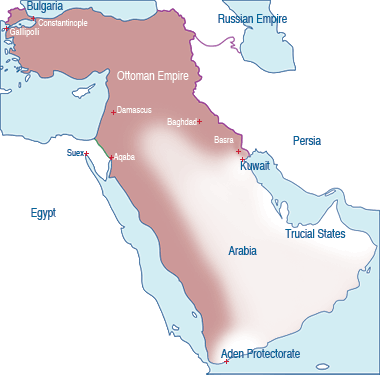
With no resources the Sublime Porte was unable to remain neutral in the coming conflict and needed to associate with one side or the other. Having had a partnership with the Allies rejected, they joined an Ottoman-German alliance with the hope that this would strengthen their economic and political positions, the Germans anticipating better links to their African colonies and the Indian sub-continent through Baghdad.
Because of this the influence of the Ottomans in the Gulf was not as significant as it was in Egypt and the Sinai Peninsula where the Allies were attempting to control the Suez Canal and access to the Indian sub-continent. However, there was significant interest in defending oil interests in the Gulf with the British taking Basra in November 1914, establishing a base for movement north into Mesopotamia.
The Ottomans achieved considerable successes in fighting the Allies in these areas, particularly the latter, but were eventually defeated by pressures in the north. Their Russian front and that against Europe became too complex to defend with the German and Austro-Hungarian being unable to spare troops to assist them.
The First World War between the Allies and the Ottoman Empire was officially brought to an end with the Armistice of Mudros of the 30th October 1918, taking effect the next day. This left the Allies in control of their interests in the Gulf and the gateway to the Indian sub-continent, though it was to take some time for the lands to the west and north to reach a degree of political settlement, issues that continue to this day.
Bahrain and Zubarah
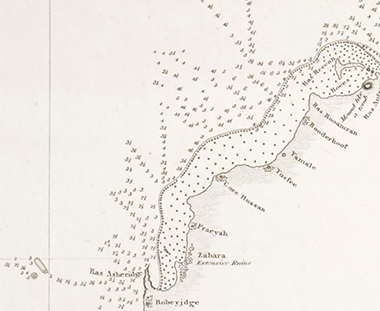
For some time there has been considerable commentary on the issue of Bahrain and its claim to ownership of Zubarah in the north-west corner of Qatar, and of the Hawar Islands immediately off the west coast of Qatar, though the legal issues relating to ownership of the Hawar Islands were resolved by the International Court of Justice in favour of Bahrain in 2000.
This group of notes are intended to give a little more background to the history of the Qatar peninsula, particularly in regard to its relationships with the Bahrain islands to its west.
Zubarah was settled from Kuwait by a branch of the ’Utub tribe, the Al Khalifa, in 1732 developing into an important pearling and trading centre due to its sheltered harbour and central position within the Gulf. Difficulties developing with the inhabitants of Bahrain, then in the possession of the Persians, resulted fifty years later in conflict between the ’Utub and Persians, the latter being routed from Qatar with the assistance of an ’Utub fleet from Kuwait, and the Al Khalifa moving into Bahrain in 1783.
Note that, in a Turkish paper, Zubarah is said to have been ‘seized’ in 1766 by the al-Khalifa migrating from Kuwait. The paper added that the area was settled at that time by the al-Musallam, Ma’adhid, Al bin Ali and the Sudan, the Al Thani being a branch of the Ma’adhid tribe.
By 1790 the town had developed and prospered, though this period lasted only a relatively short time, with Wahhabi forces sporadically attacking it due to its perceived importance for access to the Gulf as well as their belief of its acting as a religious centre in conflict with Wahhabi teachings. The town was abandoned in the early part of the nineteenth century following Wahhabi occupation in 1809. Around two years later the Wahhabi were ejected, and the town reoccupied as a pearling port, but with its population significantly diminished.
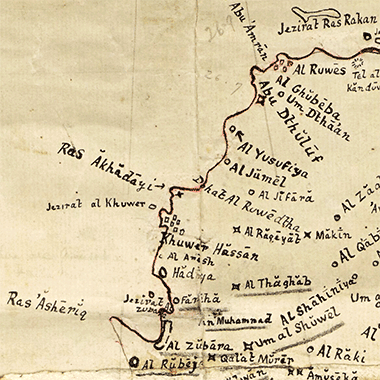
The site of Zubarah is now of considerable interest as one of the most complete examples of eighteenth and nineteenth settlement in the region. Beginning in the 1970s, a number of archaeological studies have been made of the site and the surrounding area, and these have continued into the twenty-first century bringing a better understanding of life on this area of the peninsula over the last two or three hundred years, together with something of the importance of this area within the Gulf.
This illustration is taken from a rough sketch map of the Qatar peninsula, thought to have been made in 1937, its importance is in showing the place names recorded in the area around Zubarah.
While the legal issues relating to the Hawar islands were settled in 2000 to the benefit of Bahrain ‒ despite their lying immediately off the west coast of Qatar ‒ the issue of the ownership of Zubarah, located on the Qatar peninsula, has continued sporadically into the twenty-first century. In essence, the claim is that there has been settlement of peoples in Zubarah having allegiance to Bahrain for a considerable period of time.
The argument made by Bahrain is chiefly developed on the understanding of the concepts of dirah and hamam. On the basis of these concepts, Bahrain asserts that ‘Zubarah’ might refer to
- what is now the ruined town of Zubarah,
- the town of Zubarah and its associated settled areas, and
- to the Zubarah region,
this latter being the combined dirah and hamam of the al-Jabr.
With regard to this issue, Bahrain has adapted the definition put forward in Lorimer’s Gazetteer of the Persian Gulf of the dependent forts surrounding Zubarah within a radius of around seven miles. These are:
- ’Ain Muhammad,
- Freiha,
- Hulwan,
- Lisha,
- Qal’at Murair – the main Zubarah fort,
- Rakayat,
- Thaqab, and
- Umm ash-Shuwail,
suggesting these to be the limits of the area considered by them to be within Zubarah and, hence, belonging to Bahrain, and being the home of the al-Jabr branch of the Na’im.
more to be written…
Bahrain and the al-Na’im
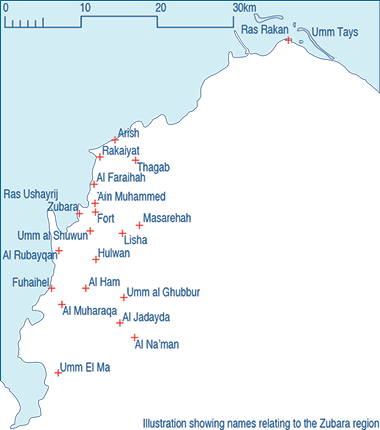
The basis from which this sketch map has been derived was an illustration provided to the International Court of Justice in 2000 by representatives of Bahrain when setting out their claim on the territorial dispute that has existed between Bahrain and Qatar for many years. This dispute related not just to Zubara and the lands around it, but also to the Hawar islands, situated immediately off the west coast.
The original reproduction was difficult to read, so it is not possible for me to guarantee the accuracy of this drawing, but it is placed here for the background it gives to this note, particularly for what is referred to as the ‘Zubara Incident’. The original reproduction is assumed to be relatively accurate given the circumstances of its production as legal evidence in Bahrain’s claim to this part of the Qatar peninsula. An illustration of the location of the Hawar Islands is given below as that was a significant element of the Bahrain claim to Qatar.
It appears that, as this note relates only to the lands on the peninsula claimed by Bahrain, the sketch only identifies places on that part of the peninsula disputed by the two parties.
The drawing might be compared with that of the map on one of the Gulf architecture pages. More precise references are given for some of the locations on the geography page.
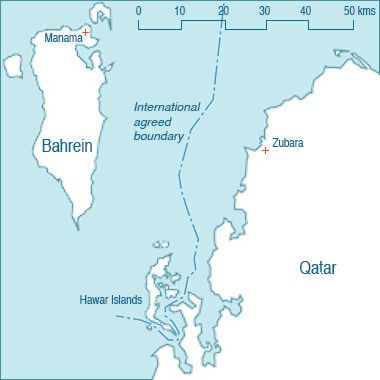
This sketch map illustrates the location of the Hawar Islands that were an important element of the appeal to the International Court of Justice in 2000 to settle the boundary between Qatar and Bahrain, the issue having been a continuous irritant in the relationship between the two countries. At its simplest Qatar has considered the Hawar Islands to belong to them due to their proximity to mainland Qatar. However, Bahrain has always understood that the islands belonged to Bahrain, their argument being mostly based on three arguments – that the islands belong to the Bahrain archipelago; that the Dowasir tribe, having asked for permission to settle there from the Qadi of Zubara – an appointee of the Bahrain government – did so around 1800, and that occupation continued into the twentieth century with no habitation either there or on the mainland of Qatar by Qatar until the 1930s. Due to the relatively late development of the State of Qatar compared with Bahrain it was, perhaps, inevitable that notes and maps asserted a relationship between Bahrain and these inhabited islands.
In the summer of 1936 matters again came to a head between the al-Na’im and Al Thani tribes. Shaikh Rashid bin Muhammad, head of the al-Na’im was, at that time, allied to the al-Khalifa family, the ruling family of Bahrain who continued to assert their claim to see al-Zubara as a part of their territory arguing that they had been there from at least the eighteenth century. However, the British did not recognise the al-Khalifa claim and refused to intervene in the conflict between the al-Na’im and Al Thani.
The issue came to a head with what was termed the ‘Zubara incident’. A man of the Ramazin sub-section of the Na’im tribe divorced his wife who then remarried into the al-Jabor sub-section of the tribe. This created significant friction between the man and Sheikh Rashid bin Muhammad and resulted in the Ramazin leaving the Na’im to move to live near Doha and associating themselves with Sheikh Abdullah bin Jassim Al Thani, Ruler of Qatar, the al-Jabor continuing to live at Zubara and retaining their allegiance to the al-Khalifah.
Disagreement festered and, in March 1937, Sheikh Abdullah bin Jassim visited the north-west corner of the peninsula with the intent of asserting his authority over the area by requiring taxes from the Na’im as well as putting an end to the practice of smuggling from Bahrain through the area, which was depriving the State of taxes. One of the group sent to deal with these issues was the man who had left the Na’im and who now was obstructed by Sheikh Rashid bin Muhammad.
A month later Sheikh Rashid wrote to the Bahrain Ruler, Sheikh Hamad bin ’Isa al-Khalifa, asking for help and complaining that Sheikh Abdullah’s intent to levy customs duty indicated hostility towards Sheikh Hamad. He also wrote to Sheikh Abdullah, presumably along similar lines. He then gathered the Na’im near Zubarah, the two events upsetting Sheikh Abdullah who demanded an apology and agreement to proposals he had previously made to Sheikh Rashid.
Sheikh Hamad’s response was to send three of his guards to the peninsula where they landed stores, apparently intended for the rebuilding of the fort, and planted a Bahraini flag either on the beach or on the fort. This incensed Sheikh Abdullah who demanded it was taken down. Eventually it was though there appears to have been a delay, intentional or otherwise.
The British concurred with the Bahrain ruling family in regarding Qatar as being in considerable disorder. Remembering historical problems they believed that Qatar would not send a relation to Bahrain to discuss their joint problems, nor would they send their own relations to Doha, though suggested to the British that a Qatari delegation might agree to come to a point at least ten miles from Zubara. However, Shaikh Abdullah rejected all suggestions from Bahrain, including the suggestion that the issue might be deferred a year, and continued to complain that the al-Na’im were being armed by Bahrain and that activities in Muharraq confirmed this.
Problems continued between the al-Na’im and Al Thani, the Qatari representatives continuing to reject anything but a ‘complete withdrawal of the Bahrain claim for Zubara and the al-Na’im’ and being reported as being ‘chauvinistic and offensive’ by the British Political Agent based in Bahrain reporting to his colleague and superior, the Political Resident in Bushire. Note that the Advisor to the Bahrain Ruler was also British, and that there was no similar arrangement in Qatar.
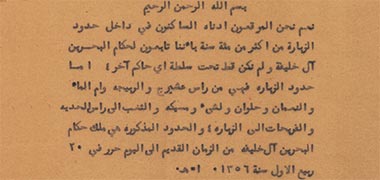
The issue was to some extent defined by a letter received by the Ruler of Bahrain and passed on to the British Advisor to the Government of Bahrain, Sir Charles Dalrymple Belgrave, which he sent on to the British Political Agent on the 20th June 1937. It stated that the Ruler had received seven petition from the inhabitants of Zubara and reads, in his translation:
In the name of God, the Merciful, the Compassionate, we the undersigned, the inhabitants within the boundaries of Zubara for over hundred years are belonging to the Khalifah Rulers of Bahrain and we have never been under the rule of any other Ruler: the boundaries of Zubara are from Ras Ashairij and Rebaijeh and Om al Mai and Na’naan and Halwan and Lisha and Misaichah and Thegab to Ras al-Hiddeyyah and Fraihat to Zubara and these boundaries are the property of the Khalifa Rulers of Bahrain from oldest time to today. Written on 20th R/Awwal 1356.
The memorandum stated that there were 536 signatories to the letter with another two hundred anticipated in a further document.
Despite this, towards the end of June 1937, Bahrain appears to have been prepared to accept the withdrawal of its claim to Zubara, the British Political Resident in Bushire writing to the Secretary of State for India in London on the 23rd June 1937 noting that
Bahrain is prepared to make a modified renouncement as follows:
‘As long as the above conditions are carried out without alterations I (the Shaikh of Bahrain) agree to withdraw my claim to Zubara and the Na’im but should there happen anything contrary to the condition my claim returns as before’.
But the same day saw him writing to Bushire again stating that while relatives of Sheikh Abdullah had agreed to a meeting with relatives of the ruler of Bahrain at al-Ghariyah – and adding that this was ‘very satisfactory’ – he believed that a general state of war now existed between Bahrain and Qatar and that badu had been attacking the al-Na’im. He reported that pearl fishers were being recalled from the pearling banks, badu were being armed, that seven hundred men had left Rayyan for Zubara and that the Qatari forces moving north numbered around five thousand men, his speculation being that these were moving to attack the al-Na’im, but hoping that the agreement of Bahrain to meet with Qatar at al-Ghariyah would prevent any fighting.
It is indicative of the feelings of Sheikh Abdullah that he had to ask permission of the British to allow his representatives in Bahrain return to Qatar. At the same time not only was he complaining about the al-Na’im, and that goods were being held at Bahrain Customs, but the al-Na’im were also complaining to the Political Agent of acts of aggression by the ‘Shaikh of Qatar’.
Behind all this was the Qatar position, essentially, that it was patently obvious – ‘according to any rule of intellect or logic’ – that the settlement of Zubara was within the shores of Qatar and, therefore, belonged to Qatar. In essence, this was also the British position.
It should be noted that the Anglo-Iranian oil company had been carrying out investigations in the area. The possibility of oil being found on or adjacent to the north-west of the peninsula must have been an issue as it is mentioned by Sheikh Abdullah a number of times, and saw him visit the area, as mentioned above, the visit causing some alarm with the Na’im.
The 27th June 1937 saw the head of the al-Na’im. Rashid bin Muhammad al-Jabur, writing to the Ruler of Bahrain to inform him that while they were not doing anything that would exacerbate the situation, as the Ruler had requested, they were being attacked and that three mounted men at al-Thaghb had wounded a Juma’h bin Mohamed bin Mani’ al-Ka’bi, hitting him in the shoulder after he refused to throw down the rifle he was carrying.
It appears that Sheikh Abdullah felt that, as negotiations with Bahrain had fallen through, he did not feel constrained by any earlier conditions that had been agreed. This obviously included his relationship with the al-Na’im whom he regarded as his subjects and, seeing them as disloyal, he stated to the Political Agent in Bahrain that he would deal with them as he saw fit.
By the 1st July 1937, Shaikh Abdullah’s forces appear to have been raiding villages with looting by ‘cavalry and camelmen’. It was considered that, if hostilities had not yet broken out, this was imminent. At a meeting at Ghariyah, Sheikh Abdullah now appeared to be distraught and admitted to Belgrave that he was having difficulties controlling his followers. The main body of Sheikh Abdullah’s army was encamped around fifteen miles south-west of Ghariyah and numbered between five and seven thousand with Belgrave noting that there were also three lorries adapted for carrying troops, and six motor cars. A considerable display was made in and around the meeting by armed men, this considered to be for the benefit of the Bahraini representatives.
The next day saw the Ruler of Bahrain with many of his relatives and leading merchants visiting the Political Agent to express their concerns for the activities of Sheikh Abdullah and their worry that an invasion of Bahrain might occur. The Agent assured him that this was unlikely but, as he had previously told Sheikh Hamad bin ’Isa that Qatar would not renounce his agreement, he was unsure that his word would be accepted.
On the same date the Ruler of Bahrain formally wrote to the Political Agent in Bahrain asking the British Government to restrain Sheikh Abdullah and protect Bahraini citizens on land and sea.

The 3rd July 1937 saw reports from Bahrain that a fort had been overrun when the defendants ran out of ammunition and surrendered, and that the Qatari forces were now advancing on the ‘old fort’ at Zubara with the intent of cutting off aid to the al-Na’im from the sea. It is probable that the fort mentioned is that at Umm Rear as this place is mentioned in a memorandum from the Political Agent in Bahrain to the Political Resident in Bushire the next day, 4th July 1937, which also attached four aerial photographs taken by the British Royal Air force – dated the 6th May 1937 – illustrating the area around Zubara and its wells. That memorandum called out a list of places claimed by the Ruler of Bahrain and which the Agent thought ‘incorrectly given’. They are noted in the list above. Note also that Umm Rear is apparently an earlier name for Murair.
On the 7th July 1937, the Political Agent informed the Political Resident that the Bahrain Ruler’s Advisor was having difficulty restraining the Ruler of Bahrain from briefing lawyers in London and that, importantly, there were rumours that the al-Na’im had now submitted to the Ruler of Qatar. The Bahrain Ruler was said to have taken the collapse of negotiations with a degree of petulance and informed the Agent that he was withdrawing the ‘Qatar transit dues privilege’, prohibiting the entrance of Qatar subjects to Bahrain, and would now require advance notice of visits by the official Qatar representatives to the Political Agency so that he could make ‘protective arrangements’. In this latter point he appears to have been referring to Salih bin Mana, Secretary to Sheikh Abdullah bin Jassim and one of the two Qatar representatives to the negotiations – the other being Sheikh Nasir bin Atieh – and whom were previously said to have been ‘chauvinistic and offensive’. The Bahrain Ruler also asked the Political Agent to inform the Qatar Ruler that he was terminating all ‘intercourse and commerce’ with Qatar.
The issue of ‘Qatar transit dues privilege’ was clarified a day or so later. All goods shipped through Bahrain paid a transit tax of 5%. The privilege that Qatar had enjoyed of a reduction from 5% to 2% was eliminated. Only Saudi Arabia within the Gulf continued to benefit from a reduced rate, this being set at 1¾%.
While Sheikh Hamad bin ’Isa was attempting to have the British intervene, they evidently could not do so without accepting that Zubarah belonged to Bahrain and not Qatar, the contrary being their position. Nor would they say that directly to Sheikh Hamad.
In the meantime, a few of the Na’im moved to Bahrain where there was some sympathy towards them, but it appears that the majority continued to live in the north-west of the peninsula. By the 13th July 1937, Sheikh Rashid had moved from the Zubara area to Umm al-Mai but complained that he and his tribesmen were worried by the presence of badu belonging to Ibn Sa’ud.
He recorded a statement on the 13th July 1937 about the damage caused to the Na’im by the followers of Sheikh Abdullah who attacked a group of around 30 of them with 30 horsemen, over 250 camel riders and four cars. Sheikh Rashid’s brother, Hamad, was killed along with three other men, four horses and twenty-four camels. There were three wounded. Sheikh Abdullah’s men captured the fort and destroyed it then occupied the towns of Faraihah, Arish, Akhdai, Qasr al-Thaghab and Khuwair, taking away foodstuffs and plundering from the Na’im’s people ‘clothes, mattings, pots, cows, donkeys and the hair tents’. He added that the property taken away from him personally by Muhammad bin Abdulatif bin Mani’ on behalf of Shaikh Abdullah were 92 rifles. Forty rifles were taken from the people of Thaghab, 10 rifles from Muhammad al Nafaihi, 12 rifles from Bu Kawwarah, 11 rifles from Ka’aban and 3 rifles from Haza’ bin Khalil. Also taken were 40 camels, 120 sheep and 100 donkeys. A group of badu took ten camels after peace was formalised, and even though Sheikh Abdullah sent horsemen after them, they were not returned.
The Secretary of State for India, writing from London to the Political Resident in Bushire on the 15th July 1937, reiterated the British position of non-intervention in the dispute while asserting that Britain had the ultimate right to settle issues between Sheikhs. Importantly the note also reminded the Political Resident that the British had, in 1875, informed the Ruler of Bahrain that he should ‘dissever himself entirely from the affairs of Qatar including Zubarah’.
On the 24th July 1937 the Political Resident was able to write to the Secretary of State for India in London informing him that the Na’im had signed an agreement with Sheikh Abdullah promising they would obey him as long as they were resident in Qatar. He added that this concluded the problem between the Na’im and the Ruler of Qatar.
The issue of the ownership of Zubarah was left in abeyance until it re-emerged in 1944.
more to be written…
Formal British protection
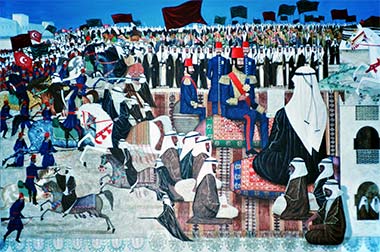
In 1903 the Sheikh of Qatar, Sheikh Qasim or Jassim bin Muhammad, asked the British if his application for protection by the British would be favourably met. It was suggested to him that there would be advantages to Qatar if this were to come about but, following discussions between the British and Turkish Governments, it was decided that the status quo would be maintained. The 1913 Anglo-Ottoman Convention, the 1914 Anglo-Turkish Convention, and the 1916 Treaty between Great Britain and Qatar confirmed British protection to Qatar, the latter being signed on the 3rd November 1916. Bear in mind that these negotiations were being made on the basis of the concerns leading up to, and current in the middle of the First World War.
The agreement required that Qatar would
- co-operate in the suppression of piracy and slavery;
- abide by the spirit and obligations of the Treaties signed with the other Gulf Rulers;
- prohibit the import and sale of arms – although the Ruler was permitted to purchase arms from a British warehouse in Muscat for his dependents;
- refrain from corresponding with or receiving foreign agents – unless with British permission;
- not grant pearl fishing concessions without British permission;
- limit taxes on imports of materials from Britain;
- protect the lives and property of British subjects in Qatar; and
- establish a British Post Office in Qatar.
For their part the British agreed to
- confer on the Sheikh ‘all the immunities, privileges and advantages what are conferred on the friendly Sheikhs, their subjects and their vessels’;
- protect Qatar from aggressions by sea; and
- protect Qatar from unprovoked acts of aggression by anyone not a subject of the Sheikh.
It should be borne in mind that, prior to the discovery and exploitation of oil, half of the population of Qatar was comprised of foreigners – Baharinah, Persians and Africans.
It should be mentioned here that there have been a number of difficulties relating to borders. In 1992 an incident at a border post with Saudi Arabia resulted in two deaths. Relations have improved and a commission established with a view to coming to an agreement on the exact line of the border. It should be noted in this context that Qatar has only a land border with Saudi; access to the United Arab Emirates has to be through a strip of Saudi which leads to the Gulf east of Qatar.
Finally, it should be recorded that the image of the painting on the wall of the Qatar National Museum, shown at the top of this note, was the object of a political incident. A Turkish minister, visiting the museum, is said to have taken exception to the manner in which the Ottomans were represented in the painting, apparently dealing arrogantly with the Ruler of Qatar. He argued that the presence of the Ottomans in the peninsula was not as occupiers but they were there for the purpose of safeguarding Islam. After consultations, the painting was removed…
Political agents and advisors

In the 18th and 19th centuries British interests in the Gulf – which had been founded on a series of treaties with the various tribal dynasties – were administered from India through an increasingly intricate system of relationships. The impetus for the British presence was considered to have arisen largely from the necessity to protect Anglo-Indian shipping from attack and the piracy common in the region. A British Resident was appointed, initially based at Bushire in Persia, to oversee the Political Agents who were gradually being established in each of the Arab Sheikdoms as they developed in their political significance. Between August and September 1946 the Political Resident relocated from Bushire to Bahrain and supervised Agents or Officers in Kuwait, Qatar, Abu Dhabi, Dubai, Sharjah and Muscat. Formal oversight changed officially from the Indian government to the British Foreign Office on the 1st April 1947.
Direct control by London was necessary following Indian independence and in 1960 Bahrain, Qatar and the UAE joined Kuwait and Muscat as independent states after the British failed to negotiate an agreement to a larger UAE Federation which would have included Bahrain and Qatar.
In the aftermath of the Second World War the British were taxed with the difficulties they perceived in finding methods of maintaining their interests with regard to the Heads of State within the Gulf, now a growing concern compared with their previous more laissez faire attitude. Bearing in mind the internal conflicts within the different countries, the differences they perceived with each other, and the sudden change in their economies with the opening up of the oil fields and the concomitant movement away from marine-based activities, the British found it increasingly necessary to develop and control their interests in the developing States.
With independence came the need for the British government to appear to keep a distance from the new Heads of State; this introduced the rôle of their Advisors. Bear in mind a Political Resident would have been a senior ranking political representative appointed from the Diplomatic Service; a Political Agent would have been a mid-ranking political representative, and the latter would have been senior to a Political Officer.
Change was now impacting the traditional social and political mechanisms particularly with the incoming expatriates required to effect the necessary developments. Charles Belgrave was appointed to Bahrain to advise the Rulers from 1926 to 1957 and Sheikh Ali bin Abdullah al-Thani in Qatar was advised by the British that he needed both a Political Officer as well as a personal Advisor.
While a junior and, perhaps, pliable individual was sought, it was Group Captain Phillip L. Plant, a senior Intelligence Officer who was eventually selected, taking up his post in early 1950. While he appears to have made considerable inroads into developing systems and structures in the peninsula, there were continuing differences between the Political Agent of Bahrain, Cornelius Pelly, and the Political Officer in Qatar from 1949 and reporting to Pelly, John Arthur Wilton, essentially complained at his lack of progress, incompetence and his closeness with Sheikh Ali who was thought by the British to be heavily influenced still by his retired father, Sheikh Abdullah bin Jassim, with whom he met daily. It is not insignificant that Plant was seen to favour an unequal distribution of State revenues between the Ruling family and others.
Dissatisfaction by the British with Plant’s behaviour and progress resulted in their asking Sheikh Ali to dismiss him. This he eventually did though asking to be ordered in writing – which it wasn’t, requesting rather than ordering him to do so.
Plant left in 1952 and his place was taken by Geoffrey Hancock in November of that year, remaining in Qatar until 1960, and getting on well with Sheikh Ali. Hancock was succeeded by the Egyptian, Dr Hassan Kamel who worked as legal advisor to the Government advising the Qatari ruler, Sheikh Ali as well as the young Sheikh Khalifa bin Hamad al-Thani who, at that time was Minister of Education having previously been the Director of Police and Internal Security and Minister of Education and, in October 1960 being designated Crown Prince, Heir Apparent and Deputy Ruler of Qatar; and in December 1960, Minister of Finance, assuming the rôle of Prime Minister.
Hancock’s move from the Sudan came at a time when the Foreign Office was devolving its control of Sudan to the Sudanese, this being completed with its independence on the 1st January 1956, and it is possible if not probable that the Foreign Office had a hand in his employment in Qatar.
Other British were introduced to the country, one being Ronald Cochrane who established an efficient police force – though one the Ruler was loathe to use against any serious issues with his own people, preferring his fidawiyya, these mainly being men of the Bani Murra and Bani Hajir tribes.
By 1955, the Political Adviser, Geoffrey Hancock, had an assistant, Willliam Wright who confirmed that Hancock had under his supervision three Heads: the Chief of Police, Ronald Cochrane, the Director of the Medical Department, Colonel Geoffrey Palmer, and the State Engineer, Hugh Hale, the Adviserate programme focussing on medical, educational, the supply of electricity and distilled water and, most recently at that time, road construction. It seems that Hale was responsible for later bringing into the country George Webster, Owen Phillips, Vic Lynch and Adam Scott, engineers and an architect respectively in order to begin the process of developing this necessary infrastructure. They worked in Qatar overseeing a significant body of works with a break from 1962 to 1965 when it was said there were insufficient funds available and they were returned to Britain. A year or so later, they returned to continue their work.

Ronald Cochrane arrived in Qatar on the 3rd September 1949, on loan from the Bahrain Police Force, his position being influenced by the British and with the remit to organise an effective police force. In addition to this he acted as a personal bodyguard to the Ruler and deputy to the British Advisor. The intention was to organise a two hundred strong unit with a British officer and four non-commissioned officers with four armoured cars at their disposal. It is likely that this was supported by Sheikh Khalifa bin Hamad with regard to internal control of the peninsula while reflecting British concern for safeguarding their oil interests.
By 1952 this group, now the State Police, were to guard both the interests of Petroleum Development (Qatar) Ltd. as well as provide a degree of security within the peninsula. With Hancock’s arrival the post of Political Officer was elevated to Political Agent, a subordinate position to the Political Resident in Bahrain.
Policing the country was difficult and the introduction of a State police fraught with problems, Cochrane preferring to employ Arabs from northern States, Yemen and Oman with no allegiance to Qatar and tribal badu. Underpaid and difficult to train they were initially unsuited to ordinary police duties. These issues, together with the pressures from British interests, the developing activities relating to oil, Sheikh Ali’s interests and competing irregular security groups employed by a number of members of the Royal family brought about a nervous breakdown on Cochrane.
The organisation of the British political interests in Qatar were not then as they are now; these were still colonial times. Geoffrey Maberly Hancock was not appointed directly by the British Foreign Office but had come to Qatar following time in Sudan where he had risen to a senior position, perhaps Governor, of Kassala Province, 1946-1950. It is not clear what he did between 1950 and 1952, nor how he was selected to be the Advisor to Sheikh Ali on the removal of Phillip L. Plant, though he is known to have been a popular and skilled Arabist. Hancock does not appear in the Foreign Office lists but would have been employed by the Sudan Political Service, directed out of Sudan at that time by the Governor-General of the Sudan, himself appointed by the Foreign Office and not the Colonial Office.
It is notable that there were serious disturbances in Qatar in the early part of 1963 with strikes and rioting on the streets with a nationalist and anti-colonialist character. This period saw a concerted effort by the British to ameliorate the situation by reinforcing their efforts to alter arrangements and develop institutions within Qatar. In addition to the physical infrastructure efforts were initiated to develop health care, education and finances.
It should not be thought that advice was given to the rulers only by the British. There were also international and national Advisors operating both openly and covertly as might, perhaps, be anticipated, many with commercial or financial benefits in mind. Qatari families competed for commercial interests with, for instance, Saleh al-Mannai advising Sheikh Abdullah bin Ali on issues relating to the oil company, but being supplanted in this rôle in 1953 by Abdullah Darwish who was also the government’s purchasing agent. Darwish contracted with the British Merchant Bank, C. Tennant, Sons & Co. Ltd. to purchase throughout Europe. Tennant was also responsible for interviewing some of the expatriate professionals now being sought.
The British government, through its Political Resident in Bahrain, had a number of objectives, these were to:
- maintain the existing relationship between the British Government and the Ruler of Qatar based on their treaty,
- create and maintain stable conditions for the production of oil,
- ensure that the revenues accruing to the State be properly disbursed or invested – note above,
- consolidate the authority and influence of British Advisors,
- develop a sound State administration, and
- create friendly relations between Qatar, the neighbouring British-protected States and Saudi Arabia.
The income from oil was now beginning to flow and Hancock was in the position of guiding Sheikh Ali in its disbursement, particularly with regard to the burgeoning State and its necessary development. A particular issue was how income should be treated. Hancock made a number of recommendations to Sheikh Ali, particularly suggesting that:
- the considerable funds used to send nationals for medical treatment abroad should be reduced or stopped and national faciliities improved instead, this incidentally created social issues with Qataris no longer being able to have the elders of their qabaa’il requesting these trips from ministers,
- young Qataris being educated and trained to take over the jobs held by foreigners,
- a Department of Labour be established,
- users of electricity and water should be charged in order that the operation of the utilities should be economical, and
- the Police Department should be able to function without fear or favour.
Bear in mind that the financial benefits from oil had yet to make a real impact, the advisors making recommendations based on a relatively slow rate of wealth growth. Incidentally, this was the approach governing the planning advice given in 1973 by the planning firm, Llewelyn-Davies, Weeks, Forestier-Walker and Bor.
Other improvements were made under Hancock’s term in the peninsula. Goods shipped in to Umm Said had been brought by lighters to the shallow waters of Doha and brought directly to the land of the main merchants there, but a channel was dredged and a jetty created in the 1950s; the airport was developed at Doha, taking over from three smaller fields at Doha, Umm Said and Dukhan; the Chartered Bank was established in 1953 closely followed by the British Bank of the Middle East and Grindlays Bank with Government funds being deposited at the Qatar National Bank; the health and education facilities were expanded; a postal system was introduced and much else was initiated in that period…
Note that a Political Officer was subordinate to a Political Agent, Arthur J. Wilson being the first Political Officer in Qatar. The Political Officer in Qatar reported to the Political Agent in Bahrain who, in turn, reported to the Policial Resident.
To clarify the sequence of British Political Officers, Advisors and the first Ambasador, this list has been drawn up from a variety of sources with the assistance of a retired Ambassador and reconciled with an online source which has some appointments missing. It is possible that there may be others who were temporarily appointed:
Sheikh Ali bin Abdullah al-Thani abdicated on the 24th October 1960 due to a range of issues, many of them relating to unrest in the country, both within the ruling family as well as the national and expatriate general populace. Having nominated Sheikh Khalifa bin Hamad as Heir, Sheikh Ali abdicated in favour of his son, Sheikh Ahmed bin Ali al-Thani. The position of Advisor was terminated by the British and Sheikh Khalifa bin Hamad became the de facto Advisor to the State.
more to be written…
The development of local interests

As mentioned above, there were a variety of those interested in the coming development of the peninsula other than the British. Lebanese and French involvement was developed in the main later by Sheikh Khalifa bin Hamad al-Thani with the intent of moving the management of the State into Arab hands rather than European or American, both of whom were involved in the development of the oil deposits through Petroleum Development (Qatar) Ltd, a subsidiary of the Iraq Petroleum Company. Much of what follows is taken from a political note made by an American Consul in 1950.
The oil wells in Qatar had been cemented over during World War II with the field only coming on stream again in 1946. A pipeline was laid across the peninsula from the field at Dukhan to Umm Said where a terminal was built enabling tankers to load. By 1949 the field was producing around 165,000 tons per month, bringing an income to the State of around $100,000 per month, equivalent to around £20,000 at that time. In 2025 that Dollar value equivalent would be around $1,300,000, and Sterling around £4,500,000.
Prior to Qatar establishing its own banking structures, this income was placed in the newly opened (1950) Eastern Bank, later taken over by Standard Chartered, and was proportioned in four quarters to:
- the Ruler, Sheikh Ali bin Abdullah al-Thani,
- a civil list, these being for the relatives and retainers of Sheikh Ali,
- for long-term investment, and
- for pubic welfare and local improvement projects.
Apart from Sheikh Ali’s quarter of the income, every other disbursement had to be signed off by both Sheikh Ali and Plant. Although Plant had a significant amount of funds theoretically at his disposal, his approach to the development of the country and the disbursement of funds was apparently restrictive, which is probably the reason for his being replaced by Hancock in 1952.
One project Plant did initiate, was the construction of a road along the bay which made accessible to the bay half a dozen jetties belonging to merchants, increasing their value substantially. This particularly benefitted Saleh al-Mana. Plant also oversaw the construction of the stone-filled jetty joining it but was blocked by Sheikh Ali in his wish to drive a road through the centre of Doha along wadi sail.
At that time, 1950, the population of the country was around 15,000 Qataris and 10,000 expatriates with very few Qataris working in executive positions, the expatriates holding nearly all the economic and commercial positions. Although a later wish of Sheikh Khalifa appeared to be to bring in Arabs to replace British controls, the British were of the opinion that the Lebanese and Syrians were disliked for their contempt of the backward Qataris, and that they might be replaced by Pakistanis who would be assimilated into the Qatari population.
There is not much written on these pages about the way in which Qataris met, discussed and made decisions. Those were the days when face-to-face meetings were the main source of news, information and decision making. The learning and dissemination of information and decisions was an intricate operation with much of this taking place in majaalis. Most of the Political Officers would have met the Ruler and others on a daily basis, a process where each would have learned much about the other. While this, mainly, political activity was in process, Qataris, particularly merchant Qataris would also be involved in a similar process, one which mixed political, economic and commercial interests. This created opportunities as well as tensions which lasted well into the twenty-first century.
For instance there were riots in Doha in March 1956 caused by the conflation of two issues:
- anti-British and anti-American sentiment linked to the Suez crisis and the broader Arab nationlist movement of the mid-1950, and
- pay and living conditions of the oil workers.
A number of people were injured with some reported to have died. The riots spread outside Doha being focussed mainly on expatriate activities and Qatari merchants, particularly the Darwish. What is unusual about the rioters was that a number of Qataris joined the disturbances, expressing their grievances at the wealth from oil not being reflected in better conditions for themselves, and irritation with expatriate controls. Many expatriates were evacuated.
The riots shook Sheikh Ali and the ruling family as this was the first time ordinary Qataris had acted collectively. Tighter policing controls were now established, both nationally and individually, and the influences of the Darwish and al-Mana weakened.
As mentioned above, Sheikh Khalifa held a number of positions both formally and informally. As a member of the al-Thani family he would have been involved in family and tribal affairs and learned much about governance and administration under the guidance of elders of the family. This was a time when there were still difficulties with other tribes in the peninsula, particularly the al-Na’im, as well as the continuing problems with Bahrain and within Qatar. While records for this period are scarce he would most likely to have been responsible for administration of some areas of the peninsula, a typical method for the Royal family developing skills in leadership.
In 1950 he was eighteen but this period from the mid- to late fifties would have seen him involved in local disputes, land issues and tribal administration as well as informal involvement with diplomatic and economic matters. In particular, he would have witnessed the manner in which British interests in Bahrain and Qatar would have influenced local issues and arbitration. The last couple of years of the 1950s would have seen him involved in oil policy decisions. 1960 saw him appointed Heir Apparent and Crown Prince as well as Minister of Finance and Economy.
At the turn of the 1950s there were noted to be two Qatari cliques vying for influence with Sheikh Ali bin Abdullah; these were represented by Saleh al-Suleiman al-Mana and the Darwish family, represented by the three brothers, Abdullah, Jassim and Abdulrahman.

Saleh al-Hamad al-Mana was born in Saudi Arabia but moved to Qatar early in his career. A sophisticated and cosmopolitan Qatari he developed extensive land ownership in Doha as well as establishing a number of profitable businesses. He acted as Councillor of State to Sheikh Ali but, by the end of the 1950s was thought to be losing his influence with the Sheikh, perhaps with the extension of his business interests outside Qatar, and his developing a house in Bahrain, the suspicion being that he might be intending to retire there. It is not known if the possibility of moving to Bahrain was the cause of the weaking of his ties to Sheikh Ali, or the result of the weakening, but it is certain that he was increasingly having to compete for favours, concessions and influence with the Darwish family in advising Sheikh Ali. By the early 1950s the Darwish family had a strong foothold in Qatar with their being agents for Petroleum Development (Qatar) Ltd, supplying labour, housing, water and a variety of goods needed for development.
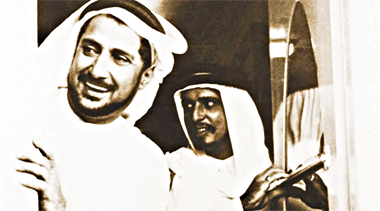
By contrast with Saleh al-Mana, the Darwish family were not thought to be as cosmopolitan but were at this time the most important mercantile and financial group in Qatar, to the extent that they were even seen to be competitors to the Ruler’s and the al-Thani family’s interests. The British, who hoped to inveigle themselves into increased influence with the Ruler kept their distance from associations with the Darwish. The Darwish had been and still were major players in the pearl industry, which was one of Qatar’s main economic pillars at the time. As Qatar faced challenges from the British and internal political dynamics, the Darwish family’s economic backing helped stabilise the country, particularly as Qatar began its transition from a pearl-based economy to one that was oil-dependent after the discovery of onshore oil at Dukhan in January 1940.
Qatar’s merchant families, particularly the al-Mana and Darwish, supported the al-Thani family in a symbiotic relationship; they were key financial backers as well as managing trade networks in the region. But times were changing. The discovery and development of oil brought Qatar into the global economy where oil companies and foreign interests were developing, and the al-Thani had less need to rely on the mercantile families previously supporting and advising them.
more to be written…
Qatar’s border with Bahrain
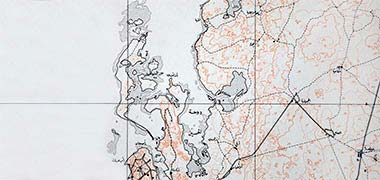
In addition to Qatar’s difficulties with Saudi Arabia, there have been continuing problems with Bahrain. The main ones relate firstly to a number of islands and reefs, the chief one being the Fasht al-Dibal reef, north of Qatar and east of Bahrain due to its proximity to the North Dome gas field. But the teritorially more serious problem was Bahrain’s claim to the Hawar Islands, a group close and immediately off the north-west coast of Qatar. In this partial map of the west coast of Qatar, the extremely close physical relationship there is of the islands to the Qatar peninsula can be clearly seen.
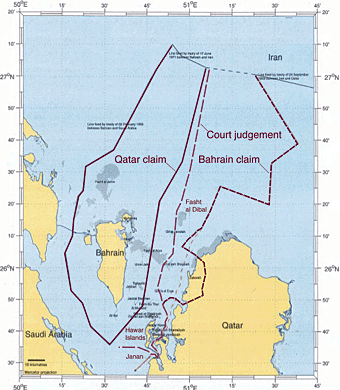
With its smaller land mass compared with Qatar and continuing simmering historical irritations, the nineteen-eighties saw Bahrain surreptitiously place a permanent garrison of troops on the islands and carry out military exercises there. This created obvious difficulties as the area was a fishing ground and used by nationals from both Qatar and Bahrain. There were a number of minor conflicts resulting in concern by the State and its inhabitants, both nationals and expatriates. The two States, with the encouragement of Saudi diplomacy, endeavoured to reach an agreement but failed to resolve the issue politically. Eventually, with what they believed to be a very strong case, Qatar decided to take the case to the International Court of Justice in 1991.
Initially Bahrain disputed the Court’s jurisdiction to hear the case, but the Court decided against Bahrain in 1994, and the case moved slowly ahead with submissions, counter-submissions and public hearings.
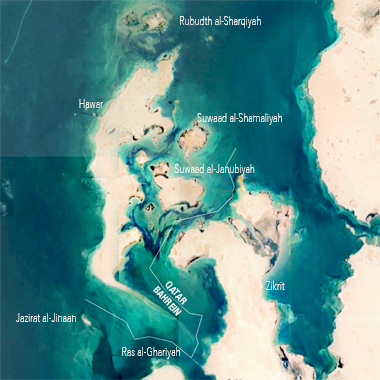
Although the proximity of the islands to Qatar is so close that natural inclination suggests they should belong to Qatar – and this was part of their case – on the 16th March 2001, the Court found for Bahrain, though disallowing the latter’s claim to the Jinaan island south of Hawar as well as Bahrain’s claim to land on the Qatar peninsula – including Zubara. The Court did, however, confirm that Qit’at Jaradah, between Bahrain and due east of the north top of the Qatar peninsula, should come under the sovreignty of Bahrain, despite its really not considered to be an island; but Qatar retained Fasht al-Dibal, close to Qatar’s North Dome gas field and the location of the April 1986 military excursion by Qatar. [It can be seen west-north-west of the top of Qatar in the second map above]. Qatar was also able to retain or acquire significant maritime areas together with their valuable resources.
Qatar was severely disappointed at the Court’s decision by what they saw as an obvious miscarriage of natural justice, knowing that much of the documentation used by Bahrain stemmed from the biased historical records made by the British when their representatives sat on Bahrain and avoided visiting Qatar for which they had little regard due to its being uncomfortable and far less developed than Bahrain at that time.
To reinforce their possession of the Hawar islands, Bahrain, as of the writing of this note in 2025, is considering the construction of a 23 kilometre causeway to the islands, both to reinforce its internationally legalised position, as well as with the intent of developing it for tourism. The islands maintain a delicate ecosystem which might be suited to minimally disruptive tourism, but would be open to abuse if unrestricted and unpoliced.
In March 2010 another incident involving Qatari coastguards injuring a Bahrain fisherman reminded both countries of the fragility of the Court’s resolution and put a hold on an initiative first considered in Qatar in the 1980s but revived perhaps more seriously in 2008 – that of a link between Qatar and Bahrain for both road and rail systems. Essentially this could be envisaged as an extension of the Saudi to Bahrain King Fahad Causeway and would cross from the north of Manama to the Qatar peninsula a little north of al-Zubarah. Diplomatic crises of the early 2020s, together with rising costs of the project have placed it on hold, but it is still being considered a viable regional development.
Qatar’s southern border
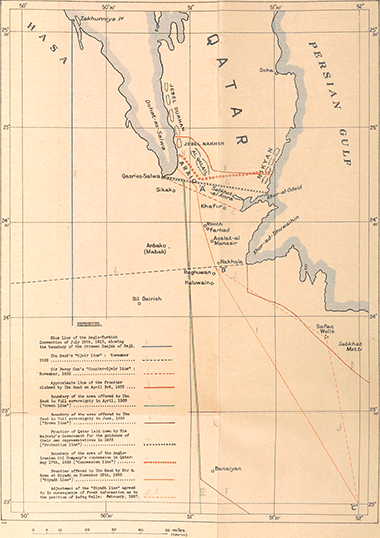
For those who lived on the east side of the Arabian peninsula, borders were not officially marked but were porous, with nationality and ownership dependent upon tradition and custom. As well as the issues relating to sovereignty of land and the borders disputed with Bahrain mentioned above and elsewhere, Qatar also had historical difficulties over its border with its southern neighbour, Saudi Arabia.
The peninsula was made a British protectorate in 1916, and issues such as those relating to the exact location of the land border with the Arabian hinterland created the setting for strong national and international debate. The British government, in effect, supported Qatar in many of its disagreements with its neighbours – as touched on in notes above – but needed to be seen to be impartial in what was, originally, a dispute created not by sovereignty, tradition and custom, but by the possible locations of productive oil fields and the wealth that might flow from them.
Following the First World War, and Turkish interests in the area being brought to an end, the possibilities of oil being located in the region became an increasingly strong focus for the international communities with British and American interests competing for access and development. The Anglo-Persian Oil Company and the California Standard Oil Company wished to search for oil, the former in the Qatar peninsula, the latter in Saudi Arabia. Following requests in 1922, a lease was granted in Qatar by Sheikh Abdullah to A.P.O.C. in 1926. The resulting explorations in 1933 discovered similarities in the geologies of Qatar and Bahrain, where oil had been discovered previously, and a seventy-five year concession was signed in 1935.
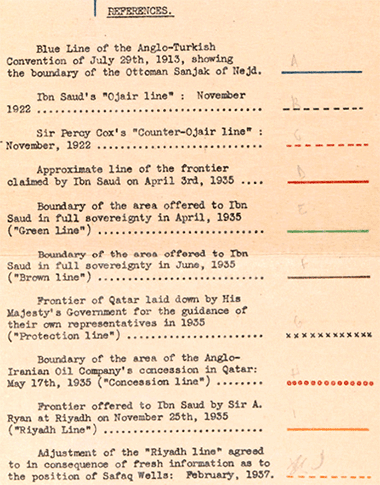
The exact demarcation of their boundaries was an obvious requirement for both Qatar and Saudi Arabia, but initial attempts had been at best imprecise. The map above illustrates a number of attempts between 1922 and 1937 made by the different parties to settle on a mutually agreeable location for the border and were almost literally lines in the sand, taking little recognition of the interests of those who lived in and around the area.
At a meeting between the King, Ibn Saud and Percy Cox, Britain’s High Commissioner in Iraq, in 1922, the King showed Cox a map upon which a blue line had been drawn east from Khor al-Dhuwaihin indicating the extent of the Hasa concession agreement he had reached with Frank Holmes who was representing American oil interests earlier in the year. Cox, irritated, had crossed out the blue line and drawn a red line across the bottom of the Qatar peninsula from Khor al-Udeid to Qasr al-Salwa specifically excluding the peninsula from the California Standard Oil Company interests.
This was countered by Ibn Saud in 1935 with a line significantly within the peninsula. Two counter-offers were made by the British later in the year. It appears that the British government were working to a notional protection line from Qasr al-Salwa to a point on the east peninsula north of Khor al-Udeid. Within this line a concession was agreed on the 17th May 1935 with A.P.O.C. Further adjustments to the border were made later in the year and in 1937 – all of these lines shown on the map above. But it took some time to come to an internationally accepted line, not shown on this map.
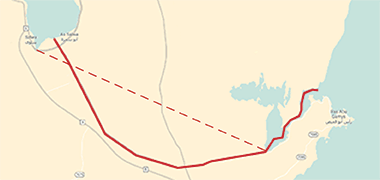
This rough sketch map is of the junction of the Qatar peninsula with its Arabian hinterland to the south. It illustrates an approximation of the position of the modern border between Qatar and Saudi Arabia, comparing it with the dotted red line which represents the line drawn by Sir Percy Cox to counter the proposal for the border made by King Ibn Saud in 1922. This map can be compared with that above.
It is notable that all the lines were contained within the land and did not project into the Gulf.
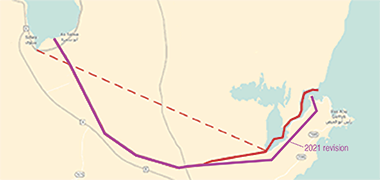
2021 saw a considerable thawing in the relations between Saudi Arabia and Qatar with a number of pending issues being revisited. In late 2021 it was announced that the border demarcation issue had been resolved in a sense to the benefit of Qatar at Khor al-Udeid. This has seen the border between the two countries being moved south from the centre of the marine entrance to the khor, Qatar now owning the whole of the khor.
more to be written…
Independence
These links with Britain continued until 1971 when a treaty of Independence was signed. This placed Qatar on a similar legal footing to the other Emirates of the Arabian Gulf – Kuwait, Bahrain and the United Arab Emirates which comprise the Emirates of Abu Dhabi, Dubai, Fujaira, Sharjah and Khor Fakkan. In addition there is Oman facing the Indian Ocean and ruled by a Sultan, and the Sultanate together with the Emirates are backed by the Kingdom of Saudi Arabia to their north and west.
In focussing on the Gulf it has to be borne in mind that the Arab world extends considerably further than the Gulf and that there are different perceptions within this world of the history and status of the various countries of the region. In particular there is a widespread Arab belief that
- the present boundaries were artificially drawn by the West;
- that many of the regimes do not have a proper legitimacy; and that
- within the Middle East, the newly recognised Gulf States do not have the rights earned by their northern neighbours. The influence of the West is particularly felt in their imposition and support of the State of Israel and their desire to benefit from the wealth of oil and gas.
By comparison, the Western states collectively appeared to believe that, despite the rhetoric of Arab unity, the Arab states are a disparate grouping at best, with conflicting goals and policies – many of them based on jealousies, dimly remembered slights or misconceptions. The argument is that it follows that Western states with their need to benefit from the oil and gas reserves of the region will continue to arrange matters to suit themselves. In this there is bound to be a conflict with the different Arab states with their desires to conform to a pan-Arab ethic. The Iraq/Kuwait conflict and now the Iraq problem demonstrates the various issues relating both to the conflict between the West and the Arab world, and to those between the Gulf states generally and their northern neighbours. This is a turbulent area.
In the context of the difficulties inherent in the geography and politics of the region, I should also mention the nineteenth century Lord Palmerston’s wish to place a state of Israel in the region in order to bring wealth to the area as well as acting as a counter to any Egyptian initiatives. More dramatically, in 1907 the British Prime Minister, Campbell-Bannerman, recognising the hidden assets of the region, declared his belief that, were the Arabs to come together in a single state, they would form a block to the access between Europe and the Far East, and that a body should be planted there in order to thwart this.
The West’s interest in the Middle East
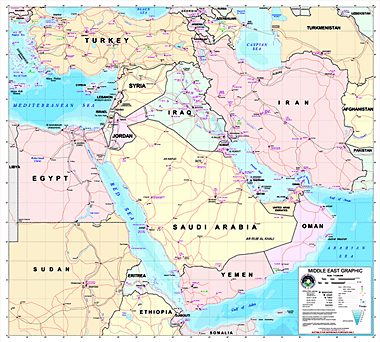
It is not my intention to write about the politics of the Middle East, but a few notes on its history might be useful to help flesh out the background to this troubled area with a view to giving context and perspective to the Gulf states. Mostly, these notes are based on entries in Wikipedia. While this is not a source recommended by academics, it appears to be clear enough to provide in more detail a fuller and more accurate understanding of any or all of the countries briefly mentioned below. The map to the side is there only to provide a basic indication of the area. For more detail, read the Wikpedia entries and other articles and books on the region. In particular you should be aware that the map changes every few years or so during the twentieth century. The more different sources you review, the more likely you are to gain a better understanding of the events of the last hundred years or so.
It is a very well-documented argument, if not belief, that most of the difficulties in the region stem from the West’s sub-dividing the area in their own interests after the First World War. In this they cut across ethnic and national borders, artificially creating states, dividing peoples and reneging on promises made to their allies. Much of this was encompassed within the twelve points of the Sykes-Picot Agreement of the 16th May 1916 between – in the main – the British and French, represented by Sir Edward Grey and Paul Cambon.
It was argued that this was an attempt to stabilise the Middle East by re-organising the Middle East territories and selecting leaders who, it was thought, would give the region the stability the West required. Oil wasn’t mentioned in the Sykes-Picot Agreement, though it had been found in Persia in 1908. It wasn’t until 1923 that it was discovered in Iraq and became a dominating issue in the collective minds of the West.
Returning to the end of the First World War, on the 28th June 1919, the Treaty of Versailles was signed, putting an end to German ambitions, and to its partner, the Ottoman Empire. It established mandates for France and Britain over the ‘Fertile Crescent’, that region of the Middle East stretching from the head of the Gulf, and including much of what is now Iraq, Syria, Lebanon and Palestine, and following the line of the Tigris and Euphrates rivers.
The next year, 1920, the San Remo Conference completed the process of dividing up the Middle East. France was given mandates for Syria and Lebanon, while Britain was given mandates for Iraq, Transjordan and Palestine. Two issues should particularly be noted as they contain much of the seeds of present discontents: sunni and shi’ite interests were not separated, but mixed; and the Kurds were spread through Syria, Turkey, Iraq, Iran and Armenia.
Brief state histories
There follows, in alphabetical order, a brief modern history of the main countries in the Middle East with relevance to the Gulf. Countries of the Maghrab, Africa and Indian sub-continent that might be thought to have an influence, have not been included:
Bahrain
Bahrain is a group of islands situated north-west of the north coast of Qatar. Its recent history really begins with the eighteenth century British involvement in supporting the Al Khalifah family in their liberation of the islands from Persia. This brought the British firmly into the Gulf, with them establishing residency on Bahrain. Persia and, latterly, Iran still lays claim to Bahrain.
Bahrain continued as the focus of British interests in the Gulf with oil being found and the lives of Bahrainis being improved through government expenditures and firm social policies as in the rest of the Gulf states.
Following the Second World War there was anti-British sentiment leading to rioting which was heavily put down. Despite this, development proceeded, though not at the same rate as in Qatar, for instance. But, in the 1960s this led to Britain requesting the United Nations to resolve the issue of Bahrain’s future. This they did through a plebiscite, the results rejecting Iran’s claims and the Bahrainis holding themselves to be Arabs, culturally.
Britain left Bahrain in 1971 under the control of the Al Khalifa family. Development continued, funded by the revenues from oil but the downturn in the economy of the 1980s forced Bahrain to diversify. Meanwhile the Iranian revolution was felt in Bahrain with a failed coup attempt intending to install an Iranian based cleric operating a theocratic government.
The mid-nineties saw rioting again, this time with Shi’ites upset by the dress of sportswomen and, later, sporadic violence leading to the deaths of over forty people. In 1990, Sheikh Hamad bin Isa Al Khalifa succeeded his father as head of state, and introduced a number of progressive policies. In particular, 2002 saw women being given the vote.
Bahrain remains a focus in the Gulf with its highly developed transport and communication links. However, depleting fresh water and oil reserves, together with continuing unemployment cause difficulties that have not been alleviated with the construction of a permanent causeway linking Bahrain with Saudi Arabia as had been hoped.
Egypt
The importance of Egypt in the region is due to a number of reasons, not least of which is the Suez Canal. Completed in 1869, it enables shipping to move from the Far East to the Mediterranean and, thence, the Atlantic, without having to sail around the Cape of Good Hope, shortening the distance between the Far East and Europe considerably.
Britain seized control of Egypt in 1882, ostensibly to protect British investments in the country which was badly in debt. Nominally, Egypt continued as a part of the Ottoman Empire until the beginning of the First World War.
The various agreements in the Middle East following the First World war brought semi-independence to Egypt in 1922. From 1924 to 1936 there were attempts to model a constitutional government along Western lines as was being attempted by Kemal Ataturk in Turkey. However, these attempts failed though full independence followed after the Second World War.
King Farouk, the constitutional monarch was deposed by Gamal Abdul Nasser’s revolution in 1952 and his son, King Ahmed Fouad II established in his place. General Muhammad Naguib became the first President of the new Egyptian Republic in June 1953, but resigned in 1954 in favour of Gamal Abdul Nasser. The West attempted to meet the perceived threat from the pan-Arabisim that they believed Nasser represented, instituting the Baghdad pact in 1954 which included Turkey, Iraq, Pakistan, Iran and Britain with the United States belonging to the crucial military, economic and counter-insurgency committees. The West’s attempts to frustrate Nasser ended with the Suez fiasco – organised between Britain, France and Israel in 1956 – and which succeeded in enabling the Arab world to align themselves against the common Western threat. Egypt and Syria combined to form the United Arab Republic in 1958, but Syria withdrew in 1961.
Nasser was succeeded by President Sadat and, upon the latter’s assassination, by President Hosni Mubarak in October 1981. Internal pressures continue in Egypt but, in September 2005, democratic elections are being held.
Iran
On the other side of the Gulf from the Arabian peninsula, the Qujar dynasty ruled from 1796, when it took over from the Zand dynasty, until 1921. During the nineteenth century, Persia came under the influence of both the Russians and British empires, the former taking over some parts of the northern regions and the British the south with its oil deposits.
The West influenced the Qujar Shahs, in 1906, to try to modernise, but internal disaffection saw Muhammad Ali Shah deposed in 1909 by Ahmad Shah for attacking the newly developed constitution.
In 1917 British troops invaded Russia in an unsuccessful attempt to counter the Russian Revolution and support the Tsar, a relative of the British Royal family. Reza Khan, a Cossack officer, deposed Ahmad Shah Qujar in 1921, declared himself Shah and establishing a new dynasty in 1925 under the name of Pahlavi.
Reza Shah began a programme of modernisation intending to create an industrialised and urbanised country, operated by an educated population and one that would have a distinct presence in the modern world. In 1935 the name, ‘Persia’, was changed to ‘Iran’.
The Shah was by nature, dictatorial, a characteristic that became increasingly disliked by many in the new Iran. His increasing unpopularity was exacerbated by his policy of not awarding contracts to British and Russian companies because of their colonial history with Persia – as well as because the Anglo-Iranian Oil Company controlled all Iran’s oil resources – though this, itself, was a cause of resentment to many Iranians. A number of the Shah’s engineers were Germans and, with the outbreak of the Second World War, Britain insisted that the Germans leave as they would be essentially, spies for Germany. The Shah refused as he was concerned their leaving would affect his development projects.
As a consequence, Britain and Russia, now allies, invaded Iran, arrested the Shah and sent him into exile. In 1942, the United States sent troops to Iran to maintain the railroad system which supplied materiel to Russia. The allies allowed the Shah’s son, Muhammad Reza Pahlavi, to succeed him to the throne in September 1941, agreeing to leave Iran within six months of the end of the war. Though the Russians initially refused to make a similar agreement they left in May 1946 but the fluid political system, caused in some measure by the allies permitting, if not encouraging, the existing systems to deteriorate, helped fuel the Cold War.
The new Shah continued to develop the country along the lines his father had begun but found himself in conflict with the Prime Minister, Muhammad Mossadeq. His interests brought him into increasing conflict with the government and, following a failed assassination attempt in 1949, he strengthened his position by expanding his constitutional powers. This was again unpopular and, in 1951, Mossadeq forced the nationalisation of the Anglo-Iranian Oil Company. He was consequently removed by the Shah but returned almost immediately. The Shah fled Iran and supporters instituted a coup in August 1953 against Mossaddeq, assisted by the British and Americans.
With the finances achieved by Mossadeq’s nationalisation of the oil company, the Shah financed a series of populist reforms, particularly the 1963 White Reform, relating to land reform, voting rights for women and the elimination of illiteracy. In addition, he used his security organisation to suppress opposition. These initiatives succeeded in uniting a variety of interests against him ranging from those wanting unionisation to the religious hierarchy fearing marginalisation. He compounded this with an extravagent celebration of 2,500 years of Persian monarchy in 1971 and the replacing of the Islamic Calendar in 1976 with a solar, Imperial calendar. This, together with his association with the West brought about the uprisings of 1978 and 1979 and the return of the fundamentalism of Ayatollah Ruhollah Khomeini in 1980.
The Iranian Revolution transformed Iran from an autocratic pro-west monarchy to an Islamic, populist, theocratic dictatorship under Ayatollah Khomeini.
Iraq
The League of Nations established Britain’s mandate in Iraq following the First World War, independence being granted in 1932. In Iraq king Faisal of the Hashemite monarchy ruled until his death in 1933 when he was succeeded by his eldest son, Ghasi, who died six years later in a car accident.
Ghasi’s son, Faisal, was only three at the time and his duties were assumed by his uncle, the regent Prince Abdullah. In 1953 Faisal became, at the age of seventeen, King Faisal II. Five years later the King was deposed in the 14th July Revolution by General Abdulkarim Kassem who instituted a repressive regime. General Kassem, in turn, was overthrown by a group of officers under Colonel Abdul Salam Arif in 1963 and executed in 1968. Salam Arif died in 1966, the Presidency being assumed by his brother, Abdul Rahman Arif.
Abdul Rahman, in turn was overthrown in 1968 by the Arab Socialist Ba’ath regime, established by General Ahmad Hasan al-Bakr who became president, followed by Sadam Hussein who seized power in 1979 killing many of his opponents.
The Iran-Iraq war began along their long, joint border in 1980 and dragged on for eight years before ending in stalemate, draining the country of its wealth and resources. This was followed by Hussein’s campaign against the Kurds in the north and the Marsh Arabs in the south. Iraq has only a small access to the Persian/Arabian Gulf at Umm Qasr, immediately to the east of Kuwait and, in 1990, invaded Kuwait, which resulted in the Gulf War.
Sadam Hussein was deposed by Western powers in 2003 and an interim government established. With the different ethnic and religious interests in the country all wanting autonomy – the Kurds in the north, the minority Sunni around Baghdad and the Shi’ite s – representing 60% of the population – in the south – the future of Iraq in its present state is tenuous.
Now, there is the possibility of the Kurds breaking away, taking with them the oil-rich city of Kirkuk and, perhaps, associating themselves with the Kurdish minorities in Turkey and Iran; the Shi’ite s are strongly supported by the regime in Iran, have oil reserves and would control access to the Persian/Arabian Gulf; and the Sunni minority would be left with the centre of the country and a fear of repercussions caused by their treatment of the Shi’ite s and Kurds under Sadam Hussein.
Israel
Much of the background that would be written here can be read below on the section relating to Palestine. The main point to bear in mind is that Jews consider the Land of Israel to be their home both as a Holy Land and as a Promised Land.
The Jewish population of the area was relatively small for some time, the first wave of Jewish immigration starting in the late nineteenth century as Jews fled persecution in Europe. In 1917 the Balfour Declaration stated that there should be a homeland for Jews in Palestine and the British-administered mandate for Palestine was established in 1920. Between the wars immigration continued, rising more strongly with the impending Second World War.
By 1939, Palestinian pressures caused the British to reconsider their commitments to the Jews and produced the 1939 White Paper capping Jewish immigration and positing a shared government for Jews and Arabs.
The Holocaust in Europe led Jewish interests to increase illegal immigration into Palestine and violence escalated with the assassination of Lord Moyne in Cairo in November 1944. The British continued to prevent immigration and in 1946 their administration in the King David Hotel in Jerusalem was blown up with the loss of ninety-two lives. The British withdrew in May 1948, terminating their mandate.
The United Nations’ plan was to partition the area giving approximately half each to the Jews and Arabs, while leaving Jerusalem under international control. This was not supported by the surrounding Arab states and, following the proclamation of the State of Israel in May 1948, the Arab states attacked resulting in Israel gaining more land west of the Jordan and annexing it to its new State.
More immigration has been encouraged into Israel and there has been increasing levels of violence on both sides. It is believed by many that the difficulties in the Middle East would be diminished if not overcome, were there to be an equitable solution found to the settlement of the Palestine/Israel problem.
Jordan
The rulers of Transjordan – which became known as Jordan in 1946 – and Iraq were established from two of the sons of the Sharif of Mecca, Hussein Ibn Ali – a friendly ruler of the Hashemite dynasty, tracing their history directly back to the Prophet. In 1922 the British established the semi-autonomous Emirate of Transjordan. Abdullah was made its Emir while Faisal was installed as the King of Iraq. In May 1946 the mandate ended and Abdullah proclaimed himself King.
Transjordan assisted the Palestinians in their opposition to the creation of a State of Israel and, following the armistice of April 1949, settled behind borders of the West Bank as the Hashemite Kingdom of Jordan in 1950. Abdullah was assassinated in 1951 by a Muslim fundamentalist. Abdullah was succeeded by his eldest son Talal but, proving to be disbalanced, he was deposed by the national assembly who replaced Talal with his son, King Hussein who ruled Jordan from 1953 to 1999. He, in turn, was succeeded by his son, King Abdullah II.
Jordan again went to war with Israel in conjunction with Egypt, Iraq and Syria in the June 1967 war, losing control of the West Bank and Jerusalem for its pains.
1970 saw open warfare break out between Jordanian and Palestinians due to the strain brought about by the massive increase in Palestinians following Arab losses in the wars with Israel. This warfare ceased in July 1971 with a conclusive victory by the Jordanians.
In 1988 Jordan officially renounced claims to the West Bank and in 1994 agreed to a continuing rôle in Muslim and Christian holy places in Jerusalem. However, these interests are being rapidly eroded by events on the ground.
Jordan has made peace with Israel in the Washington Declaration of July 1994, and the Jordanian-Israeli Peace Treaty of October 1994. It now occupies a moderating rôle in the Middle East and has embraced democracy with free elections.
Kuwait
Kuwait was settled in the sixteenth century by clans from the Al Aniza tribe of Najd in central Arabia via a relatively short stay in Qatar. The eighteenth and nineteenth centuries saw the establishment and development of trading first in spices and, later, pearling before the influx of Japanese pearls brought this to a halt in the 1930s.
The Ottoman Empire incorporated Kuwait as they did much else in the Gulf, with Kuwait becoming a British Protectorate in 1899. It was one of the earliest of the Gulf states to develop its oil resources, to the extent that by 1953 it was the largest exporter of oil in the Gulf. The wealth this brought enabled Kuwait, in June 1961, to be the first of the Gulf states to declare its independence.
Iraq took exception to this as it considered Kuwait to be a province of Iraq and threatened to invade. This was deterred by Egyptian pressure. In the Iran/Iraq wars of the 1980s Kuwait sided with Iraq due to Kuwait’s wish to avoid the influences of shi’ite iran.
August 1990 saw the invasion of Kuwait by Iraq, the excuse being twofold: that, as they had made clear earlier, their position was that Kuwait was a province of Iraq and, secondly, that Kuwait had been slant drilling into disputed territories – and taking Iraqi oil illegally. With the backing of the United Nations a large coalition of troops invaded and occupied Iraq in 1991, driving out the Iraqi forces from Kuwait who, in withdrawing looted and caused considerable damage to the whole of the country and its oil installations. The fires took nine months to put out.
The state has rebuilt much of the damage caused by Iraq and development continues. The Emir, Sheikh Jabir al-Ahmad al-Jabir al Sabah, is liberalising some of the state’s laws, particularly those that only permit 15% of the population to vote. Women’s suffrage has recently been given, effective for the 2007 Parliamentary elections, and subject to Islamic law, and there is now a female minister appointed to the Cabinet.
Lebanon
Lebanon’s constitution was drawn up in 1926 and was based on a careful balance of power between the major religious groups. It became independent in 1943 with the French leaving the country in 1946. For a period, Lebanon prospered with the focus being Beirut and its rôle as a regional centre for commerce and trade. It was a vibrant, popular capital, and an important entrepôt to the rest of the area.
However, the influx of Palestinians following the 1948 and 1967 Arab-Israeli conflicts brought disaffection between them and the Lebanese to a head. The resulting civil war of April 1975 left Lebanon with no effective government and the different factions continued their chaotic and destructive warring. In 1976 the Syrians sent in troops to bolster the Maronite forces of Bashir Gemayel, head of the Phalange party, who was fighting a coalition of Palestinian, Sunni and Druze irregular forces. However, the Maronites came to believe that the Syrians were there more in their own interests – that were seen to be both strategic and to do with the drugs grown in the Beqaa valley – and fighting broke out between them.
In 1978, Israel attacked due to cross-border raids based in Lebanon, withdrawing two weeks later in response to a United Nations resolution. They invaded again in 1982 establishing a presence in the south but their position being weakened when the Phalangist leader thought to be sympathetic to Israel, President-elect Bashir Gemayel, was assassinated. There followed considerable turbulence with increasing terrorism developing.
Israel retreated from Lebanon in 2000 in accordance with the UN 1978 resolution and, eventually, Syria withdrew in early 2005. Some degree of normalcy is returning to Lebanon with considerable development started.
Libya
The Ottoman Empire included Libya by the nineteenth century, its previous history being under the control of Arab Muslims since they conquered the area in the seventh century. Italy took control of Libya in 1912 and, following the Second World War, it was granted independence as a condition of the Allied peace treaty with Italy.
King Idris, Libya’s ruler, was deposed by Colonel Muammar al Qadafi in 1969. Qadafi established an independence based on an alliance with third world countries, and charting a course between socialism and captitalism with large resources derived from oil to back his enterprises. One of these was the greening of the country using well-water brought from deep aquifers in the desert to the relatively dry coast, a massive engineering project.
The West, which appeared at best to consider Colonel Qadafi to be mercurial, attempted to find some kind of accommodation with him, but this deteriorated to the extent that, in December 1979, the American Embassy in Tripoli was sacked in a demonstration that Colonel Qadafi described as ‘spontaneous’, denying any involvement. The rationale for this is still debated, but the Americans withdrew their diplomats from Libya, though did not break off diplomatic relations with him.
The West accused Colonel Qadafi of continuing a policy of supporting international terrorism and, in May 1981 expelled Libyan diplomats and closed diplomatic ties between the United States and Libya. The next year the United States placed a ban on the import of Libyan oil and the export to it of industrial technology. Europe did not follow these acts, choosing to continue relationships with him, though in a subdued manner.
But 1984 saw the siege of the Libyan Embassy in London, resulting in the death of a policewoman, when the United Kingdom broke off relations with Libya, and the United States clashed with Libyan patrol boats in a disputed area of water known as the Gulf of Sidra. This was followed in 1986 with an explosion in a German nightclub frequented by Americans resulting in three deaths. This brought retaliatory bombing raids on Benghazi and Tripoli which caused the deaths of sixty people.
The bombing of PanAm Flight 103 in 1992 brought United Nations sanctions. Libya admitted responsibility in 2003 and made $2.3 billion available in compensation. A year later, in 2004, the United States lifted its travel ban to Libya and, later in the year, lifted its remaining economic sanctions.
In recent years, Colonel Qadafi has moved from an extreme anti-West position to considerable accommodation with the West, while expanding his interests and influence on the African continent.
Oman
Oman occupies a strategic position at the entrance to the Gulf where it has its main littoral along the Arabian Sea but, importantly, also the tip of the peninsula facing the Straits of Hormuz. Its capital, Muscat, has been an important port for centuries, being captured by the Portuguese in 1508, but losing it to the Ottoman Empire in 1659. The Ottomans were, in their turn, driven out in 1741 by the present line of sultans, beginning with Ahmed ibn Said.
Oman was, in its day, an important country having, but losing, possessions in Baluchistan and Zanzibar. The British, driven by their occupation of the Indian sub-continent and the need to police trade routes and contain piracy, occupied Oman in 1891 as a British protectorate.
In 1970 Sultan Said ibn Taimur was replaced, with British assistance, by his son, Qaboos ibn Said al Said, an anglophile. The British involvement lasted until the next year when their protectorate was brought to an end.
Oman has taken a pro-Western line under Sultan Qaboos, opening its bases to American forces involved in actions in Afghanistan in 2001, and maintaining economic progress and good relations with other Middle East countries. The country appears settled, the citizens enjoying basic civil liberties and the lower house of the Advisory Council being elected on a free vote for the first time in 2003.
Palestine
The British mandate for Palestine covered an area incorporating what is now the entire state of Israel, including the Gaza Strip, the West Bank, the Golan Heights and Transjordan. The mandate, issued by the League of Nations in June 1922, specifically stated that a national homeland for the Jewish people should be established in Palestine, and that the rights of non-Jews should be protected. In this they were repeating the wording of the Balfour Declaration of 1917. Britain, in September 1922, excluded any Jewish interests in the Transjordan where they settled King Abdullah following his displacement from the Hejaz, and maintained British control in the Transjordan until 1946. It should be noted that Palestine and the Transjordan were a single mandate though, in practical terms, they were dealt with differently.
The 1920s saw Jewish immigration which was accomplished peacefully at first but, with the rise in anti-semitism in Europe, spilled over into Palestine where there were misunderstandings based on the lack of familiarity with land laws and the beginnings of Palestinian attacks on Jewish settlements which led to the establishment of the Jewish groups who, in turn, attacked Arab and British interests.
1936 to 1939 witnessed a rise in Arab nationalism led by the Grand Mufti, Haj Amin Al-Husseini and his Husseini family which is believed to have killed more Arabs than Jews. The Jewish organisation, Etzel, responded and the British were forced to put down the uprisings using draconian methods.
The Holocaust in Europe led Jewish interests to increase illegal immigration into Palestine and assassinated Lord Moyne in Cairo in November 1944. The British continued to prevent immigration and in 1946 their administration in the King David Hotel in Jerusalem was blown up with the loss of ninety-two lives. The British withdrew in May 1948, terminating their mandate.
In 1947, the newly formed United Nations attempted to partition Palestine with separate states for Palestine and Israel and with Jerusalem under an international control. Generally, the Palestinian Arabs rejected, and the Palestinian Jews accepted, the plan. However, Palestinian Arabs noted significant statements made by Chaim Weizmann and Menachem Begin reflecting a desire to create a State of Israel with Jerusalem its capital.
Wars between Israel and various Arab groupings such as the Arab-Israeli war of 1948, the Suez war of 1956, the Six-Day war of 1967 resulted in significant territorial gains by Israel at the expense of the Palestinian Arabs triggering considerably more terrorism.
It is widely believed that the problem of Palestine is the single issue that causes most of the difficulties in the Middle East.
Syria
Syria was established as an independent Arab Kingdom in 1920 under King Faisal of the Hashemite Kingdom but, following confrontations with the French, he was ousted and moved to Iraq as their King. Briefly the country was held by the Vichy until liberated by the Free French and British forces in 1941. The French remained in the country until April 1946 when they were eased out by republican forces.
There followed a series of military coups from 1949, this despite significant economic development. Colonel Adib Shishakli seized power in 1951 but was overthrown in 1954 by nationalistic social interests. These found comfort in the Egypt of Gamal Abdul Nasser and, in 1958 formed with Egypt, the United Arab Republic. This lasted until 1961 when Syria withdrew to form the Syrian Arab Republic.
Continuing instability characterised the next few years with the Ba’ath party having considerable influence. Their interests in a tripartite agreement with Egypt and Iraq foundered and they then explored a bipartite agreement with Iraq. President Amin Hafiz established a provisional constitution but was deposed by the army and, weakened by internal bickerings and the 1967 war with Israel, Minister of Defence, Hafiz al Asad took over control of Syria in November 1970.
Hafiz al Asad strengthened his grip on the country, crushing the various oppositions to his rule, and dying in June 2000 when, following a change in the constitution to permit it, his son, Bashar al Asad took over control of the country.
Turkey
The most important figure in Turkish history is Mustafa Kemal – later known as Kemal Ataturk; some say the most important figure in the whole region in that he completely dominated his country, changing it in virtually all respects relating to customs, alphabet, dress, rejection of sharia and equal rights for women as he focussed on emulating the West.
The Ottoman Empire had reached its peak under Sultan Suleyman the Magnificent between 1520-1555. Its territories reached from Vienna to the Persian Gulf, and from the Crimea to Morroco. It covered most of the Middle East but, by the beginning of the twentieth century had begun to lose territory. This weakening led it to side with Germany in the First World War and, at its end, resulted in the allies’ intent to break it up with the Treaty of Sèvres in 1920.
Mustafa Kamal and his nationalist troops rejected the Treaty and expelled the Greeks from Asia Minor. In 1923, following the Treaty of Lausanne which recognised the new borders of Turkey, he established the Republic of Turkey on the 29th October 1923.
Kamal Ataturk, as he was now known, continued his programme of reform until his death in 1938 when he was succeeded by General Ismet Inöü who led Turkey until the first democratic elections in 1950. In 1960 a coup d’état was attempted, resulting in the execution of the Prime Minister, Adnan Menderes, and two of his ministers.
1965 saw the re-establishment of civilian rule, though this reverted in 1971 with Turkey invading Cyprus in 1974 in response to the Greek coup. A second coup took place in 1980 but this again reverted to civilian rule in 1983. Turkey has continued to play its rôle in supporting Western interests and negotiations with regard to its joining the European Union began in 2004.
The United Arab Emirates
The Persian/Arabian Gulf is one of the two sea routes leading to possible accesses to the Mediterranean and the countries surrounding them from the Arabian Sea. In a sense, it is an extension of the Fertile Crescent, the land following the curve of the twin rivers, Tigris and Euphrates. It has been the setting of a number of civilisations for millennia, and has seen trading through and across it in that time.
Along the littoral of the Arabian peninsula a number of settlements grew with time, acting as ports landing goods for their hinterland as well as containing the fishing and pearling fleets for the Gulf. In the nineteenth century Ottoman and British interests vied for control throughout the Gulf both in order to contain the piracy which was rife in the area as well as safeguarding the trade route and access to the Indian sub-continent and African east coast. The British eventually achieving ascendancy, this being formally confirmed by the beginning of the First World War. During that time the British made truce agreements with many of the Sheikhs in the area, giving the name ‘Trucial States’ to these states, a term which lasted until 1971. This period also saw treaties that gave Britain control of their defence and foreign policies.
After the war the histories of the different states was similar to that of Qatar, with oil and gas being discovered and developed to form the basis of the economy.
In the late sixties a number of the Gulf states began discussions with a view to amalgamating into a single entity. The different interests, perhaps exacerbated by old relationships, created difficulties of various sorts within each state and Bahrain and Qatar elected not to join. In 1971 Abu Dhabi, Ajman, Dubai, Fujairah, Sharjah and Umm al Qawain merged to form the United Arab Emirates. A year later they were joined by Ras al Khaimah.
The United Arab Emirates shares many of the characteristics of Qatar, which I have written about above. Although they are a single political entity, each of the component Emirates has a different character. Dubai, for instance, which hasn’t got a supply of oil, has devoted itself to tourism and continuing its long-standing operation as an entrepôt.
Like Qatar, the Emirates is attempting to balance a number of socio-political issues within its borders as well as in its relationships with adjacent countries and those of the Arab world. Sheikh Zayed bin Sultan Al Nahyan, the UAE’s President and driving force in its inauguration, died in 2004, his place being taken by his son, Khalifa bin Zayed al Nahayan.
Borders
Finally, a word about the Sykes-Picot Agreement that is germane to the study of the Gulf; and that is the agreement did not define the boundaries of the Arab states of the peninsula, but made mention of the continuing negotiations with the Arabs to establish the boundaries.
In 1974 and 1977 there were demarcation discussions between Qatar, the United Arab Emirates and Saudi Arabia. The results of these discussions were not made public but agreements do appear to have been made. Discussions have also taken place with Bahrain and Iran with regard to international marine boundaries, but this may be complicated by Iran’s claim to Bahrain itself.
The presence of oil and gas has focussed minds on issues relating to boundaries, and the area around the narrow Straits of Hormuz has been the location of a number of incidents relating to boundary definition. The United Arab Emirates lay claim to the Iranian-occupied islands of Abu Musa and the Greater and Lesser Tumb. This is probably the most serious outstanding border issue of the Gulf.
Recent stresses
The last few decades have witnessed the continuing development and reinforcement of the State of Israel at the expense of Palestine with three Arab Israeli wars fought in forty years; the Iraqi invasion of Kuwait; civil wars in North and South Yemen, Oman, Lebanon, Sudan, Jordan and Iraq; the assassinations of King Faisal of Saudi Arabia, King Faisal and the rest of the Royal Family of Iraq together with two successive rulers, Abdulkarim Kassem and Abdulsalam Arif; the assassination of President Sadat of Egypt; and the assassination of President Shishakli of Syria and Riad Al Solh of Lebanon as well as many of these two States’ leaders; the continuing struggle between Iraq and Syria, and between Iraq and Iran; and the deposing of Sadam Hussein in Iraq.
To the West Algeria and Morocco have fought, Libya has sent troops into Egypt, Tunisia and Sudan as well as into Chad and Uganda. Additionally, within Sudan and Ethiopia there are continuing revolutions or insurrections. The belligerence shown by Iraq to Kuwait was seen to be the first step in Iraq’s hegemony over the oil-producing States. Whether the war there will be able to deal with the issues raised by Iraq to their own satisfaction or even to that of the West, and whether the West will permit the Arab States to take the time to allow this to evolve naturally, is very much open to question. However, as long as the issues of Iraq’s territorial ambitions are subordinate to their internal difficulties, there will be a continuing feeling of anxiety among the Gulf States that, to a large extent, will govern the manner in which they will perceive and effect a variety of policies, including development, within the States themselves.
There is considerable resentment in the north of the Middle East at the status the Gulf States have achieved under the protection of the West – a status formed to a large extent by the Western colonial powers and their need for access and oil. Because of this jealousy there is a significant nervousness felt by the Gulf States and a concomitant perceived need to have the West safeguard them. The dichotomy between the wish for freedom from the West and the need for protection by the same powers exercises the minds of many in and outside the region and, correctly or not, this is characterised as a fundamental religious issue.
The movement of the United States bases out of Saudi Arabia to bases on the Qatar peninsula are seen by many as being a permanent development, protecting the West in its need for fossil fuels. This is resented by many in the area and another likely focus for animus against the West.
Recent issues
The Arab world contains approximately two hundred million people, and there is no reason to disbelieve the stated intent of many of their leaders that it is their wish to democratise and establish representative governments throughout the region. However, two issues are likely to have much to do with future development. Firstly, the fundamentalist intent to base any government on Islamic principles, an aim which seems to preclude democracy as defined by the West and, secondly, the socio-cultural argument that the operation of all Arab States is likely to be based on instincts developed from tribal legacies and, particularly in the Gulf States, the concepts of honour and shame. These are central to an understanding of the manner in which individuals and nations within the Arab world are influenced. Moreover, it is believed that the the history of the Middle East reflects this precisely.
Islam and tribal moraes comfort and guide the members of the society giving a firm code of conduct, protection to the members of the society and comforting assumptions about the outside world. Within this culture ambition for leadership of the tribe is a proper route for those who believe they can achieve and hold it, and in these circumstances the people will combine under firm leadership, their culture demanding that they honour their leader whether he is right or wrong.
Because of this it is incorrect to think of the Gulf States as a number of similar countries and peoples. There are similarities between the societies, land and history but, although essentially all are newly created, the States have distinctive and different identities, have developed separately from different dates and at different rates, and have goals decided for them by their different rulers – and outside powers.
Conversely, and perhaps, because of the short history of their establishment, it is apparent from conversations that many Arabs of the Gulf States put themselves forward as Arabs first, Muslims second and nationals of their various countries third. Formally, of course, it is obvious that they are Muslims first, but the conflict between the concepts of democratic and tribal societies, and the conflict between those who wish to learn from the West in order to progress and the majority who wish to return to more fundamental values will continue to ensure a lack of stability within the Arab world without an external power to safeguard a form of peace. This can not help the smaller Gulf States establish a coherent Arab legitimacy with respect to their stronger neighbours. There will continue to be felt unease towards the larger States, although they will maintain a fierce competitiveness towards their similarly sized neighbours while embracing both pan-Arab and Muslim brotherliness – a term borrowed from Arabic but which is difficult to translate correctly.
In particular Saudi Arabia – the state that forms the protective backbone of the Gulf states – is under internal strain from Islamic fundamentalism. Liberals in Saudi believe that more democratic reforms would isolate the religious fundamentalists, but it is unlikely that this novel system would be put to the test in the short term. The reverberations from this incipient revolt can be felt in all the Gulf States and it is this, perhaps more than any other issue, that will affect the manner in which the Gulf States develop their institutions and attitudes in the future.
I should also finally mention again the other issues that are always at the back of the minds of Gulf Arabs: those relating to the states of Israel and Iran. They are a constant source of concern and, in the case of the former, a humiliation forced on them by the West. It should always be remembered that a slight to another Muslim or Islamic state will always draw Muslims together – whatever issues one has in contention with the other.
Main tribes of Qatar
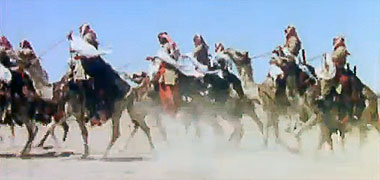
The main tribes and communities living in Qatar in 1908 and 1939 are listed on the page dealing with population. It can be seen that a number of families are missing from the list, though I don’t know why this is. The al-Attiyah, al-Na’aimi, al-Dusari, al-Khater, al-Misnad and Al Thani are ones that spring most immediately to mind but there are likely to be others. I shall have to carry out more research on this area. It would be useful to read the information which follows with the note here which looks at issues relating to the origins of the people of the peninsula.
Right up to the seventies there seems to have been considerable movement within the peninsula due to economic activity and, particularly, the efforts of the government to settle families in what was termed ‘public housing’. Generally families were settled on land which was not traditionally theirs as, in the case of urban families, their housing was levelled and land given them on the outskirts of the their towns and, in the case of less urbanised families, they were brought in and given land, also on the periphery of existing urban development.
Main families in Doha
The families who are mainly found in Doha are:
- al-Attiyah,
- al-Bu’ainain,
- al-Dusari,
- al-Hitmi,
- al-Kholaifi,
- al-Kubaisi,
- al-Kuwari,
- al-Mana,
- al-Mannai,
- al-Muhannidi,
- al-Na’aimi,
- al-Soweidi,
- al-Sulaiti,
- Al Thani,
- al-Umadidihi,
- al-Ali,
- al-Ansari,
- al-Darwish,
- al-Fardan, and
- al-Uthman.
though many of these families originally came from – and in some cases, still live in – other settlements in Qatar. Some of these families also have close relatives living in other Gulf states due to the character of the tribes occupying the Arabian peninsula and their habits of movement and settlement.
You might notice that the last five names are of different origin from the others on the list and are those of merchant families.
Tribes and communities in Doha
According to The Handbook of Arabia, 1916, there were twenty-five groupings of whom the most numerous were:
- al-bu ’ainain, a clan of the al-Subaih sub-tribe of the Bani Khalid,
- al-bin ’Ali,
- Huwalah,
- Khalaifat,
- al-bu Kawarah,
- Ma’adhid,
- Mahanadah,
- Sulutah,
- negro slaves,
- free negroes,
- Arabs from Najd,
- Baharinah,
- Persians,
- Bani Hajar,
- Ka’ban,
- Na’im,
- al-Murrah,
- Manasir, and
- ’Ajman.
The different families in the Gulf maintain their order, and through it, their status by internal social mechanisms; essentially, where the head of the tribe is primus inter pares – first among equals. This applies to the Al Thani family, for instance, who maintain their head and, therefore, the Ruler of the country, through familial accord. The first Ruler of Qatar, Sheikh Muhammad bin Thani, was selected from the Ma’adhid, themselves descended from the Bani Tamim.
Bearing in mind that all families have a number of different branches – for instance the Al Thani have the bani Khalid, bani Hamad and bani Jassim branches – it is important that the different branches and the most capable individuals are recognised and used in some way that befits them within the overall and elemental parts of the family. In this way they are supported and give support to each according to their need. In a tribe most people will know their individual place within it, and the head of the tribe will be responsible for resolving difficulties, acting as arbitrator and ensuring that the good name of the family continues.
One difficulty has arisen within this traditional hierarchical arrangement is that the government now provides some of the support which, previously, the head of the qabila used to give. For instance, not that long ago a mother might ask the head of the qabila for financial assistance in order to have a child receive specialist medical treatment. Now the state will provide that. However, the head of the qabila is still used to provide services, usually through influence in the majaalis and so maintain his place of priviledge. Nevertheless, the dichotomy introduced by the state’s wealth now providing resources does create ambiguities at least, and another difficulty for the society to come to terms with.
Tribes and communities in Qatar according to Lorimer
According to Lorimer’s Gazetteer of the Persian Gulf, the tribes and communities living in Qatar were, at the beginning of the twentieth century:
Name of tribe or community |
Number of souls in Qatar |
|
Where found in Qatar |
| al-Bu’ainain | 2,000 | Wakrah | |
| al-bin Ali | 1,750 | Dohah | |
| Amamarah | 200 | Dohah and Wakrah | |
| Arabs of Najd | 500 | Dohah and Wakrah | |
| Baharinah | 500 | Dohah and Wakrah | |
| Baqaqalah | 50 | Dohah | |
| Dawasir | 150 | Dohah | |
| Hamaidat | 250 | Lusail and Dha’ain | |
| Huwalah | 2,000 | Dohah and Wakrah | |
| Khalaifat | 850 | Wakrah | |
| Kibisah | 700 | Khor Hassan, Fuwairat, Hadiyah and Sumaismah | |
| al-bu Kawarah | 2,500 | Sumaismah, Dha’ain and Fuwairat | |
| Ma’adhid | 875 | Dohah, Wakrah and Lusail | |
| Madhahakah | a few | Dha’ain | |
| Mahandah | 2,500 | Khor Shaqiq and Dhakhirah | |
| Manana’ah | 400 | Abu Dhuluf and Dohah | |
| al-bin Maqla | 50 | Wakrah | |
| al-Musallam | 40 | Dohah, Fuwairat and Wakrah | |
| Negroes (free) | 2,000 | Dohah and Wakrah | |
| Negroes (slaves, but not living in their masters’ houses) | 4,000 | Dohah and Wakrah | |
| Negroes (slaves, living with their owners) | Are reckoned in this table to the tribe in which they are owned | … | |
| Persians | 425 | Dohah and Wakrah | |
| Sadah | 350 | Ruwais and Dohah | |
| Sudan | 400 | Dohah | |
| Sulutah | 3,250 | Dohah | |
| Bani Yas of the al-bu Falasah and Qubaisat sections | 125 | Dohah and Wakrah |
Interestingly, Lorimer notes that of the above tribes, the Hamaidat and Mahandah appear to be ‘peculiar to Qatar’. He identifies the settled population as living in the towns of:
- Dohah, and
- Wakrah,
together with the villages of:
- Dha’ain,
- Dhakhirah,
- Abu Dhuluf,
- Fuwairat,
- Hadiyah,
- Khor Hassan,
- Lusail,
- Ruwais,
- Khor Shaqiq, and
- Sumaismah,
adding that, with the addition of the Turkish garrison in Dohah together with ‘a few families of negro gardeners at two or three small gardens in the interior’, ‘there cannot be far short of 27,00 souls’ in the peninsula. It is significant that he also notes that a considerable proportion of the settled tribes of Qatar go to camp in the interior of the peninsula in winter, together with their flocks and herds.
As for the badu who live in or visit the peninsula, Lorimer records that only the Bani Hajir and around sixty families of the Ka’a ban tribe can be properly ascribed to live in the peninsula. He states that a number of the Na’im ‘fluctuate’ between Bahrain and Qatar, while the al-Morrah visit from Hasa, as well as the al-Manasir from Trucial ’Oman in the colder weather.
With regard to religion, he notes that the majority of the inhabitants of the peninsula are maliki sunni, though there are exceptions. The Sudan and a few Ma’adhid are hanbalis, the Sadah who are hanafis and shafi’is, the Baharinah and Persians who are shi’a, and the Arabs of Najd who are wahhabi. He added that negroes generally follow the religion of their owners.
Finally, here is a chart from a paper looking at the relationships of families in Qatar with business in the peninsula:
|
|
|
Ajamis |
|
Huwala |
|
Arab tribes |
| Purported origins | Persian | Original Sunni Arabs who moved from the Arabian shore to Persia and returned between the 1930s and 1950s | Qatari tribes tracing their origins to the Arabian peninsula | |||
| Families | al-Ansari | al-Ansari | al-Thani | |||
| and clans | al-Fardan | al-Darwish | al-Attiya | |||
| Mustafawi | al-Buainain * | |||||
| al-Fakhroo | al Bin Ali | |||||
| al-Jaber | al-Humaidi | |||||
| al-Jaidah | al Kaabi | |||||
| al-Malki | al-Khater | |||||
| al-Muftah | al-Kubaisi | |||||
| al-Jassim | al-Kuwari | |||||
| al-Ahmed | al-Maadeed | |||||
| al-Malki | ||||||
| al-Jahni | ||||||
| al-Marri | ||||||
| al-Mohannadi * | ||||||
| al-Mahmood | ||||||
| al-Mana | ||||||
| al-Mannai | ||||||
| al-Misned * | ||||||
| al-Muraikhi | ||||||
| al-Noami | ||||||
| al-Sulaiti * | ||||||
| al-Suwaidi |
* originally from Bahrain
There are a number of families apparently missing from the above list which was drawn up following discussions with local business interests. Others who come immediately to mind, in no particular order, would be al-Uthman, al-Hitmi, al-Khulaifi…
The Al Thani family
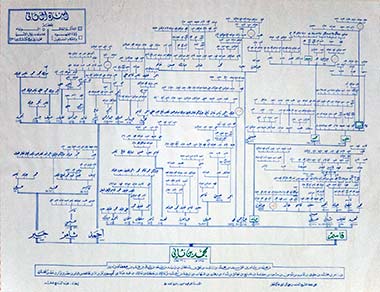
As noted above, the Qatar peninsula has, for some time, been governed by one of the families moving into and around it for centuries. The Al Thani family is now pre-eminent, rules Qatar and, with the increasing wealth of the country, has developed policies that have an influence across the whole of the modern world. But their more recent history goes back to Sheikh Thani bin Muhammad who was the head of that part of the family and living at Fuwairat. It was here that Muhammad bin Thani – whose name can be seen in green at the foot of this old chart – was born, taking over as head of the tribe in Fuwairat on the death of his father. A useful genealogical history of the Al Thani family can be found on one of the sites dealing with genealogies, but be warned, it is only the male side of the family who are noted on the trees, and there seem to be a number of variations in the trees I have seen.
In particular, I have found it difficult to follow the line before Muhammad bin Thani. But, with apologies for any misunderstandings of the Arabic, here is the line given on the different family trees I have seen, beginning with Muhammad bin Thani, taken in this case from the bottom of the above diagram:
Muhammad bin Thani bin Muhammad bin Thamr bin Ali bin Saif bin Muhammad bin Rashid bin Ali bin Sultan bin Barid bin Sa’ad bin Saalim bin ’Amruw bin Ma’dhaad bin Ris bin Zaakhr bin Muhammad bin Aluwy bin Wahib bin Qaasim bin Musa bin Musa’wd bin Aqba bin Sanya bin Nahashl bin Shadaad bin Zuhair bin Shahaab bin Rabiy’a bin Iba Suwd bin Maalik bin Handhala bin Maalik bin Zaidmanaah bin Tamim bin Murr bin Idd bin Taabakha bin Elias bin Madthar bin Nazaar bin Ma’ad bin ’Adnaan.
However, one of the charts on the above-mentioned site states:
Shaikh Jasim bin Thani gives the pedigree of his grandfather as follows: Jassim bin Thani bin Muhammad bin Thamr, bin Ali bin Muhammad bin Saalim bin Muhammad bin Jasim bin Sa’id bin Ali bin Thamr bin Muhammad bin Ali bin Ma’dhad bin Musharraf.
suggesting that there may be differences held in the perceived lineage of the Al Thani family.
Sheikh Muhammad bin Thani
The second of the five sons of Thani bin Muhammad, Sheikh Muhammad bin Thani was born in Fuwairat in the north-east of the peninsula around 1788. In 1847, under his leadership, this group moved from Fuwairat to Doha and slowly extended control of the north of the peninsula to the whole of it by the mid 1860s, making alliances in 1851 with Faisal bin Turki, the Emir of Saudi, to strengthen his position with regards to the Arabian hinterland. As mentioned previously, Sheikh Muhammad made a peace treaty with the British on the 12th September 1868 but, in 1871 invited the Turks of al-Hasa to protect Qatar’s interests, the Turks taking up residence in Qatar in 1872 and warning the British against becoming involved. Sheikh Muhammad died around 1878 or 1879 having given over the rule of the country to his son, Sheikh Jassim bin Muhammad in 1876.
Sheikh Qasim bin Muhammad
Sheikh Qasim (Jassim) bin Muhammad was born around 1825, probably in Fuwairat. He was the oldest child of Sheikh Muhammad bin Thani, with five male and two female siblings. As the effective ruler of the country he was accorded the Ottoman title, Qaim-Maqam – Deputy Governor in 1876 and, on the 18th December 1878 he assumed power. His early rule saw the Turks embarked upon a programme strengthening their position in the Qatar peninsula. They appointed Turkish administrators at Zubara, Doha, Wakrah and Khor al-Udaid and established a Custom House at Doha while strengthening their garrison there. Differences continued between Sheikh Jassim and the Ottomans leading to open warfare when Shaikh Jassim defeated Turkish troops at al-Wajbah, fifteen kilometres to the west of Doha in March 1893. Sheikh Jassim is regarded as the founder of the modern State of Qatar, and died on the 13th Sha’baan 1331, 18th July 1913.
At that time it should be understood that while Sheikh Jassim was said by Lorimer to control the peninsula from Lusail to Khor al-’Udaid, his son Abdullah was recognised as the Sheikh of Doha, and Abdulrahman the Sheikh of Wakra.
Sheikh Ahmad bin Muhammad
Although not officially a ruler of Qatar, I have added Sheikh Ahmad, born around 1860 and the second oldest of the six sons of Sheikh Muhammad bin Thani, as he took over many of the country’s responsibilities for his brother, Sheikh Jassim bin Muhammad, in 1898 following the battle of al-Wajbah after which his brother effectively retired to Lusail. Sheikh Ahmad was murdered by a servant of the Makhadhdhaba section of the Bani Hajir in 1905 after which Sheikh Jassim again assumed control of the country’s affairs.
Sheikh Abdullah bin Jassim
Following the death of Sheikh Ahmad bin Jassim, the elderly Sheikh Jassim held discussions with three of his sons, Sheikh Abdulrahman, Sheikh Khalifa and Sheikh Abdullah bin Jassim, the latter being appointed by his father in 1906 as Heir Apparent. Sheikh Abdullah bin Jassim was born in Doha in 1880, the third of six sons and, on the 17th July 1913, became the Ruler of Qatar on the death of his father. Two years later, following the outbreak of the First World War, the Turks were forced to leave Qatar and, the following year, Britain entered into a treaty with Sheikh Abullah effectively offering protection as noted above.
Two agreements were entered into with the British in 1935. The first, on the 5th May, guaranteed protection from both outside and inside the country whereas the second, on the 17th May, saw Sheikh Abdullah signing the first oil concession agreement with the Anglo-Persian Oil Company, this coinciding with British recognition of Sheikh Hamad bin Abdullah, the second son of Sheikh Abdullah, as the Heir Apparent. Regrettably, Sheikh Hamad died on the 25th April 1948 and, a month later, Sheikh Abdullah appointed his son, Sheikh Ali, as Heir Apparent on the 30th June and, on the 20th August 1948, abdicated in favour of Sheikh Ali. Sheikh Abdullah bin Jassim died on the 25th April 1957.
Sheikh Ali bin Abdullah

Sheikh Ali was born around 1896 assuming his position as Ruler in August, as mentioned above. He was the oldest of the three sons of Sheikh Abdullah bin Jassim.
The Second World War effectively delayed development in the country for its duration but, on the 5th August 1949, Sheikh Ali signed a Seabed Concession with Central Mining and Investment Corporation Ltd. This, and the previous agreement with Anglo-Persian set the seeds for the modern development of the State. The signing was quickly followed on the 31st December 1949 by the first transfer of oil from Qatar via the port of Umm Said in the south of the country where there was deep sea access for tankers.
Three years later, on the 1st September 1952, a new Agreement was signed with the Iraq Petroleum Company – which later became the Qatar Petroleum Company – under which Qatar acquired fifty per cent of the profits from oil exports. At this time, Sheikh Ali established the beginnings of an effective administrative system to manage the proceeds from oil. Sheikh Ali abdicated in favour of his son, Sheikh Ahmed on the 24th October 1960, at the same time appointing Sheikh Khalifa bin Hamad as the Heir Apparent and Deputy Ruler. Sheikh Ali died on the 31st August 1974.
Sheikh Ahmed bin Ali
Sheikh Ahmed was born around 1920 in Doha, the older son of the two sons of Sheikh Ali bin Abdullah. His rule witnessed considerable development of the oil industry, with the exceptions noted above relating the Second World War. In 1960 Sheikh Ahmed established the Ministry of Finance with Sheikh Khalifa bin Hamad its Minister. Other organisations followed to deal with the administrative and financial areas of government.
1963 saw the finding of a large oil field and the establishment of an oil terminal on the island of Halul in 1965. January 1964 saw the first seabed field in the world operating as an off-shore facility.
In 1968 the British Labour government terminated its treaties in the Gulf as its policies moved to leave from the east of Suez. The nine Gulf States failed to form an effective political unit and Qatar promulgated a Provisional Constitution on the 2nd April 1970, following this with the country’s first Council of Ministers on the 28th May 1970. Qatar declared itself independent on the 3rd September 1971, effectively ending the Treaty with the British of the 3rd November 1916. Sheikh Ahmad died on the 25th November 1977.
Sheikh Ahmed had seven sons and one daughter by his four wives –
- Shaikha Hessa bint Hamad bin Abdullah Al Thani,
- a daughter of Sheikh Falah bin Khalid Al Thani,
- a daughter of Shaikh Fahad bin Jasim Al Thani, and
- Shaikha Mariam bint Rashid al-Maktum, daughter of H.H. Shaikh Rashid bin Sa’id al-Maktum, Shaikh of Dubai.
Sheikh Khalifa bin Hamad
The youngest of seven sons of Shaikh Hamad bin Abdullah, Sheikh Khalifa was born in Rayyan on the 17th September 1932 and assumed power on the 22nd February 1972 with the agreement of the Royal Family, beginning the process of reorganising government and extending links to other countries in the world. On the 19th April 1972 he amended the Constitution, enlarged the Ministerial Cabinet and established wide-ranging diplomatic relations. He also took the opportunity to bring in a number of Western consultancies. For instance, through the Ministry of Public Works, the first of the Western planning consultancies was instructed to produce an orderly development of the country and, particularly, of Doha, its largest conurbation as well as Umm Said, the industrial area.
On the 18th July 1989 Sheikh Khalifa re-shuffled and enlarged the Cabinet to fifteen members, most of them being new to the Cabinet and, again on the 1st September 1992, it was enlarged to seventeen members.
On the 4th December 1990 Sheikh Khalifa re-organised the Advisory Council, retaining eleven members and adding another nineteen. In addition to this he established and revised fiscal and monetary agencies with a view to controlling better the increasing revenues and expenditures of the State.
Sheikh Khalifa was also responsible for developing more production sharing agreements with foreign organisations. In January 1985 and February 1986 agreements were signed with the Standard Oil Company of Ohio and Amoco respectively, and these were followed in January 1989 with an agreement with the French government-owned Elf Aquitaine.
At the same time Sheikh Khalifa organised the development of the industrial sector with steel and cement plants being established at Umm Said and Umm Bab respectively together with a chemical fertilizer plant for the country’s growing agricultural initiatives.
Education, under the guidance of Sheikh Khalifa’s brother, Sheikh Muhammad bin Hamad, prospered with schools being rapidly constructed in all areas of the country and the model Gulf University established to the north of Doha along with the development of a large area of land – the New District of Doha or dafnah – being constructed through the reclamation of a large area of shallow sea in the bay north-west and adjacent to the capital.
Meanwhile security and the army were developed with respectively, at their heads, Sheikh Khalid bin Hamad, Minister of the Interior and Sheikh Hamad bin Khalifa, the oldest son of Sheikh Khalifa and Commander in chief of the army.
This period saw considerable expansion, though there was a slow down in development in the late eighties and early nineties.
Sheikh Khalifa had five sons and ten daughters by his four wives –
- Sheikha Amna bint Hassan bin Abdulla Al Thani,
- Sheikha Aisha bint Hamad al-Attiyah,
- Sheikha Rudha bint Jassim bin Jabr Al Thani, and
- Sheikha Mouza bint Ali bin Saud Al Thani.
Sheikh Khalifa bin Hamad died in the evening of the 23rd October 2016, funeral prayers being held for him the following day after ’asr prayers at the Imam Mohammed bin Abdulwahab Mosque in Doha. He is buried at al-Rayyan cemetery.
Sheikh Hamad bin Khalifa
The youngest of the three sons of Sheikh Khalifa bin Hamad, Sheikh Hamad was born in 1952 and educated in Qatar and Sandhurst Military Academy in Britain, from which he graduated in 1971.
On the 31st May 1977 he was appointed Heir Apparent and Minister of Defence, establishing a progressive and modernised armed force capability. The early eighties saw him chair the Higher Planning Council, the organisation that establishes and guides the direction in which the country develops. He also took a keen interest in sports which continues with Qatar increasingly associated with both national and world-wide sports interests.
Sheikh Hamad assumed power on the 27th June 1995 with the agreement of the Royal Family. He has continued a programme of significant expansion in the development within the country and a wider recognition throughout the world with the movement of American troops onto the peninsula, the operation of Al Jazeera television station based there, his policies relating to the democratisation of the country, and the aforementioned sporting initiatives. In addition his wife, Sheikha Mosa, has been very much involved in advancing a number of aspects improving the life of Qatari women, particularly education.
This development has come at a time in regional affairs when there were considerable difficulties, notably the conflicts in Kuwait and Iraq and the influx of considerable military forces into the region. This conflict has seen Qatar drawn into the fight to free Kuwait, and it is notable that Qatar has aligned itself strongly with Western interests both in the search for a settled peace in the area as well as moving towards what the West would consider a more democratic society.
Sheikh Hamad has eleven sons and thirteen daughters by his three wives –
- Sheikha Mariam bint Muhammad bin Hamad Al Thani,
- Sheikha Moza bint Nasser bin Abdullah al-Misnad, and
- Sheikha Nura bint Khalid bin Hamad Al Thani
Sheikh Tamim bin Hamad

Sheikh Tamim, the second son of Sheikh Hamad through his marriage with his second wife, Sheikha Moza, was born in Doha on the 3rd June 1980, educated at Sherborne in England and, following his father, graduated from Sandurst Military College in 1998.
He came to power on Tuesday 25th June 2013 when his father handed over the position as Ruler to Sheikh Tamim, expressing full confidence in his ability to take on the significant responsibilities of leading the country.
At 2020, Sheikh Tamim had seven sons and six daughters by his three wives –
- Sheikha Jawahir bint Hamad bin Suhaim Al Thani,
- Sheikha Anoud bint Mana bin Abdulhadi al-Hajri, and
- Sheikha Noora bint Hathal al-Dosari
more to be written…
There are a number of photos of members of the Al Thani family on Flickr, but the main site has been taken down. A simple search should find others.
The future for development
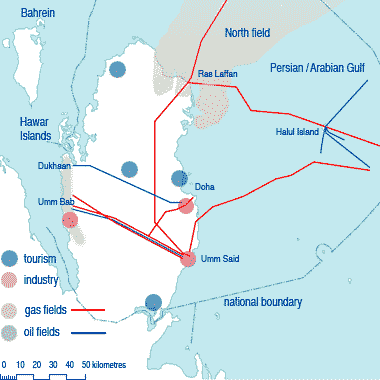
This diagram illustrates, perhaps a little crudely, the disposition of the chief industries upon which Qatar depends for its livelihood. The diagram can not show the importance of each of these, nor the reason for their location, but it is well enough known that Qatar has massive reserves of gas and significant reserves of oil.
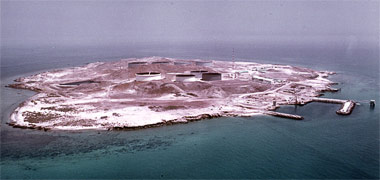
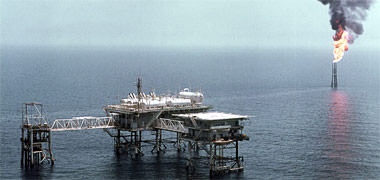
Oil was first discovered on the west side of the peninsula but is mainly located off the north-east coast of Qatar in the area known as the North Dome, as well as to its east. By contrast gas is mainly found along the west coast from Dukhan in the north, to the south past Umm Bab where the cement industry is based. It is evident from their location near the gasfields that the Hawar Islands have a strategic importance, as can be seen in the diagram further up the page that shows the result of the dispute brought before the International Court of Justice to determine the border between Bahrain and Qatar. The islands have now been determined to belong to Bahrain, though the part of the peninsula which Bahrain also claimed has been allowed to remain with Qatar.
The two photographs here are of the terminal on Halul Island, and one of Qatar»s oil rigs out in the Gulf. They are two of a number of official photographs published by the Qatar government in the early 1970s when there were the first attempts to publicise the achievements of the country and the progress made to date. These efforts were aimed both externally, as well as within the country and were useful in illustrating a snapshot of the State at that time.

As the map above illustrates, elements of the country’s oil and gas resources lie on the west side of the country where, as I mentioned earlier, there has been conflict with Bahraini interests regarding the Fasht al Dibal reef, the Hawar islands and Zubara on the Qatar peninsula, but which has now been legally resolved. These resources have to be piped overland to the south-east coast of Qatar where there is access for tankers at the deep water port of the industrial city, Umm Said. Here, in the top photo, you can see the pipes leading across the country from the characteristic low landscapes of the west coast and, on the horizon, gas can be seen being flared off. You can also see the track beside the pipeline enabling access and a measure of security to be provided.
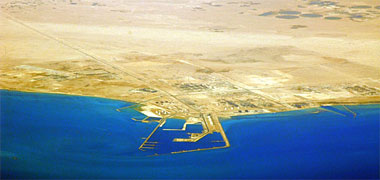
In the map above you can see the proximity of what is termed the North Dome or North Field to the north-east of the Qatar peninsula. This aerial photograph shows the industrial city of Ras Laffan which has seen remarkably fast growth in recent years with more planned. It has been established as an industrial city based on the gas and liquids derived from the North Field gas reserves. Qatar intends to be a world leader in liquified natural gas – LNG, and gas-to-liquid – GTL technololgies.

There are some industrial activities located on the west coast at Umm Bab and, on the south-east coast, at Umm Said, the industrial town which is also the deep water terminal for berthing tankers. The terminal was opened in 1949 for the loading of crude oil. For a long time there was little residential accommodation there but it is now better supported. There is also a dredged channel to accommodate shipping at Qatar’s main marine access.
The lower photograph is another of the government’s offical photographs, published in the early 1970s, and shows the Qatar Fertiliser Company’s terminal at Umm Said, established in 1968 as a joint venture and inaugurated in 1973.
As I suggested in the first paragraph, Qatar has significantly large supplies of natural gas in addition to its oil with the third largest reserves in the world after Iran and Russia. It follows that natural liquified gas, or NLG as it is usually referred to, is really the basis for Qatar’s future development. Qatargas, the company established to own and run, as well as market and export, the gas from the North Field is anticipated to generate approximately 2.8 billion cubic feet per day of natural gas.
In the nineteen seventies it was common to flare, or burn off, a lot of the gas that was produced as a by product of the crude oil. As much as 80% was flared but this has now been reduced to about 5%. More to be written on this…
While the nascent industries, powered by gas and oil got underway in the 1950s and 1960s, the need for drinking water was responded to by the development of the first desalination plant. This was located at Ras Abu Aboud, to the east of Doha. This aerial photograph of it, looking approximately south-west, is one of the official government photographs published in the early 1970s. Above it can be seen the port with four ships berthed and, beyond it, the West Bay with some of the development at al-Bid’a and Rumeillah.
Tourism, the newest industry, tends to be concentrated in Doha, particularly in the New District of Doha where there are a significant number of new hotels together with a many new sports facilities. Qatar University is also located here. Al Shahaniya, in the centre of the country, houses the national zoo, and there are a number of historic buildings around the country, perhaps the most important being in the north-west at Zubara. Within Doha there are a number of other facilities dealing with the past, the Doha Museum is the largest of these but there are many others both existing and planned.
This area to be developed…
Society 06 | top | Geography
Search the Islamic design study pages
- Introduction
- Arabic / Islamic design
- Arabic / Islamic geometry 01
- Arabic / Islamic geometry 02
- Arabic / Islamic geometry 03
- Arabic / Islamic geometry 04
- Islamic architecture
- Islamic urban design 01
- Islamic urban design 02
- Islamic urban design 03
- Islamic urban design 04
- Islamic urban design 05
- Arabic / Islamic gardens
- Gulf architecture 01
- Gulf architecture 02
- Gulf architecture 03
- Gulf architecture 04
- Gulf architecture 05
- Gulf architecture 06
- Gulf architecture 07
- Gulf architecture 08
- Infrastructure development
- The building industry
- Environmental control
- Perception
- The household on its lot
- A new approach – conceptual
- A new approach – principles
- A new approach – details
- Al Salata al jadida
- Public housing
- Expatriate housing study
- Apartment housing
- Pressures for change
- The State’s administration
- Society 01
- Society 02
- Society 03
- Society 04
- Society 05
- Society 06
- History of the peninsula
- Geography
- Planning 01
- Planning 02
- Population
- Traditional boats
- Boat types
- Old Qatar 01
- Old Qatar 02
- Security
- Protection
- Design brief
- Design elements
- Building regulations
- Glossary
- Glossary addendum
- References
- References addendum
- Links to other sites