
a collection of notes on areas of personal interest
- Introduction
- Arabic / Islamic design
- Arabic / Islamic geometry 01
- Arabic / Islamic geometry 02
- Arabic / Islamic geometry 03
- Arabic / Islamic geometry 04
- Islamic architecture
- Islamic urban design 01
- Islamic urban design 02
- Islamic urban design 03
- Islamic urban design 04
- Islamic urban design 05
- Arabic / Islamic gardens
- Gulf architecture 01
- Gulf architecture 02
- Gulf architecture 03
- Gulf architecture 04
- Gulf architecture 05
- Gulf architecture 06
- Gulf architecture 07
- Gulf architecture 08
- Infrastructure development
- The building industry
- Environmental control
- Perception
- The household on its lot
- A new approach – conceptual
- A new approach – principles
- A new approach – details
- Al Salata al jadida
- Public housing
- Expatriate housing study
- Apartment housing
- Pressures for change
- The State’s administration
- Society 01
- Society 02
- Society 03
- Society 04
- Society 05
- Society 06
- History of the peninsula
- Geography
- Planning 01
- Planning 02
- Population
- Traditional boats
- Boat types
- Old Qatar 01
- Old Qatar 02
- Security
- Protection
- Design brief
- Design elements
- Building regulations
- Glossary
- Glossary addendum
- References
- References addendum
- Links to other sites
A glossary of Gulf Arabic words
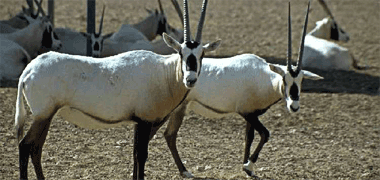
The Arabian oryx has nothing to do with the glossary or the addendum to it, but I felt it would be a nice idea to include at least one photo of it on this site as it is such a beautiful animal. Its proper name is al maha or, less commonly, al wadhihi and it once roamed the Arabian peninsula. Hunting and urbanisation killed it off in the region but now most of the states have zoos which include specimens. Incidentally, the name al wadhihi relates to the animal’s beautiful eyes.
The glossary set out below was intended as a vocabulary related mainly to building development in the Gulf. There are, however, a number of words which arise in more general discussion when dealing with planning, design and the building process, and which are included for interest if not always for strict clarity. Please be aware that there may be errors and omissions.
The glossary is arranged in Roman alphabetical order. This differs from the organisation of an Arabic dictionary, which is based on the verbal root, usually the third person singular past tense. For example, kataba (he wrote) is the root form under which maktab, (office or desk), kaatib, (clerk or scribe), and maktoub, (letter), would be found.
A limited number of official resources are available online, but the Qatar government has published a planning glossary that some may find useful. It can be accessed via the References page. It is, however, aimed at a more modern usage than that reflected here. I also recommend the glossary found at the back of An Outline of Islamic Architecture for its vocabulary of classical Islamic architectural elements; it usefully includes a list of sources, though its terminology is not specifically related to Gulf Arabic.
It should be understood that there is ongoing variation in the meanings and translations of terms in general, and that this is particularly so here, where both Gulf terms and Arabic words from other parts of the Arab world are used.
Finally, there is considerable variation in pronunciation across the Arab world. One of the most common examples is that Egyptian Arabic often uses a hard ‘g’ where Gulf Arabic uses a soft ‘j’.
There are also differences between written Arabic and spoken pronunciation. For example, feriq is often pronounced colloquially, fereej, and the Egyptian hard ‘g’ in gebel corresponds to jabal, pronounced in Qatar more like jebel.
The glossary is therefore not only arranged differently from an Arabic dictionary, but also reflects the way words are heard rather than how they are formally written. Not only is the order based on the Roman alphabet, but the initial letters relate to the way in which the Arabic word is heard, this often being different from the actual Arabic letter. This includes cases where initial Roman letters such as ‘c’, ‘e’ and ‘o’ are used to represent sounds as perceived in speech, even though these do not correspond directly to standard Arabic orthography.
In addition, there are inconsistencies in transliteration, particularly in the use of ‘ee’ and ‘i’, which have been applied variably depending on how I have heard the word in context.
The main purpose of the glossary is to provide a guide to the meaning of Arabic terms as encountered in spoken usage. It should be noted that this represents a mixture of dialects, ranging from Gulf vernacular to forms introduced by speakers from other Arab regions.
Finally, there is considerable variation in pronunciation across the Arab world. One of the most common examples is that Egyptian Arabic often uses a hard ‘g’ where Gulf Arabic uses a soft ‘j’.
Arabic also contains grammatical dual forms in addition to singular and plural. The dual is typically formed by adding the suffix ‘ayn’ (or a close variant in pronunciation) to the singular form. Plural forms vary, and in many colloquial contexts usage may simplify or regularise these distinctions in spoken speech. Although it is a little more complicated than this, generally you add the suffix ‘ayn’ to the single form for duals. Plurals apply up to ten but, after that, the plural continues with the singular form. An approximate pronunciation in Gulf Arabic would be:
| kitab wahid | one book |
| kitabayn | two books |
| thalatha kutub | three books |
| tis’a kutub | nine books |
| ashra kutub | ten books |
| hidashra kitaab | eleven books |
| ishreen kitaab | twenty books |
| wahid w ishreen kitaab | twenty-one books |
| tis’a w tiseen kitaab | ninety-nine books |
| miyya kitaab | one hundred books |
| miya w wahid kitaab | one hundred and one books |
Arabic |
English |
| A | |
| ’abbaasid | relating to ’Abbaas ibn ’Abd al-Muttalib, a paternal uncle of Muhammad, and representing a political dynasty, founded in 750, based in Baghdad and lasting around two hundred years. It was the third of four Islamic caliphates, supplanting the Umayyad caliphate – see fatimid and umayyad |
| ’abd | slave |
| ’abreeq | jug |
| ’adhaab al-miyaa’ | desalination |
| ’alam | flag |
| a’ailah | a children’s game played with stones and a double row of holes, usually scratched in the ground |
| a’amoud | column |
| a’oud | incense used to perfume, particularly, in the majlis |
| abaya – pl. abayaat | black cloak worn by women |
| ’abra bi al majdaaf | a small traditional craft used for light porterage across the creek in Dubai |
| abyadh | white |
| ’ada – pl. ’adat | a habit, or something carried out habitually |
| adab | good manners, courtesy, politeness or the proper approach to carrying out a task |
| adhaan | the call to prayers, usually made through a loud speaker attached to the minaret of a mosque |
| ’adl | justice |
| ’adliya | Civil court |
| ahmar | red |
| ’ain | the twelfth letter of the Arabic alphabet, containing a glottal stop |
| akeed | definitely |
| akhbar | news |
| akhdar | green |
| alair | on |
| alaas’aafaat alaawlya | first aid |
| alaadhaa’a | lighting |
| alaaslaahaat | repairs |
| alatool | straight ahead – coll. |
| aldhukuwr | male |
| al faas | an axe or axehead |
| alif | the first letter of the Arabic alphabet |
| alif al-ihmaal | the diacritic over a final kaf indicating no vowel |
| al ikhwan as-safa’ | the Brotherhood of Purity |
| alinaath | female |
| al khatt al mansub | a classic calligraphic style designed by the calligrapher Abu Ali ibn Muqlah |
| al haadhr | the present |
| al madhi | the past |
| al mustaqbil | the future |
| alhambra | an Islamic development in Andalucian Spain that came to an end with the Christian reconquista in 1492, and is a very commonly perceived Western model of Islamic design |
| amaan | safety |
| amil | system of pearling where a naakhuda is financed by a taajir |
| amir | prince |
| amira | princess, or a woman’s head scarf, similar to a hijab, but used with an underscarf |
| ’amm | public |
| ’amn | security |
| ’amuwd | the poles used to hold up a black tent |
| ’angar | a light anchor with four or six prongs, typically used by pearling ships |
| ’aqd – pl. ’uquwd | contract |
| ’areedth | wide |
| ’arish | palm fronds or stalks and the buildings constructed with pitched roofs of palm fronds. The word is derived from the plural of the Arabic word for feathers – see al-rish |
| ardha | traditionally a dance performed before warfare, accompanied by two facing groups chanting to each other while moving slowly with guns and swords to the accompaniment of drummers – see razeef which is a version |
| ardth | earth or land |
| arnab | desert hare |
| as’aaf | ambulance |
| ’asabiyyah | social solidarity, kinship, loyalty or cohesion |
| a’sal | honey |
| asfar | yellow |
| ashiddah | camel tack, the general word for the equipment and harnesses of a camel |
| askar | military |
| ’asiil | tribes considered to be noble |
| askari | soldier – see also jundi |
| ’asr | prayer in the mid-afternoon |
| assass | foundations or footings, also has the meaning of the basis |
| alustrlaab | astrolabe, a scientific instrument used in astronomy, surveying, way-finding, prayer timing and astrology |
| aswad | black |
| ataba | the threshold of a door |
| ’atar | perfume |
| atiq | old |
| atnab | the guy ropes on traditional tents, usually made of hemp |
| awamid | columns |
| awasij | the plant, Lycium shawii |
| ’ayaala | the Emirati name for the razeef |
| aayah – pl. aayaat | the verses that make up a surah of the Quran |
| ’ayn – pl. ’ayyuwn | eye |
| ’ayyin | small defensive holes in the wall of buildings through which firearms could be sighted |
| azal | diver who goes out in the boat of a naakhuda, but is independent |
| azba | permit for a non-residential temporary animal stock camp – see mazarah |
| B | |
| ba’ath | meaning, literally, re-birth, and the name of a political nationalistic, secular party established in Syria |
| baarid | cold |
| baazur – pl. bawazir | wrought iron, dome-headed nails used in the construction of heavy doors, face-fixed from the outside of the door through horizontal ledges and turned over to fix them |
| bab – pl. abwaab | door |
| bab khalfi or bab al-waraani | a minor, secondary or service door to a property, often giving onto a sikka, relative’s property or private grazing area |
| badawi – pl. badu | commonly, bedouin, meaning people who live in the desert |
| badgheer | natural ventilation system – from the Persian |
| ba’eed | far or far away |
| bahr – pl. bihaar or buhuwr | sea – note that the name, Bahrein, means ‘two seas’ and comes from the belief that the island and the surrounding salt water floated on a bed of sweet water – the Persian/Arabian Gulf – it being possible to find sweet water both under the land and the sea – see also buhuwr below |
| baharnah | Arabs believed to be the first settlers of the Qatar peninsula, and of shi’ite origin – see also hawwalah |
| bakhnaq | a short head covering worn by unmarried females |
| bakhuwr | wood chips usually soaked in scented oils and used to provide incense to guests |
| bakra | hoist used over a well |
| balaat | tiles or paving |
| balad – pl. bilaad | town or country |
| baladiya | municipality, also the common term for the municipality building |
| balam nasaari | a trading vessel also used for fishing and pearling and around forty or fifty feet long |
| baluchi | a person of Baluchistan, a geographical area within south-east Iran and west Pakistan |
| baniya tahatiya | infrastructure |
| bannaa – pl. bayaan | land or country |
| baraha | a majlis, or sitting area, outside the house and its compound |
| barash | palm thatched dwelling |
| barasti | construction of palm fronds but, more commonly nowadays, temporary housing constructed of flattened out oil drums |
| bareed | post office |
| barnaamaj – pl. baraamij | programme or schedule |
| barq | lightning |
| barr | desert, land or country |
| barra | outside |
| barzan | a free-standing watchtower |
| bas | enough! |
| basjeel | a woven cane mat usually employed in the construction of suspended floors or roofs |
| bateel – pl. bataateel | a type of local sailing craft, traditionally used for both fishing and fighting |
| bateel selek | a small version of the above craft |
| batin | the inner aspect of self or a thing |
| batula – pl. bataateel | the mask worn by Gulf Arab women to preserve their privacy; possibly also the colloquial name for th finial on top of a manara. |
| bawabat al hawwa | wooden shutters used to close off the circulation of wind towers |
| bawara | a heavy sea anchor, suited to sandy sea beds |
| bay’ah | an obligation upon, as well as a right for, every Muslim, man or woman; an oath of allegiance under Islam |
| bayaasira | a pejorative term for those who do not belong to a qabila, as well as a group established in the Oman whose origins are not known |
| bayt – pl. byoot | house |
| bayt khiaas | canvas tent, literally, a house of canvas |
| bayt sha’bi | a Public house, given by right to any Qatari that needs housing |
| bayt sha’r | traditional Bedu tent, literally, a house of hair |
| bazaar | a suq or shopping area |
| beeb – pl. beebaat | pipe |
| bijanb | beside or next to |
| bilaad | country |
| bid’a | not having roots in traditional understanding or sunnah |
| bideda | extended families |
| bidoon or biduwn | without – also a term given to those without nationality – see hadhar |
| bidiy | water trough |
| bihaaraat | spices |
| bin | son (of) |
| bint | daughter (of) |
| il bint il wald amha | the girl is to go to her first cousin in marriage |
| bina’a – pl. binaaya or mabaani | building |
| bi’r – pl. alabaar | well |
| biqaala – pl. albiqaala | grocery |
| bi’rkat | cistern |
| bisht | loose robe worn by men, usually black or brown with embroidered gold trimming, heavier in winter. Sometimes known as a mishlah |
| bismillah | collective word describing the religious exhortation, bismillah al-rahman al-rahim – In the name of Allah, the most Compassionate, the most Merciful |
| bitaath | hinge |
| biyaa’ | itinerant salesman |
| boom – pl. abwaam | large wooden, traditional boat with raking stem and stern, usually with a single, forward-raked mast |
| booma | owl – a symbol of bad luck |
| bratha | a small sand deposit – see also ramla |
| buhuwr | seas – with the meaning of the metres of poetry |
| bukhur | generic word for incense |
| bukra | tomorrow – bad bukra – the day after tomrrow |
| bunkah | fan, usually centrally located in the ceiling |
| burj – pl. abraaj | tower |
| burj al hawwa | wind tower |
| burj al muraaqiba | watchtower |
| burj as-sa’a | clock tower |
| burka – pl. barak | water tank |
| burq’a | the hood used to calm a hawk, an enveloping dress commonly worn by women in Afghanistan, and an alternative name for a batula |
| burtuqal | orange – fruit and colour |
| buruwz al-minbar | the external architectural expression of a minbar |
| busa – pl. busat | inch – measurement |
| bustaan – pl. basaatin | garden |
| buwny | brown |
| buwradaai – baraadi | curtain |
| buwraah | irregular, strong wind, common in May |
| C | |
| caravanserai | a combined lodging for travelling merchants and their pack animals as well as a temporary place for their business |
| chadur | a woman’s outer dress common to Iran, covering the body from head to foot |
| cubit | a measure of approximately half a metre – see the note at the foot of References. |
| D | |
| daa’ira | ring, as in ring road |
| dafnah | an alternative name of the New District of Doha, deriving from the colloquial name for dug or made ground, more classically relating to graves |
| dahl – pl. duhul | geological feature – a hole in the ground where underground water has eroded the limestone causing the surface to fall in |
| dahleez | corridor or entrance space in a traditional house |
| dahroi | a traditional game for boys |
| dakhil | inside |
| dalalah – dalalaat | women who sold clothes and the like from door to door to the women of the household |
| dallal | colloquial name for an estate agent – see samsaar |
| daluw | the bucket associated with a jaleeb – see also maqam |
| danjal | timber beams of mangrove – see shandal |
| daqiqa – pl. daqa’q | minute (of time) |
| dar | house or home – also the name of the room where pearl divers would gather onshore to share experiences and sing – also the extent of a tribal grazing area |
| darb – pl. daruwb | alleyway or street |
| daraj – pl. darajaat | staircase |
| daraj al haraara | degrees – literally, degrees of heat |
| darisha – daraaish | window openings, usually meant as shuttered windows |
| darwaazah | a pair of main doors |
| dastur | bowsprit of a traditional craft |
| dawla | state, as in Dawlat Qatar – State of Qatar |
| dawwah | a brass tray, raised from the ground, used with charcoal to prepare coffee both in the desert as well as the preparation area adjacent to or inside majaalis |
| debesh | animals |
| deek | cock |
| deira | encampment |
| della – pl. delal | coffee pot – usually the traditional pot |
| dhafaqa – pl. dhafaqaat | internal wooden window shutters |
| dhahr al-khait | windward side of a dune – see sayal |
| dhaif | guest |
| dhanoun | Cistanche phelypaea – a parasitic desert plant |
| dhow | general name for traditional, timber Arab boats, see also khashab |
| dhubab | fog |
| dhuhr | afternoon |
| dhul | shade |
| dibis | date syrup, a staple culinary ingredient used as a drink and as a sweetner, produced by pressing dates |
| dihliz | narrow passage or entrance hallway to a house |
| dikka | a raised bench or seat, usually built along an external wall and forming a side or sides of a baraha – pr. ‘ditcher’ – see also mastaba |
| dirah | an area of land over which groups of people had grazing rights. cf. haram, coll. a person’s place of residence or country |
| dirwand | the beam or lintel over an opening usually in the form of a palm trunk or bound mangrove poles |
| diwan – pl. dawaaween | the office of a government institution or head of state, sometimes used as the entrance to a large house – see iwaan |
| diwania | an occasional reference to a small, important building, usually two-storied |
| diyin or dabeen | a string bag worn around the neck of divers, in which to place oyster shells |
| djin | devils or evil spirits |
| doha | marine bay |
| dowshek – pl. dowaashek | low mattress with relatively hard stuffing on which people site or recline |
| dthabit | officer |
| dtha’eef | weak |
| dtha’eeq | narrow |
| dthahab | gold |
| dthawdthaa’ | noise |
| dthabab | mist or fog |
| dthayf | guest |
| dthuhr | prayer at noon |
| duff | a drum or tambourine created by stretching an animal skin over a circular wooden frame – see tara |
| dujarj | chicken |
| dukaan – pl. dukaakeen | shop |
| dukhan | smoke |
| duqal | mast of a traditional craft – see also saaria |
| durwa | decorative treatment of a parapet wall |
| du’un | timber window shutters |
| duwah | a low brazier on which charcoal is burned and kettles heated |
| duwnya | world |
| duwlaab | cupboard |
| duwwar | defensive wall |
| dwar | roundabout |
| E | |
| ems | yesterday |
| ’enf – pl. ’enuwf | nose, the prominent vertical feature of a batula or the vertical post on a double door |
| ’eid | celebration, festival or holiday |
| ’eid al-adha | the four-day holiday that follows the hajj |
| ’eid al-fitr | the three-day holiday marking the end of the holy month of Ramadhan |
| ’eid al-fitr sa’id | a greeting for the three-day holiday marking the end of the holy month of Ramadhan |
| ’eid milaad sa’id | the exhortation wishing a happy birthday |
| ’eid mubarak | the exhortation congratulating a Muslim on the ’eid holiday |
| ’eid sa’id | an alternative exhortation congratulating a Muslim on the ’eid holiday |
| ezrak | blue |
| F | |
| faas | axe |
| al-faatiha | the opening sura of the Holy Qur’an |
| fajr | prayer at sunrise |
| fakh – pl. afkhakh | a bird trap made from goat or sheep horns |
| falaa – pl. falawaat | wilderness |
| falaj – pl. aflaaj | water channel, usually open – see also saab and qanat |
| fan – pl. funuwn | art or science |
| fanar – pl. fanaraat | lighthouse |
| fanas | Jack wood, or Artocarpus heterophyllus, the name given to this timber by Kuwaiti shipbuilders |
| fanous – pl. fuwaanis | lamp or lantern |
| fara | carpenter’s plane |
| farash | servant |
| fard salat | compulsory prayers, avoidance of which places the individual concerned outside Islam |
| farkhat al bab | the small door that is set into a larger door – usually a pair of doors – known as darwaazah |
| farman | the yard of a traditional wooden craft |
| faruwsh | dead coral which comes in striated slabs |
| fasht | marine reef |
| fasl – pl. fusuwl | season – of the year |
| fasl al rabi’a | spring |
| fasl al saif | summer |
| fasl al kharif | autumn |
| fasl al shitaa’ | winter |
| fatail | fibrous twine used, when soaked in fish oil, to seal between the planks of wooden boats |
| fatam | the nose clip used by divers to prevent water entering their lungs, usually carved from horn |
| fat’ha – fathaat | opening or open |
| fat’ha al murakaba | defensive viewing holes in the walls of a building |
| fatimid | relating to a Shi’a dynasty founded in 909 by ’Abdullah al-Mahdi Billah who claimed legitimacy tracing his relationship with Muhammad through his daughter, Fatima al-Zahra and her husband, ’Ali ibn Abi-Taalib, the first Shi’a Imaam. The dynasty lasted until 1171 and was based in Cairo, Egypt. It was the fourth and last Islamic caliphate – see abbaasid and umayyad |
| fatwa – pl. fataawaa | edict or decision in Islamic law |
| feriq – pl. furuwq or furjaan | district of a town or city, usually associated with a particular family |
| feriya | opening in a common wall between two houses, usually of relatives, and generally not secured |
| fahamah or faham | charcoal |
| fidawi – pl. fidawiyya | armed retainers |
| fidha | silver |
| fijr | dawn or daybreak |
| fijiri | rhythmic songs sung by pearlers |
| filla – pl. fillat | villa – an obvious loan word |
| filli | strips of woven goat hair which, sewn together, form the covering of a black tent |
| finjaal – pl. finaajin | traditional Arabic coffee cup – badu pronunciation |
| finjaan – pl. finajeen | traditional Arabic coffee cup |
| finaa’ | courtyard and the space immediately adjacent to the outside of a property wall |
| fiqh | Islamic jurisprudence which has a number of schools distinguished by geographical area: hanafi – the Indian sub-continent, West Africa and Egypt; maliki – north and west Africa; shafi – Malaysia and Indonesia; hanbali – the Arabian peninsula; and jaferi – Iran and Iraq. |
| firdaws | the highest level of paradise |
| fowk | above |
| fraym fat’ha al badgheer | a shutter which closes over a ventilation system to keep the rain from entering |
| fuluws | money or fish scales |
| funduq | hotel or guest house |
| fuq’a | truffles, of which there are two main types: khalasi, which are black with a light pink flesh and zubaidi, dark cream with a cream coloured flesh |
| fuqaha | Islamic jurists |
| furshat | paint brush |
| fustaan | a woman’s dress |
| G | |
| garmoush | male saqr falcon |
| ghaduf | a fishing oar |
| ghaim | cloud |
| ghais or ghawwass | a pearl diver |
| ghalat | mistake |
| ghali | expensive |
| ghaltan | wrong |
| ghanem | sheep |
| ghaar | cave, as in the Grotto or Cave of Hiraa’ in the jabal al-nuwr where the Prophet received his first revelation |
| gharqad | probably the Parkinsonia aculeata, a tree named in a hadith as being the ‘tree of the Jews’ |
| gharb | west |
| gharghuwr – pl. gharagheer | a woven fish trap, circular with conical entrance |
| gharsha | a clay pot used as a percussive musical instrument |
| ghaus | dive – ghaus al-kabir being the chief pearl diving season, followed by radda and preceded by ghaus al-barid |
| ghazaal | gazelle |
| ghaazi | a warrior |
| ghazw | a form of warfare associated with raiding for camels – cf. harb |
| ghubar | dust |
| ghurbaal | a collection of twenty-five pearl sieves, each known as a tasah |
| ghurfa | room or a suspended floor in a building |
| ghurfat al-jaluws | sitting room for the family |
| ghurfat al-nome – pl. ghurf nome | bedroom or room for sleeping in |
| ghurfat al-sufra | dining room or room for eating in |
| ghuri | fort |
| ghutrah | headscarf square, folded on the diagonal and worn on the head over a kufiyah and held down with a black iqal. The ghutrah is white in summer and usually check in winter – most commonly white and black, red or green. Although both white and coloured are commonly referred to as a ghutrah, the embroidered, heavy ghutrah is more properly known as a shumagh |
| ghuwry – pl. ghuwaary | teapot, usually imported enamelled metal |
| girih | [not a word used in the Gulf] tiles which consist of sets of five contiguous polygons – a decagon, pentagon, diamond, bowtie, and hexagon – each with a unique decorative line pattern which, when joined together produce complex geometrical patterns |
| guidu – pl. gdawa | the name given to an Iranian earthenware water-cooled nargila with a bamboo pipe common to the region. Also qulyan or ghalyun – see shisha |
| H | |
| haashiya – pl. haashiyaat | frame or edge |
| habaan | the Arabian bagpipe, common to the southern Gulf, and related to the Bahreini qirba or jirba though there having two chanters and itself being similar to the nay anbaan used in southern Iran |
| hadaa | the rope to which a pearl driver is attached |
| hamour – pl. hawaamir | a type of grouper fish |
| haatif | telephone |
| habl – pl. hibaal | rope |
| hadam | demolition |
| hadhar, hadar or hazar | people who have settled in a particular area, as opposed to badu, who are transient |
| hadeed | iron, traditionally, wrought iron but now also used for steel |
| hadeed ash shubeck | iron window bars |
| hadiqa – pl. hadaa’aq | garden |
| hadith – pl. ahaadith | sayings or traditions – based on what he witnessed and approved – of the Prophet |
| hadith qudsi | hadiths in which the Prophet put in his own words what Allah said to him – not to be confused with the words of the Quran which are literal quotes of Allah |
| hafriyaat | excavation |
| haikal – pl. haiaakal | structure |
| hail | the spice cardamon, used in preparation of Arabic coffee |
| hajj | the pilgrimage made by muslims to Mecca |
| hajar – pl. hajaraat | stone |
| hakuwma | government |
| halaal | anything that is permitted, in English usually relating to diet, but in Islam also relating to dress, speech and behaviour |
| halib | milk |
| haluwsah | a children’s game played with stones and a double row of holes, usually scratched in the ground |
| halwa | beautiful, or a sweet |
| hamaam – pl. hamaamaat | washroom |
| hamaaya min al haraa’q | fire protection |
| hamaam | pigeon |
| hamam | an area in the vicinity of a town or settlement upon which such town or settlement has a claim of exclusive rights for the purpose of obtaining the necessities of its existence |
| hanafi | the school of fiqh within sunni Islam covering the Indian sub-continent, West Africa and Egypt and based on the teachings of Abu Hanifa al-Nu’man ibn Thabi. |
| hanbali | the school of fiqh within sunni Islam covering the Arabian peninsula and named after Ahmad bin Hanbal. |
| haqq – pl. huquwq | truth or right |
| haqqaah | the sure truth or inevitable reality |
| har | hot |
| haram | area in the vicinity of a settlement over which that settlement has exclusive rights to the necessities for its existence. cf. dirah |
| haraam | forbidden – the opposite of halaal |
| haraara | heat |
| haramlik | the private area of a house |
| harb | war waged for territory – cf. ghazw |
| harees | a popular meal combining crushed wheat and a meat, cooked with clarified butter, salt and water, and served with sugar and, sometimes a spice such as cinammon topping |
| harf | a letter of the alphabet |
| harm | pyramid |
| hariq | fire |
| hasa – pl. hasaat | stones from the desert, also the name of the stone weight used to propel a pearl diver to the sea bed |
| hasa bahri | literally, sea stones – see faruwsh |
| hassira | cane or rush matting |
| hashish | garden or grass |
| hashwat bab | carved decorative treatment to the face of a door – see also bab |
| hawaala | transfer or remit (of money) |
| hawa’ | air or weather |
| hawlaani | a badu riding saddle |
| hawan wa yad al-hawan | pestle and mortar used for the crushing of coffee beans |
| hawar | a young camel |
| hawaya | the tall, vertical openings which form the entrances for the wind in a wind tower |
| hawdaj | a covered, tent-like camel saddle, generally used by women |
| hawdh | pool |
| hawi | local name for a courtyard – see also hawsh |
| hawiya | identity, as in hawiya watani – national identity – see watan |
| hawsh | local name for a courtyard – see also hawi |
| hawta | boundary |
| haykal | tale or story, or the hull of a traditional craft |
| hayt | wall |
| hazar | see hadhar |
| hazara | immigrant settlements |
| hazm | high ground separating two depressions |
| henna or hiyna | a plant used to decorate the skin |
| hijaab | woven or fabric wall used to separate the women’s area from the men’s area of a tent – see also snaah |
| hijab | a Muslim woman’s common head covering |
| hijrah | the name given to the exile, flight or move the Prophet made from Mecca to Medina in 622 AD, the result of his increasing disaffection with polytheism and the resultant merchants’ anger with his opposition and its effect on the pilgrims |
| hilaal | a crescent or new moon |
| hima | pre-Islamic protected reserve of land – and management system based on rotation to permit regeneration |
| himaar – pl. hameer | donkey, and a mild term of abuse |
| himaar bahr | sailor’s donkey, an above-deck cross beam used to strength the structure of traditional craft |
| hisaan | horse |
| hibl – pl. hibaal | rope |
| hibb | large earthenware water vessel |
| hibr | ink |
| hiyala | a majlis, or sitting area, outside the house and its compound |
| hizam as suwr / burj | the strengthened construction of the foot or corner of a building / tower |
| housh | the garden, yard or area around the house |
| hubara | the hubara or bustard is a relatively slow bird, commonly the quarry of hawks |
| hujra | a room or the lowest floor of a house |
| huli – pl. hawwalah | Sunni Arab and Persian populations from southern Iran who link themselves genealogically to one of the tribes of Arabia from where they came in the seventeenth and eighteenth centuries, also a pejorative Gulf Arab term – see also baharnah |
| hurr | female saqr falcon |
| huwah | or juwayzah, traditional Arabic tribute levied by toll of money, animals, agricultural product, military conscription or other, reflecting the dominion of one party over another – originally a benign tradition which developed into a protection model |
| huwsh | the courtyard of a traditional house or building |
| huwtah – pl. huwaat | a walled and secured empty plot of land set aside for personal or communal use and future development |
| I | |
| idhat | the waiting period of four months and ten days during which a woman may remain in her house to effect a reconciliation |
| ibriq | kettle |
| ifsah | yield! – traffic sign |
| ifreez | carved timber or plaster frieze |
| iftah | open! |
| iftaar | the evening meal that breaks the day’s fast during the holy month of Ramadhan |
| ihsaan | perfection or excellence, related to the carrying out of prayer and, by extension, to all activities |
| ijaaza | permit or licence |
| i’jaam | dots which are a distinguishing and integral part of some consonants |
| ijar | leasing |
| ijma’ | an aspect of Islamic law based on consensus |
| ijtihad | reasoning aimed at comprehending an issue of shari’a |
| ijtima’a | meeting |
| ilm | knowledge |
| imaam – pl. a’immah | a religious leader or teacher, and one who leads the salah |
| imkabbis | a singer employed on long distance trading vessels |
| iqal – pl. uqul | a thick, doubled, black cord which sits on top of the ghutrah, holding it onto the head, and comes with or without a tail hanging down the back of the wearer |
| irq | small, narrow dune – see sahib below |
| isha | the prayer at night |
| ishaaraat | signals |
| islam | the religion of Muslims, literally – submission to God – from the root meaning ‘to surrender’ |
| istanzal | person affected by dancing at a zaar event – derived from the verb nazala |
| istihsan | a method of exercising personal opinion in order to avoid unfairness that might result from a literal application of law |
| salat al-istiqsaa’ | prayers for rain |
| istislah | a method of resolving complex problems whose answer can not be found in religious texts |
| iswarah | a bracelet, usually gold and worn on the wrist |
| itaar | architrave |
| ithil | timber beams of tamarisk – see shandal |
| streak | lamp or lantern |
| iwaan – pl. iwaanaat or awaawin | a portico, often vaulted, open on one side to a hall or, more often, an open forecourt |
| izmeel | chisel |
| J | |
| jaama’a | university |
| jabal – pl. jibaal | hill or mountain |
| jadeed | new |
| jaferi | the school of fiqh covering Iran and Iraq |
| jafir | basket for carrying building materials |
| jaleeb | or bi’r, a circular well |
| jaliboot – pl. jalaabeet or jawaalbeet | boat with vertical stem and transom stern |
| jals – pl. juluws | a long country craft, designed for racing, powered by oars. Also known as jals lal-sibaaq, literally a boat for racing |
| jama’a al-jaza’ir | the mosque of Algiers |
| jamal | camel |
| jameel | beautiful |
| jannah – pl. jannaat | paradise – an abbreviation of jannaat ’adn – the Garden of Eden – the English word, paradise, from the Persian, pairi-daeza, meaning an enclosed space. The highest level of jannah is firdaws |
| janoob | south |
| jaraadah | locust |
| jareed | palm leaves used for roofing |
| jat | animal feed, a kind of vetch |
| jayb | |
| jayyid | excellent or very good |
| jareeda | magazine or newspaper |
| jawaaz | permit |
| jawaaz as-safr | passport |
| jaww | a flat, wide open area, or weather |
| jazeera – pl. juzur | island |
| jazwa | pearl divers |
| jet | a green feed given to animals, perhaps alfalfa – to be checked |
| jibin – pl. ajbaan | cheese |
| jibs | lime, plaster, gypsum – usually used about modern internal plaster |
| jihad | struggle |
| jilaabah – pl. jilbaab | a woman’s loose fitting coat covering from the neck to the ground, usually closed with buttons or a zip |
| jinsiyyah | nationality |
| jiri – pl. jiryan | low lying depressions around which there is little planting but in which water collects during rainy seasons |
| jisr | a beam in trabeated construction, or a bridge |
| jraq | the water-cooled smoking pipe – nargila or argila – with a glass bowl and long leather or plastic hose, common to Saudi Arabia – see guidu |
| judr – pl. juduwr | a large cooking pot |
| juma’a | Friday, or a mosque particularly used for the weekly, Friday prayers |
| jundi | soldier – see also askari |
| jurn | horn-shaped hill |
| juss | lime mortar – usually referring to the traditional use of plaster, or stucco |
| juwdi | assistant for a naakhuda, receiving the share of three divers |
| juwti | shoes or sandals, the name being Punjabi |
| K | |
| ka’ba | a rectangular stone structure within the masjid al Haram in Mecca. It is the holiest place in Islam. |
| kaanah | tiller of a boat – from the Persian |
| kaatib | scribe or clerk |
| kabeer | large |
| kafaala | sponsorship, or the requirement to have a National take responsibility for an expatriate worker, or for the protection of orphans under adoption |
| kafeel | an individual acting as a sponsor to a foreign worker |
| kaf | the twenty-second letter of the Arabic alphabet |
| kaff | wrist decoration comprising a bracelet joined to finger rings – in Qatari dialect, pronounced chaff |
| kufiyah or qaffiyah | small cotton skull cap which sits directly on the head, ensuring the ghutrah won’t slip |
| kahf | cave |
| kahraba’ | electricty |
| kais | a pearl diver receiving three shares |
| kalb | dog |
| kalba | a small cross beam at the prow of a boat used to hang an anchor out of the water |
| kanaar | the edible fruit of the ziziphus mauritiana tree |
| kandiri | merchants and water sellers who came with a donkey and water tank on a small cart – also kerosene sellers who sold the same way. |
| kandura | or kanduwrah, the name given to the thub in the United Arab Emirates |
| kapuji-bashi | honorary Turkish title meaning ‘Head of the Palace Doorkeepers’ |
| kariya | villages |
| kashara | rubbish |
| kashtil is-sidr | forecastle of a boat |
| katar or katter | a small traditional boat used to move men and materials between ship and shore |
| katheef | thick or dense |
| katheer | much or many |
| kaza | Ottoman district in eastern Arabia which included Qatar, Qatif, Hasa and Najd |
| kenar | a green shrub whose fruit is sweet and was used medicinally. It is also thought to be able to control erosion |
| khaan – pl. khaanaat | a resting place, inn or hotel, similar to a Persian ‘caravansarai’ |
| khaarij | outside |
| khaas | private or special |
| khabt | a protective piece of leather covering the fingers of pearl divers |
| khail | horse |
| khaima – pl. khayaam | tent |
| khalas | enough, sufficient or stop |
| khalij | gulf, as in khalij al arabi – Arabian Gulf |
| khalil | little |
| khalyat nahl | bee hive |
| khamas | a pearling system under shared ownership |
| khanjar | curved knife, worn in the belt in front of the stomach |
| khareef | autumn |
| kharita – pl. kharaayat | drawing |
| kharuwj | exit |
| khashab | wood or timber, also a colloquial name for traditional, wooden craft, or dhow |
| ala khasham | affirming honesty, literally meaning ‘on the nose’ |
| khatt | calligraphy, handwriting or a drawn line |
| khat | handwriting or a drawn line |
| khateeb | the speaker at a mosque who delivers the khutbah on the Friday dhuhr prayers which may also be given by the imaam |
| khatr | danger |
| khatuwt al fawltya al ’aalya | high voltage lines |
| khazaan | reservoir |
| khazaan al moi | water tank |
| khazaana or khazaa’n | cupboard or lockers |
| khazuwq | a pile, or can be used in impolite remarks |
| khazzan | public water storage facility |
| khilaal | the steel or wooden pins used to fix ruaq to the covering material of a black tent |
| khilafah | stewardship of the world |
| khimaar | a woman’s cape covering from the top of the head to the waist, fastened under the chin |
| khir | the stone used by pearl divers to take them to the sea bed |
| khor – pl. khiran | a sea inlet |
| khubz | bread |
| khudar | vegetables |
| khuff | a leather sock |
| khurj – pl. akhraaj | woven woollen saddlebag |
| khul’a | divorce initiated by a woman |
| khundrus | a tree resin used in the sealing of the hulls of traditional boats |
| khurays | a wide depression covered by a thin layer of water |
| khuraytiyaat | an area characterised by depressions |
| khursa’ah | the first stage of a dahl characterised by a hole with the roof still standing |
| khutbah | sermon delivered at the Friday dhuhr prayers |
| khuwkhah | wicket door, usually in the right hand door of a pair of doors – see also farkhat al bab |
| khuws | traditional flat woven mats |
| khyaat | tailor |
| kilim | flat woven rugs, mostly used from Persia or Iran, but also woven in many other areas |
| kitab – pl. kuwtub | book |
| kohl | from kuh’ala – a black material used to line and beautify the eyes |
| kitr – pl. kitrat? | a small, usually double-ended boat, mainly used to travel between dhows and the shore |
| kull | every, or all |
| kull a’am wa antum bikhair | literally, every year and you are well, but meaning that I wish you (plural) well every year on this occasion |
| kunatb | a traditional game for girls |
| kufic | said to be the earliest form of Islamic calligraphic script |
| kuka | wicket door |
| kumbar | hemp rope used to wrap and strengthen beams |
| kuwa | opening between structural columns, piers or buttresses, used for ventilation, or a niche in a wall used for storage |
| kuwra | sphere or ball – also football |
| kursee | chair |
| kuwttab | school, attached to a masjid, providing an elementary Quranic education |
| L | |
| laban | yoghurt made from sheep or goat milk by agitating the milk in a sameel |
| laqfah | a traditional game for girls |
| lajna | committee |
| lahm | meat, usually mutton |
| lakh | general term for guy ropes on a black tent |
| lakhoya | a local Gulf term for companions, helpers or bodyguards, now used for a special branch of the police force |
| lughat | language |
| layl | night |
| laysh | why? |
| layt | light |
| lanj | launch (boat) |
| libbin | straw used as an admixture to mud bricks |
| lilbiy’a | for sale |
| liwan | covered terrace, hall or open-fronted room – see taarma |
| lowh | board – as in a board on a wall |
| lown | colour |
| lubbaan | frankincense |
| lu’lu’ | colour |
| M | |
| maa | not – see mush and mab below |
| maajil | private water system |
| ma’ | with |
| maa’ shaa allah | what Allah has willed. It is used to express a feeling of awe or beauty regarding an event or person that was just mentioned. |
| ma’aaljat al miyah | water treatment |
| ma’aaridth | exhibition |
| maail | diagonal |
| mab | not, as in ‘mab zain’ – not good – coll. |
| mabkhar – pl. mabakhir – or madkhaan | incense burner – but midkhan more usual |
| mabna – pl. mabaani | building |
| machboos | a form of cooking whereby meat, anything from chicken to young camels, and including fish, is cooked with vegetables and spices in large pots |
| mi’dhana – pl. almaadhan | minaret. See also See also manara |
| madda – pl. maddaat | plastic or cloth placed on the ground to receive food for a meal |
| madina – pl. mudun | city |
| madkhul | entrance or entrance hall |
| madrassa – madaaris | school, traditionally associated with a mosque |
| madyan | pearling system allowing merchants and naakhuda to charge interest |
| mafaasid | social evils – see masaalih |
| maflaj | the knife used for opening oysters |
| maghrab | prayer at sunset |
| maghsila | laundry or washing area |
| maghzal | frame on which to weave material used as snaah or similar |
| maha | common name for the Arabian oryx |
| mahal | place or location, also a collection of tents or an encampment |
| mahram – pl. mahaarim | those members of the family whom a man or woman is not permitted to marry – for a man these are his mother, daughters, sisters, his father’s sisters, mother’s sisters, brother’s daughters, sister’s daughters, his foster mother who gave him suck, his foster milk suckling sisters, his wives’ mothers, his step-daughters under his guardianship, and two sisters in wedlock at the same time |
| maidaan | open place, market place, square |
| maajari | drains |
| mahr | the marriage dowry given to a woman by her husband |
| majaani | free |
| majdah – pl. majadih | bow drill |
| majdthaaf – pl. majaadthif | oar |
| majlis – pl. majaalis | in relation to a house, a sitting room, either internal or external, generally understood to be the room in which men of a household entertain their male friends – also the informal institution where issues are aired and decisions made at a variety of scales within the society ranging from individual families through that of the qabila, to that of the Ruler. It also describes the general system by which information is passed and decisions made and in this sense has a more formal meaning as a council – see majlis al shura below |
| majlis al-aoud | a neighbourhood majlis, usually associated with a masjid |
| majlis al shura | literally, a consultative majlis or council |
| majmuw’a | group, collection, sum or total |
| majtim’a al-mahali | community |
| makaan – pl. ’amaakin | a place |
| makhraj | the exit point from the throat or essential articulation of a letter |
| makhzan | shop or store |
| maksuwr | broken |
| maktab or maktaba | |
| maktoub | letter, or that which is written |
| malah – pl. mlaal | bowl |
| malfa’ | cloth used to cover the hair |
| maliki | the doctrine of fiqh in sunni Islam covering north and west Africa, named after Malik bin Anas |
| malqaaf | wind scoop or ventilator |
| ma’maari | architecture |
| mamr – mamraat | path or passage |
| mamnoo’a | forbidden |
| mamnoo’a dakhuwl | entrance forbidden |
| mamnoo’a al tadkheen | smoking forbidden |
| manaakh | climate |
| manara – pl. manaaraat | the tower of a mosque from which the word ‘minaret’ is thought to be derived. See also mi’dhana |
| manaz | a baby’s or child’s cradle |
| mandthuwr | perspective |
| manjuwr | percussion instrument used in tambouras, consisting of a skirt-like material to which is attached dried goats feet, and activated by shaking the hips rhythmically – also the name used for reed matting |
| manqa’ | land within an area of jiri in which water settles |
| manqala | a board game consisting of two parallel rows of holes along which markers are moved – from the verb naqala – he moved. |
| manqalah | the wrist cuff used by falconers to protect their arm |
| manqruf | mangrove slat timber |
| manqrur | woven palm matting used in the construction of suspended floors |
| mantaqa – manaataq | district |
| manzil | house, or a place to stay |
| maq’ad | projecting balcony, generally used as a women’s sitting area |
| maqam | the wooden structure associated with a jaleeb – see also daluw |
| maqahwi | the person who serves coffee, usually in a majlis |
| maqataab | the ridge pole or beam used in some types of black tent |
| maqbadth – pl. maqaabadth | handle |
| maqbara – pl. maqaabir | graveyard |
| maqta | section |
| ma’quwl | believable |
| maraafaq al ghaseel | washing facilities |
| marash | container from which rose water is sprinkled |
| maridh | ill or sick |
| markab – pl. maraakib | generic term for a ship or boat |
| markaz | a headquarters, centre or place devoted to a specific activity |
| markaz ashurta | police station |
| marqad | gravestone |
| marub’a | square |
| maruwr | traffic |
| masaa’ | evening |
| masaalih | social good – see mafaasid |
| masaleeb | a wooden dowel used to hold two flat paddles together creating the base for holding a camel saddle – see thuluwf |
| ma’shaa | earthenware pot used to cook harees, wide at the base to optimise heating and narrow at the opening to retain moisture |
| mashghuwl | busy or occupied |
| mashru’a | project |
| masjid – pl. masaajidmasjidaan – two of (coll). | mosque – masjid al Qubaa’, the house the Prophet built in Medina in 622AD; masjid al Haram, Mecca, the holiest mosque in Islam; masjid al Nabawi, Medina, the second most holy mosque in Islam; masjid al Aqsa, Jerusalem, the third most holy mosque in Islam |
| maslaha | considerations which produce benefit or interest, or prevent harm |
| mastaba | table or bench – see also dikka; also a sloped or stepped construction, typically found in Egyptian tom |
| masuwl | person in charge |
| mastalki | the upwards facing side of a calligraphic stroke |
| mat’am | restaurant |
| mataar | airport |
| matar | rain |
| matbakh – pl. mataabach | kitchen |
| matbakh al ra’yyis | main kitchen |
| mat’haf – pl. mataahaf | museum |
| mawaasafaat | specification |
| mawaad kham | raw materials |
| mawjood | present, in the sense of it existing |
| mawqif – pl. mawaqif sayaraat | car park |
| mawthafeen | staff |
| mazarah | permit holder for permanent house associated with animal stock – see mazra’a and azba |
| mazdm | the rear tent pole of a black tent |
| mazlaaj – pl. mazaalij | a traditional wooden bolt used in securing wooden doors from the outside also, now, of metal |
| mazra’a – pl. mazaar’a | farm |
| mecca | or Makkah, the holiest city in Islam, containing the ka’ba towards which all Muslims turn in prayer |
| meen | who? |
| midfa’ – pl. madafi’ | hard pillow for propping up on the elbow – see misnad |
| midkhan – pl. midakhn | incense burner |
| mifattah | a circular mat made from palm fibres – see sufra |
| miftah – pl. mafaatiyh | key |
| mighzal | drop spindle used for working goat and other hair into yarn |
| mihma | a long-handled spoon on which coffee is roasted in the preparation of traditional Arabic coffee |
| mihrab – pl. mahaarib | feature in the wall or qibla of a mosque – usually a niche , arch or, in earlier times, a marker – indicating the direction of Mecca for prayer. Note that there appears to be no word for the external expression or projection of the mihrab as an architectural element. |
| mijwiz | a musical reed instrument of the clarinet family, comprising two pipes with a number of tuned holes, bound together and played with a continuous blowing technique |
| mikhir | the front tent pole of a black tent |
| miknasa | sweeping brush |
| milaabis | clothing |
| milaqat | spoon or trowel |
| milh | salt |
| mimbar | a seat in a mosque for the use of the imaam |
| min | from |
| min seen | from a long way away – literally, from China |
| min’a – pl. mawaani | jetty, port or harbour |
| minb’a sharb – pl. sanaabir myaa’ al-sharb | drinking fountain |
| minbar | pulpit in a mosque – see buruwz al-minbar |
| minfaakh – manafeekh | bellows used to blow air on a fire |
| mirzam – pl. maraazim mirzamain – two of (coll.) | a projecting roof water spout, usually made from timber, or the central point of the ghutrah above the eyes |
| mirzam a’amoudi | exposed vertical rainwater channel constructed in the body of the wall to lead water down a wall |
| misbah | prayer beads |
| mishaash | temporary rock pool |
| mishat – mshoot | comb |
| mishlah | loose robe worn by men, usually black or brown with gold trimming, heavier in winter. More usually known as a bisht |
| mishtakhata – pl. mishtakhtaat | chest |
| mismaar – pl. misaamir | nail or a tent peg |
| mismaar hadeed | iron or steel nail |
| misnad – pl. masaanid | hard cushions used on the ground or upon a raised dikka for people to lean against |
| misnad al majdthaaf | rowlock – arranged in pairs they act as fulcrums for oars to power a rowed craft |
| mistah | an area of hard pan ground surrounding manqa’, covered with broken rock |
| miswaak | a piece of fibrous wood from the root of the arak tree – Salvadora persica L. – used to clean teeth and which is associated with prayer |
| mithaal – pl. amthila | pattern or model, similitude or allegory |
| mithkab | drill |
| mitr | measure or tape measure |
| mitraqa | hammer |
| mizan | level or plane |
| mizmar | a double reeded, conical woodwind musical instrument – see zurna |
| mntharah�– pl. manathr | mirror |
| mnya | well, all right |
| moi | water |
| miyaah al jawfiyah | ground water |
| moi warid | rose water – literally flower water |
| mu’allim | teacher |
| mu’adhin – pl. mu’adhneen | person who calls Muslims to pray at a masjid, traditionally from a mi’dhana |
| mub | coll. not, as in mub zain – not good, i.e. bad. See also: mush |
| mubarak | blessed or congratulatory as in the term ‘eid mubarak’ |
| mubarrad | a shallow, wooden box into which roasted coffee beans are placed for them to cool down prior to their being crushed and added to water in the process of making coffee |
| mudaaris | teacher |
| mudabab | pointed arch |
| mudabissa | a specialised room in some houses set aside for the storage of dates and production of date syrup, dibis. It is characterised by the channels for liquids to drain away to a collection pot |
| mudhaarabah | a profit-sharing venture where two parties share profit, but one bears any loss |
| mudhakarat | memorandum |
| mudir | director of a government department or a private organisation |
| mufak baraghi | screwdriver |
| mufasl – pl. mufsalaat | hinge |
| mugharib | generally understood to be the Mediterranean littoral Arabic states of Libya, Tunisia, Algeria and Morocco |
| muhandess | general name for an engineer |
| muhandess ma’mari | architect |
| muhandess takhtiyt | planner |
| muharrik | fire engine |
| muhim | important |
| mujtamah | society |
| mujadilah | the name of the fifty-eighth sura of the Quran, and relates to divorce |
| mujannah | the practice of winning pearls by wading in the shallows |
| mukhada | diver’s earnings |
| mukhbaz | bakery |
| mukhtalif | different or mixed |
| mukab | the downwards facing side of a calligraphic stroke |
| mukaiyem | temporary animal herding camps |
| mukayif | air-conditioner |
| mukhat | a bag, usually made from canvas and carrying raw meat to feed to returning hawks as their reward |
| mulk – pl. amlaak | ownership |
| munshar | saw |
| muntaqah – pl. manaataq | area, zone or neighbourhood |
| muntaqah mazruwa’ | cultivated area |
| muqarnas – pl. muqarnasaat | decorative or structural element, generally in a stalactite or honeycomb form, usually in the area between the foot of a dome and its supporting walls, or around the head of a column |
| muqawwal | contractor |
| murabba’a | literally a square space, but the name given to a corner room where guests might be entertained |
| murabahah | the sale of goods including a pre-agreed profit |
| muraaqaba | surveillance or supervision |
| murfaah | storage box hung from a kitchen ceiling |
| marmar – coll. murmar | marble |
| musalla – pl. musallaat | prayer hall, open prayer area or place to pray |
| musalla saidaat or nisa’ | Ladies prayer area |
| musaqqam | financier of a pearling fleet |
| mush | coll. not, as in mush jayyid – not good, i.e. bad. See also mubwhich is the more Qatari of the two words |
| mushaarakah | a profit-sharing venture where two parties share profit and loss |
| mushrafaat | decorative top to wall or building |
| mushkil | difficult |
| mushrabiya – pl. mushrabiyaat | lattice screen, usually of turned or carved wood – also a house type in some parts of the Arab world having mushrabiya to the street and open windows on the other side giving light and ventilation to the house |
| muslim – pl. muslimeen | a follower of Islam |
| must’ajil | urgent |
| mustaqbil | the future |
| mustashar | an expert or advisor |
| mustashfa | hospital |
| mutasarrif | person appointed to govern a mutasarrifiyya |
| mutasarrifiyya | an Ottoman administrative district |
| mutawain | religious police of Saudi Arabia with broad powers for policing the shari’a |
| muthaad | a bangle, usually of gold and worn on the wrist |
| muwadhin | the official or chosen person who makes the call to prayers |
| N | |
| na’al | traditional open sandal |
| naady | club |
| naakhuda – pl. nawaakhada | ship’s captain |
| naakhuda al-birr | land captain, or merchant who finances a sea or ship’s naakhuda |
| naaqa | female camel |
| naar | fire |
| na’ashat | a dance performed by badu women where they sway their head from side to side, sweeping their hair in arcs in time with the music |
| nabati | Qatari dialect based on classical Arabic with a local influence |
| nabq | the edible fruit of the zizphus spina-christi tree |
| nadhif | clean |
| nafaaiyaat al-khatara | hazardous waste |
| nafl salat | voluntary prayers which may be offered in addition to fard, but not at sunrise, true noon or sunset |
| nahaar | daytime |
| nahaas | brass |
| nahham | a pearl ship lead singer |
| nahlah – nahal | bee |
| nahr | river |
| na’ib | deputy |
| na’im | low lying grassed area suited to grazing |
| na’in | a particular kind of Persian carpet, predominantly beige and blue, and of high quality |
| najaz | adze, or edge cutting tool |
| najd | area of Saudi Arabia and general name for a sand dune |
| najjar | carpenter |
| najm – pl. najuwm | star |
| najwat | steep shoal, coral reef or pearl bank around eight metres deep |
| nakhl – nakheel | cultivated area |
| nakhuda – pl. nawakhidah | captain of a pearling boat |
| nakhsh | a prominent spur |
| namawzaj | model, shape, form or design |
| naqoush mefat’ha | carved plaster panels or plasterwork allowing air to circulate |
| naqaa | barkan sand dunes |
| naqoush suwr al bab | carved plaster panels or plasterwork around a door |
| naql | transportation |
| naqsh | carved plaster panels or plasterwork |
| naquwsh | inscribed decorative features |
| nat a habl | a traditional rope game for girls |
| nazala | to descend or climb down down |
| natuwr | watchman or gatekeeper |
| neel | the material used to give the distinctive finish to a batula |
| neem | a construction forming the roof of the poop deck on a country craft |
| ni’al | sandals |
| niqaab | a double- or triple-layered black veil worn by some women to mask their faces |
| niswan | women |
| nuhaas | copper |
| nusf | half – fraction |
| nuqta | point or place |
| nuwr | light or lamp |
| nuwra | lime wash |
| O | |
| ’oud | a plucked string instrument from which the lute is derived. It has no frets and eleven strings arranged as five pairs and a single |
| Q | |
| qa’a | a house type in some parts of the Arab world having a qa’a, or small covered central courtyard, and surrounding rooms |
| qabila – pl. qabaa’il | tribe or family group characterised by a common family name |
| qadeem | old |
| qadm – pl. aqdaam | foot – measurement |
| qaffiyah or kufiyah | small cotton skull cap which sits directly on the head, ensuring the ghutrah won’t slip |
| qahwa | coffee, traditionally made with coffee beans and cardamon, and served in small cups, poured from a della |
| qaim maqam | a Turkish title given to the person who administers a kaza, or district |
| qalaaf – pl. qalaleef | caulker, one who prepares and inserts caulking between the planks of boats – also a name given to a joiner |
| qalam | pen |
| qalami | the mizzen mast of a traditional wooden craft |
| qal’at – pl. qalaa’a | fort |
| qal’at al askar | military fort |
| qalb | heart or centre |
| qalm | pen |
| qamah | wheat |
| qamees | shirt |
| qamr | moon, arch or crescent-shaped |
| qamriyah | decorative feature in the shape of a crescent |
| qanas | falconry |
| qanat | underground channel for water with periodic vertical ventilation shafts, more commonly used in Iran |
| qanuwn – pl. qawaaneen | laws |
| qanuwn al binaa’ | building regulations |
| qareeb | near |
| qaraar – pl. qaraaraat | decision |
| laqum al qaraar | television programme – The Decision is Yours |
| qasbah | fortified quarters or citadel of rulers – mostly in reference to Mugharib buildings |
| qasr | castle, fort or fortified structure |
| qata | an internal tent dividing wall constructed from woven strips sewn together |
| qataf | Limonium axillare – a desert plant |
| qatan | diver’s share of the total profits after everything due from him has been deducted |
| qatiya | low, head-height dividing wall that usually gave privacy to a toilet |
| qatuba | a reinforcing strip that links the filli of tent roofs and protects the material from tension stresses |
| qaws – aqwaas | moon or arch |
| qaws mujannah | a winged, or ogee arch |
| qawi | strong |
| qayis | good |
| qibla – pl. qibal | the direction of Mecca, usually understood to be the wall of a mosque on that side facing Mecca. Note that the plural is rarely used, because qibla usually refers to a single sacred direction. |
| qidr – pl. quduwr | a large cooking pot |
| qif | stop! or stand! – traffic sign |
| qifl – aqfaal | door lock |
| qism | section |
| qiyaam | the act of standing in prayer |
| qiyas | an aspect of Islamic law which is reasoned by analogy |
| qiyaas | measurement |
| qleena wa al-maatuwa’ | tipstick, a traditional Qatari game played with a stick and a bat or paddle to strike it with |
| qubba – pl. qubab or qubaab | dome or cupola |
| qubqub | crab |
| quffal | end of the main diving season |
| quran | the sacred text of Islam, understood by Muslims to comprise the revelations of God to Muhammad through the angel, Gabriel. Its text is valid for religious purposes only in its original Arabic. Translations are interpretations only |
| qutb | pivot, pole or axis |
| qiyraat | a unit of weight derived from the Greek word for a carob seed |
| R | |
| ra’ad | thunder |
| raas | head of a body or a geographical cape |
| rabaaba | the single stringed violin used by Badu |
| rabadth | suburb in the immediate vicinity of the older, central part of a medina |
| rabi’a | spring (season) |
| radha | a processional dance, performed by women, associated with weddings |
| radif | a boy sa’ib, usually an apprentice who receives half the share of a sa’ib, i.e. one share |
| ra’ees | head of a group or chief of a tribe |
| raff – pl. rafuwf | shelf |
| rafiq | companion or friend |
| raha – pl. rahaat | a pintel hinge, most commonly found on doors, or a circular stone grain mill |
| rahma | compassion |
| rahnama | sailing directions |
| rajul – pl. rijaal | man |
| rakaab | pack camels – camels used for transporting |
| rakhis | cheap |
| Ramadhan | the holy month – ninth in the Muslim calendar, the month in which the first verses of the Quran were revealed to the Prophet, and marked by fasting through the hours of daylight |
| ramaadi | grey or ash-like |
| raml – pl. ramaal | sand |
| ramla | a small sand deposit – see also bratha |
| raqaaba | monitoring |
| raqam – pl. aarqaam | number |
| ras | head |
| rashash | rifle |
| rawdha – pl. riyadh | private garden or cultivatable land – also the colloquial name given to soil which can be used for planting |
| rawshina | the niche formed between structural columns, usually used for storage – see rushanih and kuwa |
| razeef – pl. razafaat | Badu sword dance accompanied by men standing in two facing lines, singing eight-bar verses at each other, backed by two kinds of drum, the tubal and the tara – see ardha |
| riba | usury |
| rify | rural |
| rijl | foot |
| risaala | letter or transmission |
| risha – pl. al-rish | a feather |
| ruaq | the walls of tent, fixed to the tent roof with wooden pins |
| ruba’a | a quarter – fraction |
| ruba’a al-khali | the Empty Quarter of Saudi Arabia |
| rukhaam | marble |
| rukhsa | a permit |
| rukn | corner |
| ruku’ | the act of bowing in prayer |
| rumaana | a vertical timber bollard, fixed in conjunction with a horizontal kalba, just aft of the prow of a vessel, and used in securing the vessel with mooring lines |
| rushanih – pl. ruwshaanaat | the internal part of a wall between structural columns, or a niche, usually used for storage – see rawshina |
| ruttub | a half-ripe date which has contrasting tastes and textures |
| rutuba | humidity, damp or moisture |
| ruwaaq or riwaq | porch or arcade, originally of palm fronds before simple rooms |
| S | |
| sa’a | clock, watch or hour |
| saab | water channel, usually open – see also falaj and qanat |
| s’af | date palm fronds |
| saajaat | cymbals |
| saala | sitting room for the family |
| saamry | the music associated with zaar events |
| saaria | mast of a traditional craft – see also duqal |
| sa’b | difficult |
| sabaah | morning |
| sabbah | a traditional game played by boys |
| sabil | a fountain used as a water source for washing in a wudhuw’ |
| sabkha | an area of sea which has been covered by wind-driven sand to form land of varying solidity and safety to travellers |
| sabr | wait, as in ‘be patient’ |
| sabr shway | wait a little |
| sadaqah al-fitr | a small gift, generally of food, given to the deserving in the week before the end of Ramadhan |
| sadu | a badu simple weaving loom, fixed to the ground or the material used for floor covering |
| saf – pl. sufuwfsaffain - two of. (coll). | the lines Muslims make at prayer |
| safaqa | timber window shutters |
| safarat | embassy |
| safir | ambassador |
| safina | ship |
| sagheer | small |
| saha | healthy |
| sahab | cloud |
| sahaaba – singular: m. sahaabiy, f. sahaabiyyah | disciples of the Prophet |
| sahn – pl. suhoon | plate, or alternatively, a courtyard |
| saharaa’ | desert |
| sahat | cul-de-sac |
| sahib | small, narrow dune – see irq above |
| sa’ib – pl. siyub | the partner of a pearl diver, responsible for pulling the diver to the surface, and who receives two shares compared with the diver’s three shares |
| sa’id | happy |
| saidaliya | pharmacy |
| saif | sword or a curved sand-dune |
| saif | summer |
| saif | land immediately adjacent to the sea that would be used for mending boats, selling fish and by children playing |
| salaam | peace |
| salaf | payment to a diver made in advance of earnings |
| salafi | a term referring to the first three Muslim generations which are held to be a model for the manner in which Islam should be practised |
| salah | ritual prayers |
| salama | safety |
| salat | prayer |
| salat al-fajr | early morning prayer |
| salat al-dthur | mid-day prayer |
| salat al-’asr | mid-afternoon prayer |
| salat al-maghrib | sunset prayer |
| salat al-isha | evening prayer |
| saj | teak timber |
| sajada – pl. sajjad | prayer mat |
| salaamlik | the public area of a house |
| sallam pl. salaalim | wooden ladder or stair |
| salsabil | water spout usually associated with a shadirwan or carved marble slab. The name comes from one of the wells, fountains or rivers in paradise from which the faithful may drink according to the Holy Quran |
| saluqi – pl. sulqan or salaq | a hunting dog |
| samak | fish |
| sameel | bag made from a sheep or goat skin, used to prepare laban |
| samsaar | estate agent – see dallal |
| sanbooq | a boat traditionally used for pearling, also seen written as ‘sambooq ’ |
| samr | the plant, Acacia tortillis |
| sanduq – pl. sanaadiq | box |
| sanduq al-bareed | post office box |
| sanduq manajam | wooden chest decorated with ironwork |
| sanduq mubayat | wooden chest decorated with brasswork, also referred to as a Kuwaiti chest |
| sanna | year |
| saqf – pl. suquwf | roof or ceiling |
| saqr | the most popular hawk for hunting – hurr is the female, garmoush the male |
| saraaj – pl. saraajaat | bed |
| sareer – pl. saraaeer | bed |
| satur | stem post or prow of a traditional boat |
| sat’ha – pl. astuwhu | roof |
| sawm | the practice of fasting |
| sawma’a – pl. sawaami’ | an early ventilation tower |
| sawr | to make a picture or take a photograph |
| sawt | sung poetry |
| sayaali | bitumen |
| sayaana | maintenance |
| sayal | the leeward, steep side of a sand dune – see dhahr al-khait |
| sayyara | motor car |
| sbuwq | the jesses used to tether a hawk’s feet |
| seeda | straight ahead – coll. |
| seekh | a steel or brass bolt used to secure a door, usually on the outside of the door. It is the replacement of the mazlaaj |
| sha’ab – pl. shabaab | a youth, or popular |
| shaar | hair |
| shaasha – pl. shuwsh | a raft or boat constructed from reeds or cane, common to the Oman |
| shadaad | camel saddle |
| shadakha – pl. shadakhat | bird trap |
| shadirwan | a carved marble slab onto which a salsabil pours water |
| shafi | the school of fiqh within sunni Islam covering Indonesia and Malaysia based on the teachings of al-Shafi’i of the Quraysh tribe. |
| shahada | the expression of faith, and one of the five basic practical tenets of Islam |
| shaheen | hawk |
| shahuf | a small double-ended fishing boat, common to the Emirates and north Omani coast |
| shaikh – pl. shyuwkh | leader of a tribe or qabila, or a term of respect |
| shaitaan | Satan or the Devil |
| shajjar | trees |
| shakush | hammer |
| shamaal | north, or the local name for the strong north north-west wind, often sand-laden. Also the colloquial name for ‘left’ or ‘left hand’ – see shimaal |
| shams | sun |
| shanad | a type of mackerel fish |
| shandal – pl. shanaadil | timber roof joists, usually of round sectioned mangrove poles – see danjal, or tamarisk – see ithil |
| shaqiqa | sister state or body, a familiar reference to states or groups with which there are close ties of one sort or another, particularly religious |
| sha’r | hair |
| shahr – pl. shahuwr | month |
| shara’ | road |
| sharika | (commercial) company |
| shari’a | Islamic legal tradition based on regulations, traditions and principles |
| sharq | east |
| shawkat | fork |
| shawna | a mixture of animal fat, usually goat, and lime used to rub onto the underwater planks of boats in order to make them more durable |
| sharq alawsat | Middle East |
| shayba or shaybi | an old man |
| shayla | a loosely worn headscarf for women |
| sherbala | the carved wooden architraves around a door |
| shi’a | a branch of Islam representing between 10-15% of Muslims, representing followers of Muhammad’s son-in-law and cousin, Ali. |
| shi’b | water course or stream with little vegetation |
| shibreet – shibareet | match |
| shidaad | camel riding saddle |
| shi’ite | derived from shi’at Ali – the followers of Ali, the son-in-law of Muhammad who, his followers believe, was designated by Muhammad to succeed him |
| shimaal | the left hand |
| shisha | the water-cooled smoking pipe – nargila or argila – common to the region – see guidu and jraq |
| shitaa’ | winter |
| shnaan | Arthrocnemum glaucum – a desert plant |
| shubak – pl. shubabik shubaakin – two of (coll). | window |
| shumagh | a heavy headscarf square, folded on the diagonal and worn on the head over a kufiyah and held down with a black iqal. Usually worn in winter it commonly has a white and black, red or green check pattern. It is often referred to as a ghutrah |
| shuw’i – pl. shwa’i | typical, small fishing boat with raked stem and transom stern, also used for general cargo movement |
| shuf | look! |
| shura | consultation |
| shurfa – pl. shuruf | a verandah or balcony, or a merlon or crenellation – the articulated top of a wall |
| shurfa zukhrafiyyah | a projecting ornamental gallery without internal access |
| shurta | police |
| shuwar | oatmeal feed for camels, presented mixed with water |
| shurti – pl. shurta | policeman |
| shway-shway | gently or quietly |
| shy | tea |
| shy ahmar | tea, literally red tea, served with sugar but without milk |
| shy na’na | mint tea |
| sidr or sidra | the plant, Zizyphus nummularia, a scrub tree found in the peninsula |
| sifaat | the attributes and characteristics of the letters of the Arabic alphabet |
| sifr | nought, zero or nothing |
| sijaad | carpet |
| sijn | prison |
| sikka – pl. sikkak | narrow urban alleyway |
| sikkan | rudder |
| sikkin | knife |
| silaf | financial advance made to a diver at the beginning of the diving season for his necessities and his family’s provisions |
| sim | poison |
| simawar | kettle or container for boiling water |
| siniyyah – pl. sawaani | a large serving dish |
| sinn – pl. alasnaan | tooth |
| siqaataat | crenellation |
| sintiwaan – pl. sintiwaanaat | the non-structural decorative element between column and beam on traditional buildings |
| sirdal al-ghaus | admiral of the pearling fleet |
| sirwal | loose trousers worn by both men and women below their outer garment |
| sirwal qamees | woman’s clothing comprising loose trousers and a long shirt |
| sitara | raised parapet walls at roof level for privacy |
| snaah | woven or fabric wall used to separate the women’s area from the men’s area of a tent – see also hijaab |
| subagh | paint |
| suban | shell sand |
| subh | morning |
| suff | a pearling oar |
| sufra | woven mat, usually circular, from which meals are eaten |
| sufun | generic term for a ship or boat |
| sujuwd | the act of kneeling in prayer |
| sukkan | a steering device, hung from the right hand stern of some traditional craft |
| sull | fish oil |
| suna’ | land within an area of jiri where there is no vegetation |
| sunnah | source of law second only to the Quran, essentially deeds and recorded sayings of the Prophet |
| sunnah salat | optional prayers which may be offered on a regular basis and are of two forms: one which, if abandoned would be a sin, and one which, if abandoned, would not |
| sunna | a branch of Islam founded on acceptance of the legitimacy of the first four caliphs – Abu Bakr, Umar, Uthman and Ali – who succeeded Muhammad, and representing 85-90% of Muslims |
| sunni | a follower of the sunna traditions of Islam, and the majority religion of Qataris |
| suq – pl. aswaaq | market or bazaar |
| sura – pl. suwar | any of the 114 chapters of the Holy Quran. surat al-baqara – the chapter of the cow surat al-alaq – the clot |
| surbuwt | coffee pestle |
| surf al sahiyah | sanitation |
| suwf | wool |
| suwr | wall |
| suwra – pl. suwar | a picture |
| T | |
| taajir | merchant |
| taarma | covered terrace, hall or open-fronted room – see liwan |
| taalib | student |
| tabakh | gas oven or cook |
| tabeeb | doctor |
| tabeeb asnaan | dentist |
| tabiq | a storey of a building |
| tabl | a double-ended drum which is carried at waist level, suspended by a rope around the neck of the drummer |
| tadiem | the strengthened corner of a rectangular building |
| tafaaya al hareeq | fire extinguisher |
| tafteesh | inspection |
| taht | under or below |
| tahuwiyah | ventilation |
| tajweed | recitation of the Quran, the root word meaning doing something well |
| takhzeen | storage |
| takhtiyt | planning |
| tal | hill |
| talaq | divorce initiated by a man |
| tamam | good |
| tambura | pre-Islamic dance performed by women and associated with the pre-Islamic god, zaar, and a drum used in that dance? |
| tambara | a tall, stringed, lyre-like instrument used in Tamburas? |
| tamr | date |
| tanuwr | clay bread oven |
| tanween | the addition of ‘un’, ‘an’ or ‘in’ to the end of indefinite nouns to create, respectively, their nominative, accusative and genitive case forms | taq taq taqiyyah | a traditional game for boys |
| taqadam | progress |
| taqiyyah | the practice of dissimulation, permitted under certain conditions |
| taqlidyah | traditional |
| taqs | weather |
| taqwa | the attitude of care, and reverence for all things |
| tara | a single-sided drum used at a razeef or ardha – see duff |
| taraaz – pl. taraazaat | pattern |
| tarfa | name given to the wooden construction of a camel saddle, the name deriving from the tamarisk tree from which the y-shaped structure is usually taken |
| tarifa | representative |
| tariq | street |
| tarmeem | repair of buildings |
| tasah | a pearl sieve – see ghurbaal |
| tasmeem | design |
| taswiq | marketing or shopping – see dukaan |
| taswir | a picture |
| tatwir | development |
| tawash – pl. tawasheesh | pearl trader |
| tawasha | collective term for boats engaged in the pearling operations |
| taweel | tall |
| tawel umrak | m. term of respect – literally long your life |
| tawela | table |
| tawheed | the belief of faith in God |
| tawjeed | the art and science of recitation |
| tawwash | a middleman in the business of trading in pearls |
| tayammum | ritual washing for wudhuw’ with dry material |
| tayyara | aeroplane |
| tayyib | good or strong |
| teen – soft ‘t’ | figs |
| teen – hard ‘t’ | mud used for building |
| thab | desert lizard |
| thalaja | refrigerator |
| thalith | third – ordinal |
| thalj | snow or ice or hail |
| thaqaafa | culture or education |
| thaqeel | heavy |
| thub or thawb – pl. thiyaab | ankle-length traditional Arabic male dress, white and light in summer, darker and heavier in winter |
| thulth | third – fraction |
| thuluwf | a pair of flat hard wood paddles forming a part of a traditional camel saddle – see masaleeb |
| tilwah | a cord with a lure at its end used by a falconer to swing round the head in order to attract and encourage a falcon’s return |
| tirsha | individual pearling trip |
| tistaahleen | congratulations |
| tiwaar | a flat-topped mesa or low rounded hill |
| tubal | drum used in razeefs |
| tufah | apple |
| turaab | earth used for building |
| turaath | heritage |
| U | |
| ubuw | father |
| ’ud | the main mast of a traditional wooden craft |
| ufuqi | horizontal |
| ulema | Muslim scholars who are responsible for interpreting the shari’a |
| umayyad | relating to the dynasty founded by Umayya ibn ’abd Shams, the great grandfather of the first Umayyad caliph. Based in Damascus, it moved to al-Andalus. It was the second of the Islamic caliphates – see abbaasid and fatimid |
| ’umdah | a community social leader |
| umm | mother |
| umm salal | a hard, rocky area |
| ummah | community or nation. In the context of Islam it refers to the whole of the Islamic world |
| ’uqla | a well in the southern desert |
| ’urf – pl. a’raf | local or tribal rules and customary practice |
| usbuwa’ | week |
| ustad | master builder |
| W | |
| wa’ab | geological depression likely to collect water |
| waasut | the central pole of a black tent |
| wadi – pl. widyan | dry river bed or valley |
| wadi’a | safe-keeping of funds with a reward payable on a voluntary basis |
| wadhihi | the Arabian oryx, one of the antelope family |
| wahhabi | a movement, influenced by Hanabali jurisprudence, originating with Muhammad ibn ’abd al-Wahab (c.1703–1791) in Saudi Arabia, holding among other things, that the veneration of saints, ostentation in worship and luxurious living are evils |
| waha | oasis |
| wakaalah – pl. wakaalaat | an agent-principal financial arrangement |
| waalid | father |
| wajib salat | compulsory prayers, avoidance of which make the individual a sinner |
| waajiha | elevation |
| wakaala – pl. wakaalaat | open area serving a number of private houses |
| wahhabi | a movement, influenced by Hanabali jurisprudence, originating with Muhammad ibn ’abd al-Wahab (c.1703–1791) in Saudi Arabia, holding among other things, that the veneration of saints, ostentation in worship and luxurious living are evils |
| wakr | the mushroom-shaped seat on which a hawk sits, with a spiked base for fixing in the sand |
| walad | boy |
| walayah | guardianship |
| wali – pl. ’awliyaa | custodian, helper or protector |
| waqf or awqaf – pl. awqaaf. | a charitable endowment usually established for the advantage of a religious, educational or hospital establishment – in Qatar under the auspices of the Ministry of Endowments and Islamic Affairs |
| waqaaya min al haraa’q | fire protection |
| waqt | time |
| waraqa | piece of paper or the leaf of a tree |
| warid | flower |
| warra | behind |
| waarish | high wall constructed for privacy |
| wasit | middle |
| wasta | influence |
| wasakh | dirt or dirty – coll. |
| wasm | tribal property symbol branded onto animals and carved near wells to express ownership |
| watad – pl. awtad | turned and painted wooden peg, let into the wall of a majlis or other room, and from which cloaks are hung, or a tent peg |
| watan | homeland |
| wayn | where? |
| wazarat | ministry |
| wazir | minister |
| wudhuw’ | ablution, or the Muslim act of washing parts of the body before prayer, or the ablution area |
| Y | |
| yameen | right – as opposed to left |
| yasaar | left – as opposed to right |
| yad | hand |
| yawm | day |
| Z | |
| zaar | dance with a pre-Islamic African origin |
| zabeen | the rope to which a stone is attached for assisting divers to reach the sea bed |
| zabtiya | a police post or station – from the Turkish, zabtiye |
| zahir | the external expression of self or a thing |
| zain | good |
| zait | oil |
| zakaat | a tax and the name given to one of the five pillars of Islam – the giving of alms to the poor |
| zanbil | bucket, pail or woven basket made from palm leaves |
| zanjabil | ginger, particularly tea served in winter with ginger and condensed milk |
| zariba – pl. zaribaat | open area for animals |
| za’tar | a herb of the thyme family, commonly a tea made with thyme which is considered to have beneficial medicinal properties. Also an element of a mixture of spices eaten on bread |
| zawiya | corner |
| zibda | traditional butter |
| zift | black tar or an impolite expression |
| zihar | a pre-Islamic form of divorce |
| ziyada | outer enclosure or extension of a mosque common to congregational mosques in the early Islamic period |
| ziyr | large water jug or container |
| zubar | medium sized sand dune |
| zujaj | glass |
| zuli | partially enclosed toilet fixed to the side of a boat |
| zulia – pl. zuwali | carpet or rug – coll. |
| zulij | mosaics or glazed tiles |
| zurna | conical musical woodwind instrument operated through a double reed mouthpiece – see mizmar |
Building Regulations | top | Glossary addendum
Search the Islamic design study pages
- Introduction
- Arabic / Islamic design
- Arabic / Islamic geometry 01
- Arabic / Islamic geometry 02
- Arabic / Islamic geometry 03
- Arabic / Islamic geometry 04
- Islamic architecture
- Islamic urban design 01
- Islamic urban design 02
- Islamic urban design 03
- Islamic urban design 04
- Islamic urban design 05
- Arabic / Islamic gardens
- Gulf architecture 01
- Gulf architecture 02
- Gulf architecture 03
- Gulf architecture 04
- Gulf architecture 05
- Gulf architecture 06
- Gulf architecture 07
- Gulf architecture 08
- Infrastructure development
- The building industry
- Environmental control
- Perception
- The household on its lot
- A new approach – conceptual
- A new approach – principles
- A new approach – details
- Al Salata al jadida
- Public housing
- Expatriate housing study
- Apartment housing
- Pressures for change
- The State’s administration
- Society 01
- Society 02
- Society 03
- Society 04
- Society 05
- Society 06
- History of the peninsula
- Geography
- Planning 01
- Planning 02
- Population
- Traditional boats
- Boat types
- Old Qatar 01
- Old Qatar 02
- Security
- Protection
- Design brief
- Design elements
- Building regulations
- Glossary
- Glossary addendum
- References
- References addendum
- Links to other sites