
a collection of notes on areas of personal interest
- Introduction
- Arabic / Islamic design
- Arabic / Islamic geometry 01
- Arabic / Islamic geometry 02
- Arabic / Islamic geometry 03
- Arabic / Islamic geometry 04
- Islamic architecture
- Islamic urban design 01
- Islamic urban design 02
- Islamic urban design 03
- Islamic urban design 04
- Islamic urban design 05
- Arabic / Islamic gardens
- Gulf architecture 01
- Gulf architecture 02
- Gulf architecture 03
- Gulf architecture 04
- Gulf architecture 05
- Gulf architecture 06
- Gulf architecture 07
- Gulf architecture 08
- Infrastructure development
- The building industry
- Environmental control
- Perception
- The household on its lot
- A new approach – conceptual
- A new approach – principles
- A new approach – details
- Al Salata al jadida
- Public housing
- Expatriate housing study
- Apartment housing
- Pressures for change
- The State’s administration
- Society 01
- Society 02
- Society 03
- Society 04
- Society 05
- Society 06
- History of the peninsula
- Geography
- Planning 01
- Planning 02
- Population
- Traditional boats
- Boat types
- Old Qatar 01
- Old Qatar 02
- Security
- Protection
- Design brief
- Design elements
- Building regulations
- Glossary
- Glossary addendum
- References
- References addendum
- Links to other sites
Development of the building industry

While the nineteen-fifties saw a number of new buildings being constructed, it was housing that formed a significant percentage of construction, along with the beginnings of the infrastructure construction – roads, drainage, sewerage, electricity and water distribution. But it was housing that gave ordinary Qataris the opportunity to develop their construction and management skills while developing the economic basis of the country as they produced housing both for themselves as well as for the increasing numbers of foreigners that were beginning to make their way into the country. Housing, both in terms of individual houses as well as apartment buildings formed the bulk of all new development and, as a consequence, offices were located in both villas and apartments. Is was not for some time that purpose built office buildings were constructed.

This was a period that saw a number of buildings produced, mainly around the outer ring of Doha, with no effective controls on either their designs or construction, and in a variety of styles – but all based on a structure based on a reinforced concrete frame construction with concrete block infill. The inner ring of Doha, as well as the smaller settlements around the peninsula, were left more or less as they had been for decades with no significant constructions due to a lack of a comprehensive plan for development or redevelopment. This photograph illustrates the foundation work for a residential development in 1972.
The use of poor quality materials, combined with lack of controls in the construction process saw a considerable waste of resources, regrettably demonstrating itself particularly in the houses for ordinary Qataris. In those early days local construction companies relied on the government to assist them in their start-up. Thus there was a surge in the construction of housing funded by the government. These companies – who were registered as General Merchants and Builders – were given no more than six housing units to build and, in a sense, developed their skills on these first housing projects. This was the manner in which the State began the development of its building industry.
Materials of construction

I have written elsewhere about the character of the natural materials of the peninsula, particular the limestone. In essence it is relatively soft, dissolving in long term contact with water. The results of this can be seen in a number of natural dahl formations around the country and, in construction, with deterioration in concrete and road paving. This photograph, taken just north of the New District of Doha, illustrates something of the size they can reach, but smaller ones have been the source of problems. Not only has a Ministry of Public Works fallen through the surface into one, but foundations for constructions in the NDOD required considerable investigation to discover any smaller holes that might cause problems with the developments there.

By the nineteen-sixties there was concern, not just in Qatar, but also in the region for the effects of saline attack. In fact the Gulf Hotel in Bahrein, a prestige project, was found to have its reinforcing steel severely eroded and had to be demolished. It was also noticed that, in Qatar too, steelwork was being eroded. This first photograph shows the result of erosion of steel with the inevitable consequence that the lower part of this cantilever will fall unless dealt with. Having said that, this particular problem also may have something to do with both the poor placement of reinforcing steel, the quality of the mix and its compaction around the steel. These are all issues relating to proper supervision of construction. This type of problem was a very common sight in buildings not just from this time, but also at least into the sixties and seventies.
Sand
Like the shell sand mentioned below, building sand was commonly won from the beaches around the peninsula. For construction work in Doha this meant that the area of coast between Ras Abu Aboud and Wakra was developed as the nearest useful location for the winning of sand for construction. The sand there obviously had a saline component due to its having been deposited from the sea.
The method of collection was by manual shovelling onto lorries and delivering to the sites where buildings were being constructed. Initially the quality of the material was not that bad but, with time, those employed to produce the sand worked closer to the shore and, in doing so, picked up increasing percentages of salts together with some of the shell sand deposited there. The latter was not thought to be much of a problem, and the former was not fully understood.
The problem came to a head both with the realisation of salinity problems as well as the need to find increasing amounts of sand for building as the supply from the beaches was a dwindling resource. The then Minister of Public Works identified a suitable area off the Salwa Road where water-borne gravel was mixed with a hard sand that was winnable. The Ministry established a sand-washing facility there that was able to meet the needs of the construction industry for some time. I am not able to say how sand is being resourced now for the massive constructional requirements of the peninsula. It is probable that it is being imported from suitable crushed rock.
Shell sand
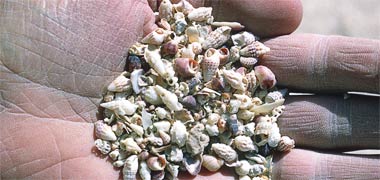
For years there has been a tradition in Qatar of using shell sand in both traditional and modern construction. Many of the beaches had extensive quantities of it, and commonly it was thought to have both a constructional integrity as well as providing a degree of thermal insulation. What was not fully realised was that, having been washed up from the sea, the material had both a saline content, and that it was relatively soft. But it was plentiful, easily accessed and cost little or nothing to provide to small building projects, so its use continued for some time. Note in this photograph, the amount of small, broken particles that were a feature of this material.
Aggregate
As I have written about on one of the pages relating to traditional Gulf architecture, the domestic constructions on the peninsula were built originally of mud and then of desert stones, hasa, or slabs of coral, hasa bahri or faruwsh, bound with a juss mortar.
With the development of the building industry with its need for more rapid and consistent methods of construction, the introduction of massed concrete works as well as concrete blocks saw a need for hard aggregates. In the first instance these were all provided by teams of men picking up rocks from the desert and loading them onto lorries. These rocks were of very good quality as they formed the top layer of rock that had weathered away with the action of the elements and driven sand leaving the hardest elements behind. This material was used in the construction of the original Doha Port quay where interlocking blocks, made from this aggregate, proved excellent even though they were located in the most at risk areas of the construction, that of the wet/dry zone of tidal salt water.

In the late 1960s the area for winning this rock would be outside the present location of the ‘D’ Ring Road but, with the continuing expansion of Doha, the area of search moved outward. But it proved increasingly obvious that sufficient quantities could not be produced using this scavenging method so the Government established a quarry at Umm al-Affai off the Dukhan Road. Though this was not the most suitable resource for hard aggregate, it was a location that was deemed to be suitable from the point of view of minimising the environmental nuisances that is a feature of quarries – devastation, noise, sand and dust.
While the top strata here were suitable for hard aggregate, continuing excavation to lower levels exposed increasingly soft material that continued to be used in construction both for buildings as well as for the rapidly expanding road system in the peninsula. The problem was most immediately apparent in the latter, when, in the rainy season, the limestone aggregates were dissolved and the milky solution became apparent on the road surfaces which subsequently failed.
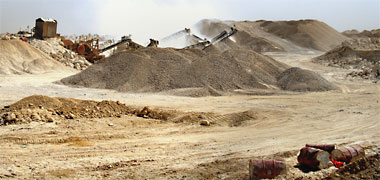
In order to avoid the problems being experienced by government, the larger contractors, such as JBK and Midmac, bought land and opened their own quarries with, in the early stages, a similar degree of success as the government had enjoyed as they stripped away the top layers. But they, too, suffered the same problems as their excavations worked lower into the softer, underlying limestone.

The development of the Hotel and Conference Centre was pivotal in resolving some of the issues surrounding the the character of aggregate available within the peninsula for building. The pre-cast plant that was established for that project, as well as for the University and other prestigious projects being considered such as the Corniche sea wall, required a harder material. The latter, in particular, required a material that would withstand the constant immersion and action of sea water. Sources were determined in the United Arab Emirates and companies established to import limestone and granite material for such projects. However, this was too late for the sea wall which experienced failure due to the dissolution of aggregate by the salts in the sea water. Remedial actions in terms of coatings were tested but it will require the replacement of units constructed of more suitable aggregates to resolve the problems.
more to be written…
Cement
The Qatar National Cement Company, QNCC, was established in 1965, its remit being to produce sufficient Ordinary Portland Cement for the needs of the country. Production at Umm Bab, on the west side of the peninsula, began in 1969.
more to be written…
Steel
The Qatar Steel Company, QASCO, was established in October 1974 as the direct result of a perceived need to make Qatar self-sufficient in terms of this material, particularly for the requirements of the construction industry. In order to establish the facility, the Government of Qatar entered into a partnership with Kobe Steel and Tokyo Boeki, the latter taking 20% and 10% respectively of the joint venture. Situated at Umm Said, the plant became fully productive in 1979.
more to be written…
Water
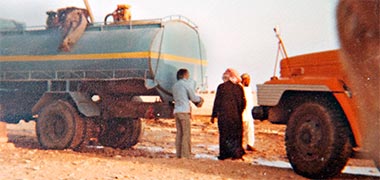
The construction industry also required water in considerable quantities, particularly in order to manufacture the concrete being used in the rapid development of the country. Very early concrete was made with saline or brackish water but, with the completion of the desalination plant, less saline water was available, though there was little or no inspection or control of water quality in construction works. In this photograph, taken in the early 1970s, water has been brought to a construction site outside Doha. A little more has been written relating to an associated problem on the page looking at gardens.
more to be written…
Road construction

The original roads within the Qatar peninsula were tracks following the desire lines of those needing to move between the increasingly settled developments. With time the desert paths were graded and, while marginally smoother, were very dusty because of it. They were designed to follow from point to point which meant that many of the changes of direction took place on unsighted rises, making travel dangerous not just because of the state of the surface and oncoming vehicles hidden by the road layout, but also by animals, as in this photograph.
The next phase in road development was taken by the Qatar Petroleum Company who maintained a tanker at Dukhan which, loaded with crude oil, was used to spary the roads. While keeping the dust down it had a tendency to render the roads dirty and slippery in the rain – as well as a little smelly. An ancillary problem was their disposition to fire. In the nineteen-sixties a street vendor threw hot charcoals on the road at the end of the day, setting shara’ al-kahraba on fire.
The next stage in their development was the use of what was termed ‘premix’, a mixture of sand, bitumen and water. The sand would be set out in heaps of around a couple of tons each and water mixed with it to create a damp mix. A barrel of bitumen, imported from Bahrein would then be poured into a hollow made in the centre of the damp sand. Workers, wearing rubber boots would then trample the mixture, so producing the ‘premix’.
This material was then loaded by hand onto trucks and taken to the site where it was tipped onto the track and rolled flat. The sun evaporated the water from the mixture leaving the bitumen and sand mixture to form a dust-proof, impermeable surface. While an improvement on the crude oil spray, it shared with that a tendency to be slippery when wet and was not particularly strong. This was the method used to surface the first runway at Doha. It is said that, in order to test for slipperiness on humid days, a Humber Hawk car was driven at speed down the runway and, at a pre-arranged point the brakes were hit hard and the slipperiness judged from the number of revolutions the spinning car made.

This aerial photograph, taken in November 1972, is of a site in the desert given over to the production of asphalt. It shows two asphalt plants making road surfacing materials. The long horizontal drums rotated and aggregate was fed in at the high end, rolling downhill while a fire was directed up the drum to heat the aggregate before it was mixed with bitumen to make asphalt or bitmac, as it was termed. It was dirty work.
more to be written…
Labour force
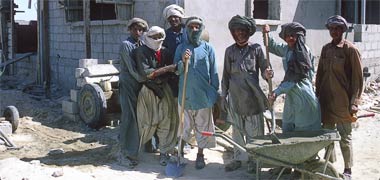
The labour force employed in Qatar in the last quarter of the twentieth century was drawn from a relatively narrow area and comprised Pathans, Baluchis and the like, a cadre of people who were strong and used to carrying out hard work under difficult conditions. This group, photographed in 1972, were building a small house and, like many such groups, came from the same village, thus giving them a degree of support away from their homeland and families. In many respects, this still happens, though the origins of many of the workers ranges farther afield with labourers being brought in from Nepal, Thailand and many other areas of the world. There are notes here on issues relating to expatriate labour.
While many in the West might assume that this produces a poor standard of work, this is patently not the case. With training, work to international standards was produced. This is still the case, though there have been complaints in the press about standards of finishing, a problem more likely to be associated with supervision and other issues.
training, supervision, origins, etc.
more to be written…
Plant and equipment

Sights such as this were extremely common in the early days of large and small scale constructional works in the peninsula. There was little regard for safety in either work clothes or protection by shoring, for instance, and those who worked on these projects commonly were injured. It was not that nobody cared, it was that more sophisticated methods of carrying out work had not yet been introduced, as most jobs were seen to be relatively simple works and not requiring a great deal of expenditure.
Despite this, plant and equipment were readily introduced into the country by the major merchants and contractors, particularly for the larger works, their costs usually being amortised over the life of a single contract. This meant that the country had an increasing supply of modern equipment to be used with relatively inexpensive overheads, thus enabling plant and equipment to move out into the wider contracting economy.

This photograph was taken in 1976 and shows some of the plant used in the construction of the Guest Villas at Rumaillah. The walls of the Villas were formed with reinforced concrete rather than with the usual concrete blocks, the concrete being poured between plywood formwork buttressed by a relatively stable steel framework system. This contrasted strongly with the usual way of working at that time where formwork was ill-fitting and the fines leaked between boards. This system was certainly an improvement.

However, prior to the introduction of more modern equipment, such as the commercial shuttering system shown above, construction was carried out using timber in many ways, particularly for scaffolding as well as shuttering. But because softwood boards were expensive, having to be imported usually through Saudi Arabia or the Indian sub-continent, they were often in a very poor condition due to constant re-use when employed for shuttering, and not in much better condition when creating the scaffolding.
It is worth noting that in the early days of constructions such as with the manara here, there was no concept of personal or site safety. While some of the workforce wore turbans, which might have afforded a degree of protection to the head, plastic flipflops were the universal footwear on sites, and even bare feet.
In this example of construction in the early 1970s, the manara of a masjid has the whole of its structure scaffolded with softwood strips nailed together, creating very little safety for those working on or around the construction. The shaft of the manara was constructed of concrete colums and staircase with concrete blocks infilling.
traditional, amortising, taxi association, etc.
more to be written…
Transportation

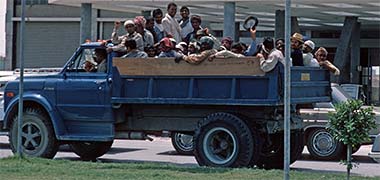
While the workers in Qatar were brought into the country for their strengths and capability to withstand onerous conditions of labouring in the peninsula, it took time for the building industry to develop its practices and procedures in the increasingly rapid expansion of the country. Lorries and pickups were an essential part of any contractor’s resources. The need to transport building materials and equipment as well as his workforce were essential aspects of building, with workers – generally housed by the contractor in encampments – needing to be moved from their accommodation to work site on a daily basis. The first of these two photographs shows a small group of workers being driven to work in the north of the country on the back of a pickup, a common sight in the 1970s; the second shows a larger group happily waving to the camera, also taken in 1972.

It took some time before contractors began to invest in buses to transport their workforce between their accommodation – generally located on the periphery of towns – and the building sites in which they worked. Whether this was due to a safety initiative, or whether the contractors saw improvement in their workforce due to their being treated better, is unclear, but some of the larger contractors started the trend in the late 1970s and, in one case, coupled this with a choice of meals for their workers, a significant improvement that was said to result in better workmanship.
The construction boom naturally saw a concomitant increase in the purchasing and sale of construction equipment with the costs of the equipment being amortised over the life of a single job. The Taxi Association, which operated the lorries, among other equipment, was able to derive considerable work by lobbying for the continual use of their equipment, particularly lorries. Vehicles were then sold on and moved down the scale of contractors, benefitting the construction industry and the economy. With this increase in transport vehicles there was a burgeoning of mechanic and tyre repair shops throughout the peninsula, adding to the existing steel fabrication yards for both structural and decorative work.

Vehicles of the Taxi Association were much in demand as the scale of construction increased throughout the peninsula, but particularly in and around Doha. Lorries were a standard feature on the roads as they ferried, particularly, desert stones to sites needing fill or took away material from excavated sites. The largest of the sites requiring fill was the West Bay, or New District of Doha where the Taxi Association’s lorries provided a bund outlining the shape of the area to be developed, forming a container to the fill that would be pumped in from dredged material of the West Bay.
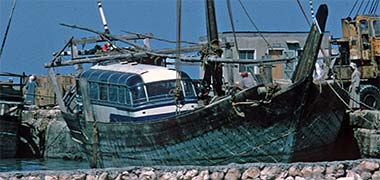
Meanwhile, equipment began to pour into the country with the prospect of a boom in the economy. Some of the equipment came in overland through Saudi Arabia, but much came by sea, generally in large cargo ships docking at the new jetty. But other methods were available. In this photograph a Mercedes bus, one of a pair, awaits lifting from a traditional boom in the country craft harbour in April 1972.
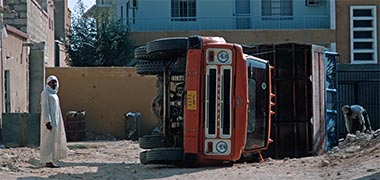
Much of the early development was carried out with equipment that was not equal to the task or, if the equipment might have been up to date, the skills for managing work were not. In this photograph, taken in 1972, a load of steel for a new house has turned the lorry on its side when the driver activated the tipper to unload the badly placed steel reinforcement bars, there being no workers available to move the load by hand.

Nor were the lack of handling skills and management the only problems facing contractors with regard to transportation. For instance, the Ras Abu Aboud flyover witnessed a significant number of accidents from loads that were too tall to clear the underside of the bridge. It might have been that some of the loads brought in overland through or from Saudi Arabia might not have been aware of the restriction, but a number of these loads were being moved within Qatar. This type of problem on building and completed sites was not uncommon and resulted in a number of accidents and fatalities.
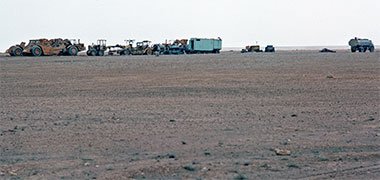
The increasing amount and scale of development required contractors to buy in considerable plant and equipment in order to be able to fulfil the number of projects the state was now embarking upon. There were few contractors’ yards large enough to contain this equipment and, with land prices escalating, some took to parking their equipment in the desert on land either leased or bought with the possibility of future development. This photograph, taken in March 1972, shows one contractor’s graders and associated vehicles resting in the desert outside Doha.
more to be written…
Management
origins, training, etc.
more to be written…
Public and private sectors
joint ventures, expertise, etc.
more to be written…
Standards
There is more on this subject on the page specifically relating to Building Regulations. This page looks more at the development of standards and regulations.
Not all building practices were sound in the early days of construction. A number of practices that were remnants of traditional building continued, and new bad practices developed. For instance, and as mentioned above, the use of littoral sand contaminated with salt contributed to the attacks on steel in the new reinforced concrete construction as did shell sand used by some as an insulating material, often on roof screeds and, occasionally, in concrete block production.
As for poor new practices, some related to the specification of materials and others to methods of construction. The introduction of mild steel pipework to carry water resulted in the heavy contamination of water supplies and the rusting through of both pipework and steel water tanks. There were also unsound constructional practices that had to do both with an ignorance of sound construction as well as a lack of supervision. It was not uncommon to see workmen hammering short steel reinforcing rods into the green concrete of roofs in order to act as starter bars for the next column, steel mesh was rusty and badly placed, there was no quality control on poured concrete with the pour being heavily worked bringing latence to the surfaces, nor was there any attempt to slow down the drying rate of concrete under the strong sun.
Scaffolding was invariably of timber, nailed together, the batching of concrete and mortar was measured by eye, shuttering was effected with whatever was available and the pouring of concrete a random operation. Steel reinforcement was usually rusty and I have heard contractors claim this gave an improved grip. It was often placed theoretically incorrectly in many smaller buildings with, for instance, steel placed at the bottom of internal floor slabs continued out to form cantilevers instead of moving towards the top of the slab. In any case, reinforcement was usually too low in the slab with no control of workers walking across and treading it down.
Many of the problems stemmed from ignorance, some of the poor knowledge having been imported, at all levels, with the new expatriate workforce brought into the country to build for the new contractors. But there were also unfit materials brought into the country as some importers introduced material that had been condemned elsewhere for a variety of reasons. Asbestos based products were bought inexpensively when banned in Europe, and materials that would not pass tests in their national country of origin also found their way into Qatar as well as into other newly developing countries. As merchants attempted to improve profits, they sourced their materials from a wider selection of countries, some of the products of that sourcing producing poor materials and equipment, in some cases, actually or potentially dangerous.
regulations, standards, competencies, etc.
more to be written…
more to be written… shell sand, steel, rust, concrete mix, management, on-site and off-site, work force, equipment, supervision, practices, etc.
Search the Islamic design study pages
- Introduction
- Arabic / Islamic design
- Arabic / Islamic geometry 01
- Arabic / Islamic geometry 02
- Arabic / Islamic geometry 03
- Arabic / Islamic geometry 04
- Islamic architecture
- Islamic urban design 01
- Islamic urban design 02
- Islamic urban design 03
- Islamic urban design 04
- Islamic urban design 05
- Arabic / Islamic gardens
- Gulf architecture 01
- Gulf architecture 02
- Gulf architecture 03
- Gulf architecture 04
- Gulf architecture 05
- Gulf architecture 06
- Gulf architecture 07
- Gulf architecture 08
- Infrastructure development
- The building industry
- Environmental control
- Perception
- The household on its lot
- A new approach – conceptual
- A new approach – principles
- A new approach – details
- Al Salata al jadida
- Public housing
- Expatriate housing study
- Apartment housing
- Pressures for change
- The State’s administration
- Society 01
- Society 02
- Society 03
- Society 04
- Society 05
- Society 06
- History of the peninsula
- Geography
- Planning 01
- Planning 02
- Population
- Traditional boats
- Boat types
- Old Qatar 01
- Old Qatar 02
- Security
- Protection
- Design brief
- Design elements
- Building regulations
- Glossary
- Glossary addendum
- References
- References addendum
- Links to other sites