
a collection of notes on areas of personal interest
Introduction to the First World War battles of Bullecourt – May 1917

On Wednesday 22nd May 2002, I travelled to Bullecourt in Picardy, northern France for the first time. The setting for two of the terrible battles of the Great War, I didn’t know what I expected to see there or learn from the visit, but I found it an uncomfortable experience, perhaps for three reasons; I had not previously and deliberately visited a recent foreign battlefield, nor had I directly investigated anything of the aftermath of the First World War, particularly with a personal connection.
It was difficult to visualise what it must have looked like at the time of the battle, both in terms of the physical disposition over the ground, as well as with the character and atmosphere of a battlefield. But perhaps it was also because my grandfather had died there eighty-five years previously. So too, coincidentally, had one of the grand-uncles of my wife; an Acting Captain at the age of nineteen who had won a Military Cross a year earlier. These events made the experience so much more personal.
Nevertheless, it was possible to learn something about the details of the battle from the museum, and to be able to visualise a little of what it must have been like to participate in the two dreadful battles that took place there. However, it was not possible to understand whereabouts on the ground my grandfather would have been during the action.
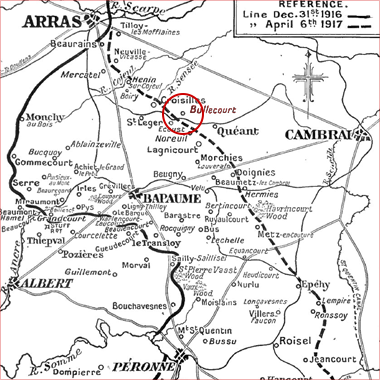
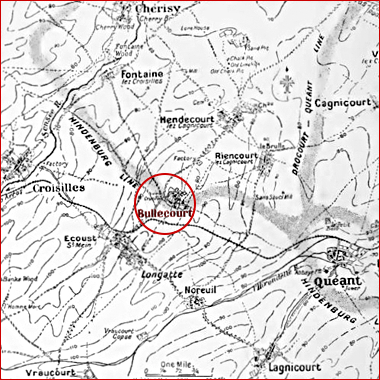
These two maps illustrate, firstly, the lines of retirement of the German army from 31st December 1916 to 6th April 1917, and the position of the Hindenburg or Siegfriedstellung defences wrapping round Bullecourt on its south and west sides in April 1917.
As a slightly unrelated note on the cruel coincidences of war, not only did my grandfather and one of my wife’s grand-uncles die at Bullecourt in 1917, but her grandfather and one of my grand-uncles died at the siege of Kut in Mesopotamia, the Spring of 1916.
Andrew Thomas Lockerbie
My grandfather, Andrew Thomas Lockerbie joined the Honourable Artillery Company on the 9th December 1916 as Private 9618 of the 2nd Battalion, Honourable Artillery Company, which formed a part of the 22nd. Brigade of the 7th. Division. He is recorded as being killed on Thursday, 3rd May 1917 at Bullecourt – at least that is what the records eventually stated. Although there is some doubt, certainly in my mind, as to the actual date of his death, it seems his military career lasted less than five months.


There is no grave for him. His death is commemorated carved high up on one of the stone walls of the Arras Memorial in the Fauborg d’Amiens cemetery on the Boulevard du Général De Gaulle, situated in the western part of Arras.
He is also remembered at France’s National Memorial, the Anneau de la Mémoire - Mémorial international Notre-Dame-de-Lorette where around 580,000 dead are listed in alphabetical order, with no indication of rank.
In line with the records of the Government, the Commonwealth War Graves Commission records his death as being on the above date, but it is probable he survived a little longer.
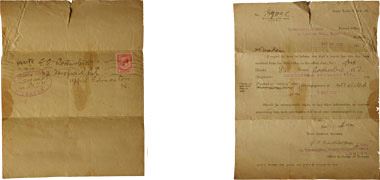
These two photos illustrate the front and back of a yellowed form letter which, as was their administrative practice at the time, the British Government sent my grandmother as Andrew Thomas’ next-of-kin, his wife. Date stamped the 29th May 1917 it records that, three weeks after the event, they had only just learned that her husband was missing in action, there being no description of what this might mean:
I regret to have to inform you that a report has this day been
received from the War Office to the effect that (No.) 9618
(Rank) Pte. (Name) Lockerbie, AT.
(Regiment) Honourable Artillery Coy. was
posted as ‘missing’ after the engagement at not stated
on the 3 May 1917.
Should he subsequently rejoin, or any other information be received
concerning him, such information will be at once communicated to you.
The letter is stamped for the Territorial Force Record Office No. 259 HAC and dated 25th September 1917. I assume she received the letter within a week or so of that date. It seems a long time before she was given this news and, during this four-and-a-half month period, she must have been aware of the lack of news from him, and concerned for his safety.

It is now impossible to know exactly when it was that my grandmother received additional information – aural family history says that it was an unspecified time after she received the official news in late September – relating to what had happened to Andrew. However, my grandmother found herself suddenly, and extremely, confused when she later received a letter from, as she recalled, a woman representing the German authorities returning my grandfather’s personal effects and referring to ‘our Australian prisoner’.
Unfortunately I have no idea what happened to this letter, assuming it was received in letter form, nor do I have any idea as to the character and extent of the personal effects, although one of the items was said to be a pocket watch, referred to below.
At first I had thought this to be a representative of the Swiss Red Cross but, having checked with them, have been told that they have no record of him so I have to assume the woman was German. I have also been able to check with the German State archives and was told that all records relating to prisoners were destroyed by British bombing in the Second World War…
Andrew Thomas Lockerbie was neither Australian, nor was he ever seen again in England. As there were both British and Australian troops opposing the German lines at Bullecourt I can understand that there might have been some confusion.
Unfortunately, I don’t know when this package arrived but I can imagine the emotions my grandmother must have felt, first to believe he was dead, then suddenly to believe her husband was still alive. I imagine she must have continued to believe he was alive for some time.

In addition to the notice informing my grandmother that her husband was missing, I have found three other documents when going through papers that I must previously have overlooked. Two of them are form letters of sympathy from the Secretary of State for War and King George V, and will have been sent out in their thousands. Neither of them is dated and I don’t know when they would have been received.
I was told that the Honourable Artillery Company amended their records in October 1918 to record Andrew Thomas’ earlier death on the 3rd May 1917.
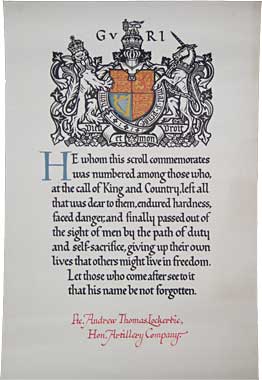
The fourth document is a small scroll of remembrance that was transmitted to her in a protective tube. It is stamped and franked, and appears to have been sent on the 20th May 1920, three years after the death of my grandfather. Again, I assume that these were sent in their thousands to the next-of-kin of those killed in the war.
There must have been correspondence which has disappeared in the intervening years. I have seen a letter my grandmother wrote to the War Office asking for them to give her any information they might have relating to his being missing or dead. I have also been told that it was very common for women in her position to ask the War Office and the relevant regiments if anybody had seen their men on the battlefield as they attempted to obtain some kind of closure. Regrettably regimental records rarely mentioned anybody other than officers, so it would have been unusual to find anything written there on individuals of other ranks.
Later she wrote another letter, this time to the Honourable Artillery Company, with whom she had obviously had some form of communication, and this time mentioning her brother whom she now knew to be dead:
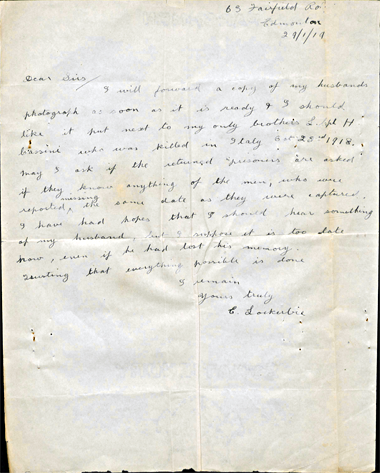
63 Fairfield Road
Edmonton
29/1/19
Dear Sirs,
I will forward a copy of my husband's photograph as soon as it is ready & I should like it put next to my only brother’s L. Cpl. H. Cassini who was killed in Italy Oct 23rd 1918.
May I ask if the returned prisoners are asked if they know anything of the men, who were reported missing the same date as they were captured.
I have had hopes that I should hear something of my husband, but I suppose it is too late now, even if he had lost his memory.
Trusting that everything possible is done
I remain
Yours truly
E. Lockerbie
On the evidence I have my initial belief was that my grandfather was captured by the Germans, lived long enough for him to be recorded as a prisoner, have his personal effects taken and processed for return to his wife, but then died in captivity or was killed – I assume accidentally – either by German or allied fire. The rolling nature of warfare would have made it difficult to keep formal records of burials. However, there seem to be four other possibilities:
- the personal effects may have been taken from his live or dead body and returned by the Germans,
- the personal effects may have been taken from his live or dead body by a German whose wife later sent them back to my grandmother,
- he may have been wounded and given his personal effects to somebody else – a relatively common practice, I’m told – and presumably to an Australian who, himself, was later captured, or, perhaps most probably
- he may have died in prison, Fort MacDonald, near Lille in Belgium, his probable place of imprisonment, having considerable notoriety attached to it, particularly following Bullecourt when the Germans reacted adversely to rumours that their captured troops were being mistreated.
The only odd thing about the explanation I have is why the Germans would have thought him Australian. Given that the Australians took the brunt of the strong defence mainly, they believed, because of the incompetence of British officers, I would have thought the personal effects would have identified my grandfather as British – and bear in mind they were returned to England.
Since I wrote the above, I have had the opportunity to correspond with a number of individuals with some experience of this period and its conditions. One of them has been particularly generous by writing in some detail of the possibilities relating to his disappearance and death. What follows is what has been suggested to me, seems to make sense, and for which I am extremely grateful. Although I have not shown it as such, much of what follows is quoted:
The first possibility was that he was captured, wounded, and died before it was possible to register him as a prisoner-of-war. The registration process, where the German government was required to register all prisoners with the International Red Cross, was extremely slow and, by 1917-18, more or less overwhelmed. By 1918, captured British prisoners were generally not registered at all.
Prisoners captured as wounded were nursed in military hospitals where there were female nurses – at the front or behind the lines in France and occupied Belgium. From there they were often evacuated on to military hospitals in Germany. From what my grandmother told me I have assumed that the woman who wrote to her was German and, if she was writing from France or Belgium, she may have been either one of the female nurses or Hilferinnen who worked in the occupied territories, or a nurse working on a hospital train in the case that my grandfather died while a wounded prisoner being evacuated to hospital in Germany. Bad wounds may also explain why he would have been unable to clarify to the woman who nursed him that he was not actually Australian; she would have been going on the nationality of the other wounded prisoners arriving from the same battle into her nursing unit.
If the woman who wrote to my grandmother was writing from within Germany, the case becomes more confused. A British prisoner who was sent to Germany was usually registered, enjoyed better conditions, and was able to write home. So it appears unlikely that this was the scenario – unless he was evacuated to a hospital in Germany where he died of wounds. In this last case, a German nurse may well have sent on his personal possessions home. This was a fairly frequent act of kindness done for prisoners who died in Germany. If he died fairly soon after reaching Germany, and was still unconscious, that would also explain why he was not registered and why the woman believed him Australian.
Another possibility might have been that the covering letter that my grandmother received, enclosed with my grandfather’s personal effects, was written by a woman working for the Swiss Red Cross organisation. However, having written to them some time ago, I was informed that there was no record of his being recorded as a prisoner.
There appear to be a number of problems with this. Firstly, if the personal effects were in the possession of an Australian prisoner, why had the prisoner not got any Australian papers that might have identified him? Secondly, it might be assumed that the writer would have realised the discrepancy between the understanding of dealing with an Australian and the sending of the letter to an English address. A third problem has to do with names and the effects themselves. It is difficult to understand the circumstances where the personal effects of a British soldier would be confused with those of an Australian soldier as the Red Cross, had a record in the name of my grandfather as a British soldier when corresponding with his father.

In 2017 I found a document on the Red Cross’s web site, an image of which is shown here, appearing to show that an enquiry was made by Andrew’s father about his son possibly being a prisoner-of-war. The document shows that enquiries were made by the Red Cross, that they found nothing, and replied to his father on the 3rd August 2017 stating that to be the case. The note states that he disappeared in the region of Bullecourt and Fresnoy. The phrase ‘Négatif envoyé’ has the meaning that the person addressed, my great-grandfather, has been told that nothing was known. There is also a handwritten addition, ‘rien’, meaning, ‘nothing’. At the top right of the card is the typed number ‘14756’ crossed out with the handwritten ‘A20758’ replacing it. This reference leads nowhere, probably to another record which has disappeared. Interestingly, the document also notes that Andrew had been ‘serait: blessé’, wounded. I have no idea how that information had been learned if he was not found, though it is extremely likely to have been the case.
The last possible scenario is that he was captured wounded or unwounded and sent into a German army prisoner-of-war labour company. These companies were kept working behind German lines in 1917 and 1918 in harsh conditions. Prisoners who worked in them were often not registered and usually could not write home. If they died they were buried at the front. If they fell ill or were wounded at work they were sent to a military hospital in France and Belgium – where they encountered nurses – and it is just conceivable that my grandfather may have been an injured or ill labour company prisoner who died in a military hospital near the front; again this would mean the woman who wrote to my grandmother was a nurse.
I used to believe that a hospital scenario was the most probable one to explain how a woman was able to write to my grandmother and send on his possessions. I had thought it most likely that she obtained those possessions because she was with my grandfather when he died or just after death. Now I don’t know what is the most likely chain of events, though perhaps the scenario of a German taking his possessions and his wife returning them to England, makes the most sense and might account for misunderstandings regarding nationality.


A little while ago, and long after I had begun these notes, it occured to me that I had never had sight of the standard war medals my grandfather would have been awarded, despite his abbreviated war service. He would only have been given the two received by everybody who served abroad – the British War Medal and the Victory Medal – but it seemed to be a responsibility to establish what had happened to them, if that was at all possible.
In July 2023 I searched again for information relating to my grandfather and noticed on the form setting out his medal entitlement some initials suggesting that the medals might, at some time, have been returned to the government. The Ministry of Defence confirmed that this was so, though they were unable to tell me when the medals had been given back to them or by whom.
There is also another HAC document with a note relating to medals, the relevant information shown as a composite on the lower of this pair of images. Unfortunately it has not been possible to translate the different initials on it, although some of the notes or initials can be seen to be common to both cards.

It is obvious from the little evidence there is that my grandmother was upset by the return of some of her husband’s effects, and the lack of knowledge of what had happened to him. This must have preyed on her mind and is perhaps the reason that she or, perhaps, her father returned her husband’s medals to the government. With that in mind, as noted above, I wrote to the War Office and they, having determined that the medals had indeed been returned, provided me with replacements.
My grandmother married again four and a half years later in January 1922, her second marriage lasting to her second husband’s death, fifty years later.
Harry Leonard John Cassini
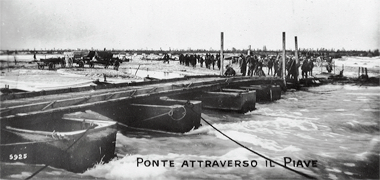
My grandfather’s best friend was Harry Leonard John Cassini, his wife’s brother, my grand uncle. I have not been able to work out the sequence of events but was told that both of them had gone to Canada some time before the war, returning to enlist in the Army, and joining the Honourable Artillery Company a day apart. I suspect that they would have tried to enlist together but that they were required to join up at enlisting stations relating to where they lived near to each other, both in North-East London.
Some time after the above note was written, I discovered that my grandfather did, indeed, travel on the ‘Empress of Britain’ from Liverpool on the 14th June 1907 arriving in Quebec at mid-day on the 21st June 1907, then travelling on by the Canadian Pacific Railway that evening to Toronto. I can find no record of Harry going, nor of either of them returning though, obviously, my grandfather did. There seems to be no family record of why he went or why and when he returned. There is, however, an accompanying story that my grandfather was given a pocket watch for rescuing a child from being run over by a train. The pocket watch, or a pocket watch, is one of the items returned to my grandmother as part of the effects of ‘our Australian prisoner’, referred to above.
My grand-uncle Harry was the only son of the seven children of John Dominicus Cassini and Emily Webster, the latter of whom lived to the ages of 91 and 81 respectively.
Harry enlisted on the 8th December 1916 and was trained and sent to France on the 18th March 1917 on the troopship, ss. ‘Donegal’. I have assumed the ss. ‘Donegal’ must have been in regular use criss-crossing the Channel with troops and equipment. But, having managed to out-distance a submarine on the 1st March 1917, her luck ran out and she was torpedoed and sunk on the 17th April 1917, a month after Harry had been transported to France. He is recorded on the Honourable Artillery Company’s ‘Nominal Roll of men proceeding to Unit of the 13th April 1917 Draft No. 12.’
The day after Harry joined up, my grandfather, Andrew, enlisted on the 9th December 1916 and was originally posted to ‘B’ Company 3rd Battalion, both of them with the Honourable Artillery Company. The First Reserve Battalion of the Honourable Artillery Company was based at the Tower of London where he was listed as part of a ‘Special Draft’ of twenty-two ‘other ranks’ on the 5th March 2017.
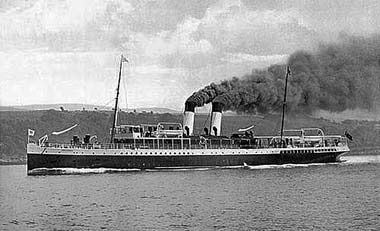
Transferred to the 1st. or ‘A’ Company, 2nd Battalion, he was sent to France on the ss. ‘Arundel’ on the 8th March, leaving from Folkestone and arriving at Boulogne on the same day. From there they travelled on to no.8 Infantry Base Depot at Havre, arriving on the 10th March 1917. The ss. ‘Arundel’ is shown here, probably on the Newhaven to Dieppe run, its usual route when used as a troop transport. Unlike the ss. Donegal, the ss. Arundel went on to survive the war, only to be broken up in 1934.
Of the twenty-two privates of the Honourable Artillery Company shipped to France as reserves with my grandfather – and listed at 15 Camp, Havre on the 12th March 1917 – five, including my grandfather, were killed on the first day of the Second Battle of Bullecourt, 3rd May 1917, Harry surviving until three weeks before the end of the war.
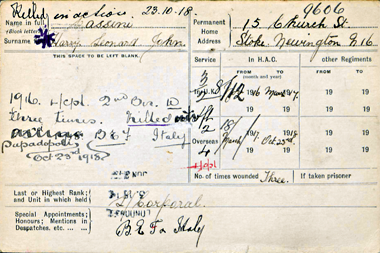
To date I have not been able to learn much more about what happened to Harry, though here is a transcription of a newspaper article it appears he sent to a local newspaper. Apart from confirming his convalescence after at least one of his woundings, it illustrates something of the The ‘Church Street Boys’, a reference to people who lived on Church Street, Stoke Newington in north London where they obviously formed a recognisable group, Harry’s address being shown as No. 15 Church Street, Stoke Newington, London N16.
Mud at the Front
Letter from a Church Street Boy
Corporal H. Cassini, H.A.C, a well-known “Church Street Boy”, writes home in a cheerful strain, thus: You will be pleased to hear that I am now staying here for a fortnight or so, and I am enjoying the change. It is much healthier here than it was in Flanders last week. I suppose I ought not to grumble, for we were out six weeks, going from one place to another. Of course we had plenty of hard marches and training, but we did not have a bad time until we crossed the frontier and got into Flanders. Well, the least said about that the better, but mud, and guns, shells, men – and more mud. You will have been able to get a better idea as to what it was like, from the newspapers than I can give you, for I see they have been devoting a good many columns to the subject of mud. Many of us looked as if we had been dropped into mud carts, and we had great difficulty in keeping our rifles in working order, but somehow or other we overcame all obstacles, and when we did get among the Huns they got the full benefit of our bad temper. They dodged about from one place to another, like frightened rabbits (and they had reason to be frightened). Some of them came out of the “pill-boxes” with their hands up, but continued to fire machine guns from them, and they accounted for some of our fellows. They had a short life but not a merry one. I have never seen men in such a state of ????
When a few of them had been bayoneted, it took all the fight out of the rest of them and up went their hands and it was “Mercy! mercy! Kamerad.” It was terrible hard work in that mud, but it was just as bad for Fritz, and they were only too glad to be taken prisoners. One of them said to me “It is good, I am finish. War no good.” Another said, “Artillery too good. Drop shells here, here, here;” and pointed to the ground all round him. “No good, Kamerad,” and he put up his hands. There was a humorous side to it, though. I saw one little chap about five feet two inches with a German overcoat on that would have fitted a man six feet six inches, and a German shrapnel helmet on that nearly rested on his shoulders, taking a batch of prisoners behind the line. He looked like little Tich with a City policeman’s uniform on. Even the prisoners grinned. There was a “jock” with a bullet through his nose, too. He said, “There Man, that’s what we get for fightn.” Not all the scenes were amusing. There were some terrible sights which I will not attempt to describe, although I shall never forget them.
Corpl. H.C. 9606 2nd H.A.C. No. 6 Convalescent Depot, A.P.O. S11, France.
This was obviously written within the constraints of the censor’s requirements at the time and has a character that many will read uncomfortably, though fitting the times in which it was written. Regrettably there is no detail of the battles he fought in nor mention of his brother-in-law and best friend’s, my grandfather’s, death.
So far I have been unable to determine when this was written nor when published, but from his address it appears it may have been on one of the three occasions he was wounded and convalescing. No. 6 Convalescent Depot was located outside Étaples, a couple of kilometres inland from Le Touquet on the Channel coast. ‘A.P.O.’ stands for ‘Army Post Office’. Convalescent Depots were said to have a bad reputation caused by disaffection of many of the wounded who did not wish to return to combat duties aggravated by the attitude of the guards many of whom had not seen combat.
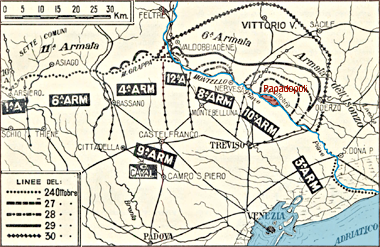
The battalion moved from the north of France to Italy in November of 1917 as part of the 22nd. Brigade of 7th. Division. A note I have just found suggests that the article he wrote may have been published on the 17th October 1917. It is not possible to tell if this was the first, second or third time he was wounded. I have yet to find the original newspaper despite searching the Hackney Archives situated in the area of London which would have covered his home in Church Street, Stoke Newington.
Harry Leonard John Cassini, Lance Corporal 9606 of the 2nd Battalion, Honourable Artillery Company, a constituent part of the British Expeditionary Force in Italy is recorded as having been wounded in action three times. Although I don’t know in which areas of the conflicts these occured, it is assumed they would all have been in northern France. At least one of the incidents must have been serious enough for him to have been sent for convalscence at No. 6 Convalescent Depot outside Étaples from which he wrote the above note.
The British Expeditionary Force had been sent to bolster the Italians who were facing Austro-Hungarian troops of the 6th. Army, reinforced by troops brought up from the Eastern and Balkan fronts and commanded by General Svetozar Borojević von Bojna. Both sides took very heavy casualties. The strategy of the Italian forces, whose superior numbers were under the command of Marshall Luigi Cadorna, was to spread out his forces along the front. This contrasted significantly with the strategy of the Austro-Hungarian troops, who concentrated their attacks in specific areas and were generally more successful.
Harry was killed at Papadopoli island in what was termed the Third Battle of the Isonzo – on the 23rd October 1917 in the joint Italian-British-Franco action against entrenched Austro-Hungarian troops.
There was a lull in the fighting before the final battle of the war, the battle of Caporetto on the 24th October 1917 began. However, within a short time the Italian army collapsed in what was regarded as the Italian Army’s greatest defeat. Both armies saw a change in leadership and reinforcement in the area but neither side were able to make significant gains. In June 1918 with a stalemate centred on the Piave river, the Austro-Hungarian army began its final attack, Second Battle of the Piave River, ending in a decisive victory for the allies. This was a significant turn in the tide of the war and was followed by the collapse of the Austro-Hungarian empire. The First World War came to an end on the 11th November 1918.
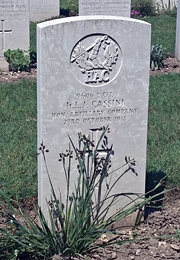
Harry Leonard John Cassini is buried in the Tezze British cemetery in Italy. The cemetery is situated in the north-west quadrant of the village of Tezze, around three kilometres north of Papadopoli island, which is north of Treviso, itself around twenty kilometres north of Venice, Italy. This image shows his gravestone at Plot 3. Row A. Grave 11.
Bullecourt

A small village in the flat plains of northern France, Bullecourt lies mid-way between the towns of Arras and Cambrai, in Nord Pas de Calais. Like so many other small villages that were overwhelmed in the conflict, its devastation – photographed here in 1917 – was complete as the two armies struggled for supremacy over this part of the defensive German Hindenburg Line which ran through the village, just to the south of its centre with the village effectively acting as a bastion of that line.

Demolished and abandoned in 1917, the village was slowly rebuilt in the following years. As can be seen from this image, the Offices of the Mayor, the Mairie, was reconstructed in the centre of Bullecourt in, I have been told, 1932, some time after the First World War hostilities had ended. Its interesting styling reflects something of both the rural character of Bullecourt in this part of France and the Art Deco styling of the early decades of the twentieth century.

The delightful early-twentieth century lettering over its entrance, illustrates the the post-war dating of the Mairie’s reconstruction.
Nowadays, as then, Bullecourt is approached over the flat, undulating countryside so well suited to the deployment of tanks and artillery. The open ground must have been difficult to use effectively by the infantry due to the ease of observation. Apparently, one of the first things the Germans did was to demolish the church tower there to reduce the capability of the allies locating targets and directing their artillery fire.
Today the church, town hall and the other buildings of the village are rebuilt and consolidated with new buildings so it is difficult to see the pattern of the fortifications but, from the photographs in the small museum it is evident that the whole of the village was virtually obliterated by the force of the bombardment.
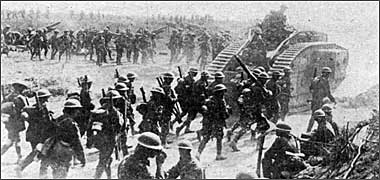
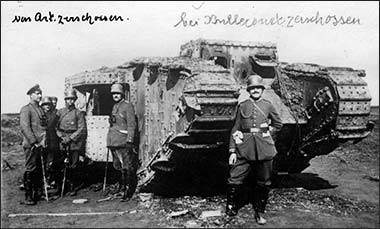
It has to be remembered that tanks were a novelty in this war, and that they were, as yet, not sufficiently developed to deal with all the issues they would face in battle. Much has been written about the difficulties in conceptual thinking relating to the moving away from mounted cavalry to enclosed, mechanised machines. Tanks were used by the British in the development of the battles at Bullecourt with the intent that they would make light of the barbed wire and be formidable weapons on the battlefield. But neither they nor the rolling artillery barrages were able to deal with the wire and clear a route through for the infantry. This was compounded by the fierce opposition the allies faced from the Prussian troops ranged against them as well as by the fact that they were cumbersome, unpleasant for their occupants, lightly armed and protected, as well as being difficult to operate. Perhaps more importantly, the British underestimated not only the ability of the Germans to protect themselves against artillery by developing deep trench and bunker systems, but also their interception of allied telephone communications.

It is said that the German troops here were some of the best in their army and that they were able to mount a very professional defence of Bullecourt, but they were assisted in this by the British artillery’s inability to time their rolling barrages properly, allowing the Germans to come out of their bunkers when the barrage had passed over them and attack the advancing infantry. The Australians, particularly, took very heavy casualties in this part of their war and Bullecourt is remembered there to a greater extent than it is in Britain.

This photograph, from German archives, shows that the battles did not always go the way in which the allied armies wanted. Here, German soldiers are seen occupying part of a British trench somewhere between Bullecourt and Croiselles, three kilometres to its west, in 1917. The view behind them shows something of the featureless character of the battlefield with, in the foreground, the relatively exposed trenching with its covered shelters. The relaxed attitudes of the soldiers suggest they were inspecting the trench during a significant break in the fighting.
What follows is a brief description of elements of the First World War relating to my grandfather, Andrew Thomas Lockerbie, and to his best friend, brother-in-law and my grand-uncle, Harry Leonard John Cassini, both of the Honourable Artillery Company.