
a collection of notes on areas of personal interest
Final thoughts on the search for my grandfather
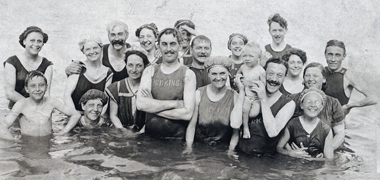
It has been a long time since I began the research into what might have happened to my grandfather, Andrew Thomas Lockerbie at Bullecourt. From time to time I have searched records which might have helped but no new avenues have presented themselves, until now. The increasing use of Artificial Intelligence has enabled me to use it to search areas otherwise inaccessible or unknown, and this has suggested that I add this page to my notes, essentially assembled with the use of AI, and the only part of my site that does so.
Recently I have returned to the question of what might actually have happened to Andrew, partly because it has always seemed to me unsatisfactory simply to say that he was killed at Bullecourt on 3rd May 1917 when, in fact, nobody knows that he was.
I have not found a missing piece of evidence that would clarify his disappearance, and I suspect that such records no longer exist. The International Red Cross has no further information, and I understand that the relevant German records were largely destroyed during the Second World War. What follows is necessarily conjecture, albeit conjecture based on what is now known about the fighting.
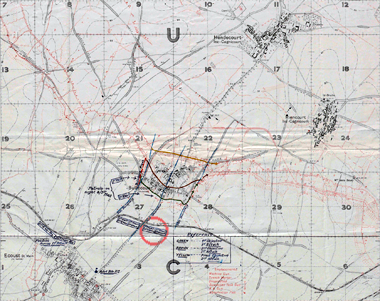
This first map is taken from the War Diaries – WO95/1661/3 – of the 22nd Infantry Brigade, which includes the Honourable Artillery Company, and is held in the National Archives. The map indicates the position of the 2nd Battalion Honourable Artillery Company before they went into action at about 10.30pm on the night of 3rd May 1917. The green, brown and orange lines mark, respectively: the intended first objective, first attack; the second objective, first attack; and the third objective second attack. A and B Companies were to take the first objective, with C and D Companies passing through towards the second. By 11.50pm they had reported that they had reached their objectives. Thereafter the situation appears to have deteriorated rapidly.
The instructions to the Honourable Artillery Company are contained in the 22nd Infantry Brigade Operations Order n°. 125, 3rd May 1917:
#4. The objectives of the 2nd H.A.C. will be:-.
- 1st. The German Front line from U.28.a.3.1. inclusive to road at U.27.b.7.8. exclusive.
- 2nd. The second German Line from U.28.a.8.8. inclusive to road at U.27.b.7.6. exclusive.
- 3rd. To work up the German Front Line system and gain touch with the 6th Australian Brigade whose left now rests at U.22.d.6.3. - U.22.d.6.0.
- 4th. To push strong patrols into the village and gain touch with any parties of the 125th Infantry Brigade holding out there, and with the patrols of the 1st R.W.F.
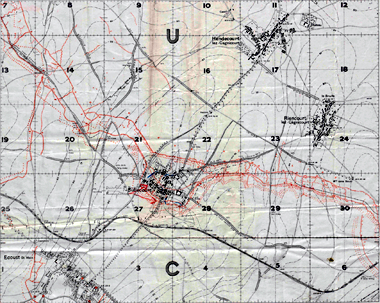
Pencilled on this second map, and with two arrows made in red, is a note indicating the direction of the German counter-attack which began at 12.30am on the morning of the 4th; at 1.45am Captain Bower reported that he was practically surrounded, with only about thirty men left; at 2.15am he reported that he had been ‘bombed out’ and had taken up positions in shell holes outside the German wire. At 3.30am orders came to withdraw, followed by a German barrage and yet another counter-attack.
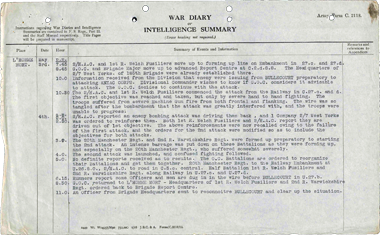
The ‘Narrative of Operation Against Bullecourt For Period 3/5/1917 to 5/5/1917’ sets out in some detail the difficulties of this combat. Having advanced under a rolling barrage the British troops were met with strong resistance and counter-attacks by the Germans who managed to drive a wedge between the right wing of the 2nd HAC and the left wing of the Australians. There was hand-to-hand combat with noise and smoke so dense that some troops fell into German trenches they were unable to see. It became evident that the initiative had not succeded and the necessary orders given.
The battalion eventually collected what men it could and took up a position along the Écoust-Noreuil road which runs south-east at the bottom left corner of the map. It is certainly possible in the rapidly changing conditions that Andrew was wounded and became separated from his comrades without anyone subsequently knowing whether he had been killed, rescued, or taken prisoner.
The 2nd Honourable Artillery Company’s casualty return for the period 3rd to 5th May is uncomfortable reading.
- 2 officers and 2 other ranks killed,
- 5 officers and 101 other ranks wounded, and
- 4 officers and 99 other ranks missing,
presumably one of the latter being Andrew.
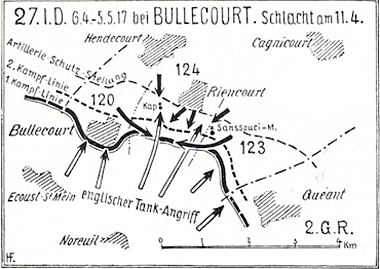
It is worth remembering just how confused this fighting was. The German defenders were not necessarily in their trenches waiting for the British to arrive. There were deep dugouts in the Bullecourt defences, and German infantry emerged from them during the fighting. The 2nd HAC could have found itself being fired upon from three sides. The German force in the sector included the 27th Württemberg Infantry Division which included the 120 and 124 Infantry Regiments along with the 123 Grenadier Regiment. Their records contain a specific account of the fighting around Bullecourt including the need to abandon the rescue of one of their wounded soldiers due to a British advance. Ironically, these records are held at the Hauptstaatsarchiv Stuttgart, Germany, a city in which I once worked.

The International Red Cross card is an interesting document, perhaps for the information it seems not to have. The usual letters establishing where the information on the card came from are missing in Andrew’s case, but notes on their site establish that it was issued for each person registered in documents such as lists of prisoners and notices of death received by the Agency from the warring countries, in this case the card contains information from either Germany or Turkey, in this case obviously the former.
The assumption must be that Andrew was a wounded prisoner, living long enough for the Germans to make some form of record registering him to the International Red Cross. My understanding of the card is that it records that Andrew’s father has been notified, but that there is nothing further to report. The word ‘rien’ – ‘nothing’ and the date 3.8.1917 are written in different hands, suggesting they are not connected. That date, and the ‘A20758’ may have been written at the same time, the latter being simply an internal coding for the document. The fact that he appears to have been in German hands might also be related to the return of his personal effects, including the pocket watch.
My grandmother was told that the effects came from ‘our Australian prisoner’, yet the card definitely states Andrew’s rank and regiment, therefore obviously aware that he was British. The woman may have come across Andrew personally, equally she may simply have been passing on information or possessions which had reached her through somebody else. Andrew was British, serving in the Honourable Artillery Company, but alongside a large Australian contingent on their east flank, and I have no idea how the German side identified the nationality of individual prisoners or casualties.
It seems likely that Andrew may have been wounded when captured by the Germans, some details noted, and died shortly afterwards, perhaps in a German collecting station or hospital, before he was formally registered as a prisoner. Or, and this remains the possibility which has always seemed to me most interesting, he may have been captured alive, perhaps wounded, and subsequently employed as a prisoner labourer, dying at some later date and leaving no surviving record of his captivity.
The last possibility is not as straightforward as I once thought, however. There is no evidence that Andrew entered the German prisoner system, and the return of his possessions is not sufficient evidence of this. Nor is the absence of an International Red Cross record evidence that he did not; a man who died before formal registration could very easily disappear from the surviving record.
After all these years, I am reluctant to believe that Andrew was killed on 3rd May, although that remains entirely possible. Nor can I say that he was captured, although I still think that is the most likely possibility.
It is probable that Andrew was wounded or killed during the confused fighting of the night of 3rd/4th May. If wounded, he may have been taken prisoner by the Germans and died before he could be formally recorded. Alternatively, he may have died on or near the battlefield and his personal effects subsequently passed into German hands.
The mysterious return of those effects remains, to me, the most tantalising part of the story. But it is evidence of the journey of his possessions, not necessarily evidence of the journey of Andrew himself.
Perhaps that is as far as the evidence allows me to go. I would love to know what happened to him. After more than a century, however, I have come to think that the most honest conclusion may simply be that we know where Andrew probably disappeared, we have an indication that he had been wounded, we know that some of his possessions ‘from our Australian prisoner’ eventually travelled through German hands, so it is likely that, for a brief time, he was a prisoner in German hands.
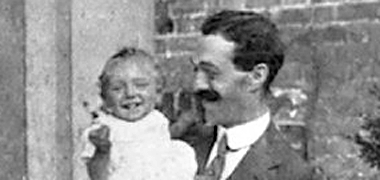
My father never knew any of the above other than that of Andrew’s personal effects being returned. Throughout his lifetime he was saddened by his slight memory of his father, particularly on Remembrance Days. With others, Andrew went into the darkness at Bullecourt on the night of 3rd May 1917, and there my search now ends.