
a collection of notes on areas of personal interest
- The Cassini and Maraldi families
- Cassini family history
- Giovanni Domenico Cassini
- Jacques Cassini
- César François Cassini
- Jean Dominique Cassini
- Alexandre H G Cassini
- Maraldi family
- Giacomo Filippo Maraldi
- Giovanni Domenico Maraldi
- Giovanni Filippo Maraldi
- Giacomo Francisco Filippo Maraldi
- Astronomy
- Cartography
- The Babaud & Masson families
- France and England
- The Age of Enlightenment
- Joseph Cassini and Susanna Gill
- Cassini and Maraldi references
Alexandre Frédéric Jacques Masson and Angélique-Dorothée Babaud
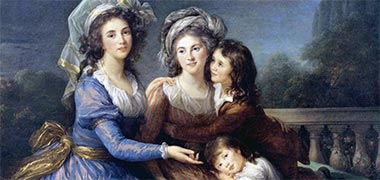
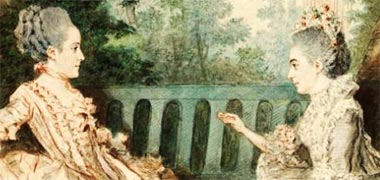
The detail to the right is taken from a painting by the French artist, Elisabeth Vigée-LeBrun, and is of the ‘Marquise de Pezé and the Marquise de Rouget with her two children’, 1787. Pezé and Pezay are alternative spellings of the same name. Caroline de Murat was the wife of Alexandre Frederic Jacques Masson, Marquis de Pezay, the half brother of Angélique-Dorothée Babaud, who became Mme de Cassini on her marriage with Dominique Joseph Cassini, a non-scientific member of the Cassini family.
It was my intention when I began writing notes on the Cassini family, to deal only with the more famous scientific members of the Cassini and Maraldi family. However, in my research I have discovered that some of the related members are also notable, albeit for different reasons. One of these is Alexandre Frédéric Jacques Masson, or the Marquis de Pezay as he became known.
Another is his sister, Angélique-Dorothée Babaud who married Dominique Joseph Cassini, the younger brother of César François Cassini – Cassini III, in 1754. Born on the 17th November 1715 Dominique Joseph was thirty-nine when they married and she was seventeen, later becoming known as Mme de Cassini, the Marquise de Cassini.
In addition to learning more about a number of individuals, these were interesting times…
Revolution in France
So, first a small digression relating to the dramatic changes at the end of the eighteenth century and the beginning of the nineteenth centuries in France. Bear in mind that there are different conceptual views as to the dating of both the start and end of the French Revolution.
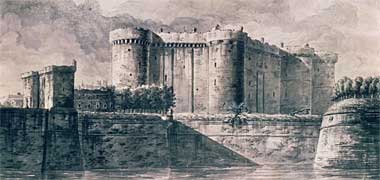
At its broadest it might be considered that revolution in France began when the citizens of Grenoble rose against the King in June 1788 and refused to pay his taxes; and that it ended with the death of Napoleon in 1821 and the beginnings of democracy. However, the 14th July 1789 witnessed the citizens of Paris storming the Bastille, and while this was mainly symbolic as the Bastille contained only seven prisoners, the military was routed and the governor, Bernard de Launay, was executed. This is the date that most accept revolution to have begun, and is that celebrated by France as its National Day. Napoleon returned to France from Egypt on the 9th October 1799, and overthrew the Directory on the 9th November. Many date the end of the revolution to this date.
Incidentally, there is a record that the Comtesse de Cassini was involved in a mass following a two day tour on the 2nd and 3rd August 1789, by Abbé Pheillipes, Dean of the Chapel of Saint Marcel, of the combined districts of Val-de-Grâce and Saint Jacques du Haut Pas for those who died in the revolution and the return of peace which introduced the ‘era of French liberty’. In this, the Comtesse de Cassini was said to be representing one of the most influential families of the district.
Three phases are considered to define the Revolution. The first phase lasted until 1792 in which period the monarchy was rejected, the Church subordinated to the State, and a number of freedoms enacted.
This was followed by two years of the Terror when the King and Queen, many of the nobility and those who supported monarchy were executed. It is considered to have ended with the execution of Robespierre, one of the leaders of the revolution, and many of his supporters in July 1794.
The third phase might be considered to have lasted until the appointment of Napoleon Bonaparte to the position of First Consul when France again had an established leader. This was further consolidated on the 18th May 1804 when the Senate elected him Emperor of France and, on the 2nd December 1804, famously crowning himself. Incidentally, he also crowned himself, this time with an iron crown, on the 26th May 1805 to symbolise his control of Italy.
This was an extraordinary period of European history, coinciding with the end of what has been termed the Enlightenment, an intellectual movement asserting that rational human reason can be used to combat, if not resolve, the difficulties which beset the world.
Revolution was in the air both in Europe as well as America. Britain was fighting in America where France was supporting the American revolution. Britain and France formally declared war in 1778: Britain on the 6th February and France on the 10th July. This year saw Napoleon sent, at the age of nine, to the Collège militaire royal de Brienne in Paris. In 1785 he graduated as a Second Lieutenant at the age of sixteen and rapidly progressed in the French army which was fighting on a number of fronts before, through and after the Revolution. He was named général de division on the 15th October 1795 and général en chef de l’armée de l’Interieur on the 26th October 1785. He was twenty-six. Campaigns continued in Europe and Africa with the tide of war eventually turning against France. On the 11th April 1814 Napoleon abdicated and was exiled to Elba. On the 3rd January 1815 he returned to France and marched on Paris. 18th June 1815 saw the defeat of Napoleon at the Battle of Waterloo and the 15th July 1815 his exile to St. Helena where he died on the 5th March 1821.
During this period Britain had an interest in supporting activities against France on the continent. The result of this was a high level of intrigue and espionage. There are interesting files in British archives dealing with the problems of controlling the borders and, particularly, ensuring that ‘French picture framers and Italian mirror makers’ did not slip through the system.
Dominique Joseph Cassini
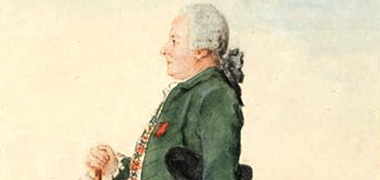
Born in Paris on the 27th November 1715, Dominique Joseph Cassini may have died at Fillerval, near Thury, Oise on the 17th April 1790, being then recognised as the Marquis de Cassini following his elevation to that title by Royal Patent on the 19th February 1776. I have come across his name on a list of ‘seals affixed at Châtelet’, recording that he died on the 18th April 1790 at the Rue de Babylone. This appears to conflict with a note on the Minutes et répertoires du notaire Pierre Henri PÉAN de SAINT-GILLES, 1er février 1788 - 9 mars 1819 (étude XCI), stating that his death was on the 17th April 1790, adding in parentheses ‘au château de Thury le 17 avril 1790’. He was the younger brother of Dominique Jean Cassini and César Françoise Cassini, and had two younger sisters, Elisabeth Géneviève Cassini and Suzanne Françoise Cassini.
His was a distinguished military career. Starting at the age of seventeen with his becoming a Musketeer of the Guard of the King in 1732, he saw continuous advancement. He became a Captain of a Polish regiment of cavalry from the 19th February 1734 at the age of nineteen, and later held the titles of Knight of the Royal and Military Order of Saint Luigi of France. He was promoted to the First Company ‘Villeroy’ of the Bodyguard of the King of France on the 9th April 1745, distinguishing himself in the Flanders campaign (1744-1747) in that year. He was promoted to Camp Marshall on the 1st December 1745 and to Brigadier in 1759, then again promoted to Field Marshall of the Royal Army on the 16th April 1767. In 1775, by Decree of the Grand Duke of Tuscany, Dominique Joseph was given the right to sit on the Senate of the city of Siena, Italy, the location from which the Cassini family are said to have originated. I should also add that for some time he was Captain of the Royal Hunt of the Prince de Condé.
As I mentioned previously, Dominique Joseph married Angélique-Dorothée Babaud in 1754, in the middle of the military career that had, perhaps, delayed marriage for him. Nevertheless the woman he married had an interesting background as had, to an even greater extent, her brother. Perhaps, more importantly, she brought to her marriage with Dominique Joseph the substantial dowry of 560,000 livres, equivalent to around 181,200 gms of gold, in 2026 the equivalent of over £18,000,000 Sterling.
I know little more about Dominique Joseph other than that the Hôtel Cassini, at nº. 32 rue de Babylone in Paris was constructed for him in 1768 on a parcel of land of 5,525 sq.m. by the architect Claude Billard de Bélisard or Bellissard. However, it was returned to the family of Antoine de Landrieffe from whom Dominique Joseph had borrowed the funds to buy the land, but who had not been repaid. Two years later the property was appropriated by the Revolution on the 16th Nivôse Year IV – 6th January 1796 – and given, ten years later to (later General) Marie François Auguste Caffarelli (1766-1849), regarded as gifted and one of the best servants of the First Empire. It was bought by the State in 1976 and is now the home of the Direction générale de l’administration et de la fonction publique. Mme de Cassini had all her property confiscated by the State which I assume would have included nº. 32 rue de Babylone, or her salon at nº. 14 rue de Babylone, or both. French archives have records relating to Dominique Joseph not only at the rue de Babylone, but also the rue de Mouton and the rue du Feaubourg-Saint-Jacques. So far I have not been able to trace what his association with those addresses were.
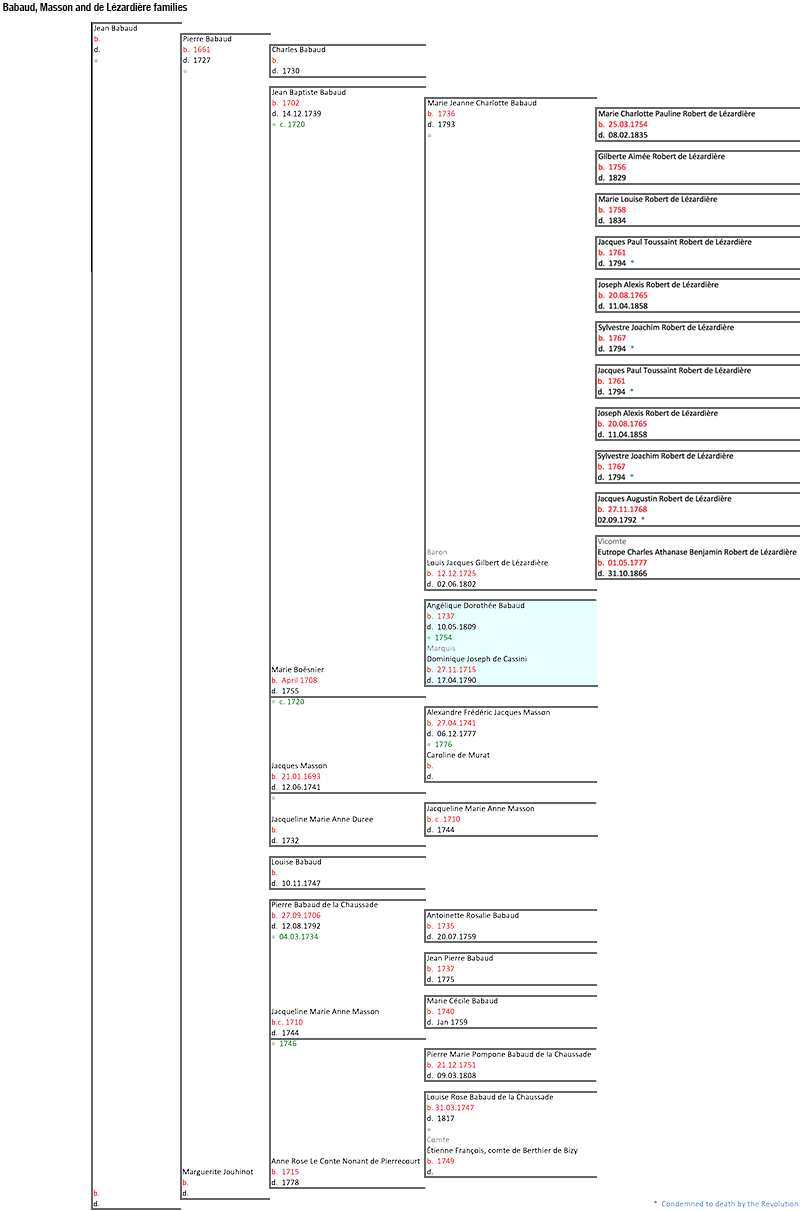
The Babaud and Masson families – this partial family tree opens in a new window – prospered through a series of favourable marriages and alliances as well as successful business deals and partnerships, in the process doing much to advance the French rôle in the industrial revolution that was now moving through Europe.
In Britain there is considerable information on the British industrial revolution made available in our schools and to the public, but we seem to have learned little in school about what was happening in Europe at that time. It appears that the French began their industrial revolution at the beginning of the eighteenth century, and it is apparent that the activities of Pierre Babaud and Jacques Masson were important in moving this forward.
But a combination of the French Revolution and the rise and rule of Napoleon had the effect of slowing the process of industrialisation in France, this despite the efforts and activities of entrepreneurs such as those in the Masson and Babaud families.
The families became increasingly powerful from their wealth, acquiring noble titles associated with their buying of land, hence ‘de Guérigny’ and ‘de Pezay’. Their considerable wealth came particularly from their establishment and development of iron forges in the area in which they operated, the department of Nièvres, in the French region of Burgundy. It was Pierre Babaud and Jacques Masson who can be argued to have established the first industrial empire based on iron, Jacques being the former business partner of Pierre Babaud’s father, Jean.
The association of Jacques Masson and Pierre Babaud – both Protestants who converted to Catholicism – which began in 1725, carried on until the former’s death in June 1741 at the age of fifty-seven. Pierre continued to run the iron forges successfully. In ten years the company had expanded into thirty parishes and comprised five blast furnaces, seventeen forging mills, five forging mills for the production of anchors, mast collars, metal sheets, and cannonballs. He provided iron and anchors for the ports of war having obtained a virtual monopoly in 1762, as well as for the French India Company. The organisation was able to produce up to 4,000 tons of iron for the Navy, and employed a workforce of more than 2,000.
With the peace following the Seven Years’ war in 1763, the government scaled back its needs and Pierre sought to sell the company to Louis XVI in 1769 for 2.4 million livres. This was rejected but, in 1780 Pierre sold it to a private company. On learning of this Louis XVI instructed that the sale be cancelled and paid 3 million livres for it. The company continued to fabricate chains and anchors for the French navy until the 1960s when it was eventually closed down.
The Babaud family
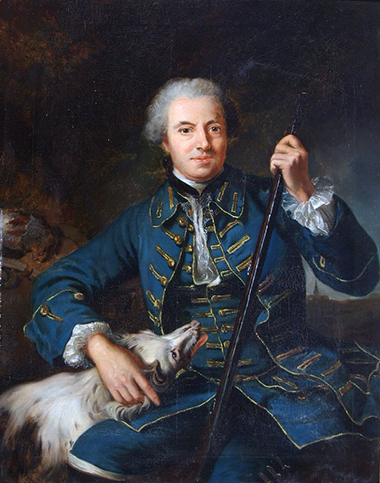
Jean Baptiste Babaud and his brother, Pierre Babaud, were the second and last of the four children of Pierre Babaud, Sieur de Beaupré, and Marguerite Touhinot. Their older brother, Charles, became a priest and, born between them, was a sister, Louise. Jean, Pierre and their father were life-long timber merchants working in the lucrative family business providing timber to the French navy. Following the deaths of his brother in 1738 and his father-in-law in 1741, Pierre turned his interests to the metallurgical industry, owning the important Royal Forge at Guérigny in the Nièvre départment.
Jean Babaud and Marie Boësnier were married in 1728 and had two daughters, Marie Charlotte Jeanne – who married Louis Jacques Gilbert Robert, Baron de Poiroux and Marquis de Lézardière in 1750 – and Angélique-Dorothée Babaud, the latter and her relationship with the Cassini family being my reason for taking an interest in the Babaud and Masson families.
As I wrote earlier, Pierre and Jean worked in the family business, providing timber to the French navy. In order to cement a business deal, Jacques Masson, a Swiss, gave his fourteen year old daughter, Jacqueline Anne Marie Masson, in marriage to Pierre. They were married on the 4th March 1734.
Jean Babaud died on the 15th December 1738 at St. Eustache, Paris. The following year his widow, Marie, married his business partner and naval commissioner, Jacques Masson and a son, Alexandre Frédéric Jacques, was born on the 27th April 1741. Alexandre Frédéric Jacques was six weeks old when his father, Jacques Masson, died in July 1741. Marie, who had been born in April 1708, died in either 1744 or, in accordance with the Graffigny index, 1755.
Pierre Babaud seems to have lived an interesting life, the kind which many others of the Babaud and Masson families enjoyed, involving intrigue and politics in their quest for fame and fortune. By 1740 he was known at Court. There is an interesting story that Pierre even married off his younger daughter, Louise Rose Babaud de la Chaussade, to a hated competitor, Berthier-Bizy who had a nicer chateau than him in Guérigny.
Interestingly, Louise Rose took it upon herself to visit the National Convention – between 1792 and 1795 – in Paris to save the life of her husband when he was arrested as a nobleman. She explained that not only were they not a real noble family, but that they had even invited Jean Jacques Rousseau to their home when he was convalescing in nearby Pougues-les-Eaux.
The Masson family
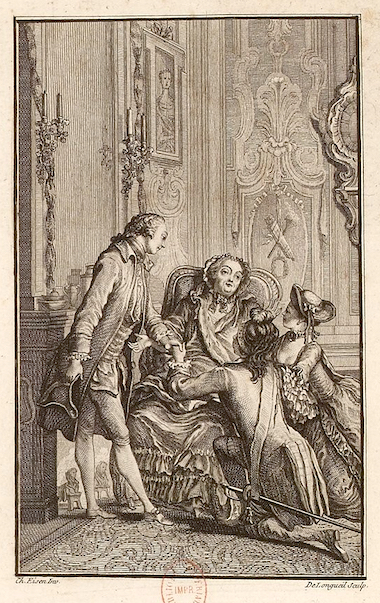
Little is known of the origins of the Swiss, Jacques Masson. By 1725 he had become the Director of Finance of Léopold, Duke of Lorraine, where he was briefly jailed on the suspicion of having embezzled a considerable amount. In 1736 he was appointed Chief Clerk to the Controller General of Finances responsible for businesses in Lorraine and, in 1740, Director General of French mines and minerals.
Marie Boësnier was born on the 14th February 1711 at Blois in the Loir-et-Cher department of central France. The second of four children, she was the older sister of the youngest of the four, who became the economist Paul Boësnier de l’Orme.
It was probably the 20th January 1728 that she married Jean Babaud with whom she had two children: Charlotte Babaud de La Chaussade in 1733 and Angélique-Dorothée de La Chaussade a year later in 1734. Charlotte’s birthdate is a guess, but is based on the known age of Angélique-Dorothée. Following the death of Jean Babaud in 1738, she again married, this time to Jacques Masson in 1739 by whom she had a son, Alexandre Frédéric Jacques Masson de Pezay. Jacques Masson died on the 12th June 1741 at Versailles. Charlotte married Louis Jacques Gilbert Robert Lézardière, records stating she was married in 1748 when she would have been fifteen.
This illustration is said to show her with Claude Joseph Dorat, standing, and her two children, Angélique-Dorothée and Alexandre Frédéric Jacques on their knees. She appears to be elderly at this stage. Her death is reported as being in 1767, which would have made these two children respectively thirty and twenty-six at her death.
Angélique-Dorothée – Demoiselle Masson following the marriage of her mother to Jacques – was now the step-sister of Alexandre Masson who later called himself the Marquis de Pezay; and Jacques Masson was the Seigneur de Guérigny, having bought the title in 1720. Although I believe the dates in the preceding paragraph are correct, my researches have Jacques Masson’s death as being at Versailles on the 12th June 1741, shortly after the birth of his son, his second wife Marie dying three years later in 1744. However, I have also seen a note stating that Mme Masson died in early September 1767. Incidentally, Paul Boësnier de l’Orme was a neighbour of the Count de Cheverny who wrote much about her in his memoirs.
Be that as it may, some time after Angélique-Dorothée married Dominique Joseph Cassini her brother, Alexandre Frédéric Jacques married Caroline de Murat, a noted beauty though their union produced no children. She is the woman on the left in the portrait at the head of this page. Previously, in 1772 – according to the memoirs of the Duke of Lauzun – believing them to be extremely rich, Pezay had declared his love to Marianne Dorothy Harland, the older daughter of Admiral Sir Robert Harland and, on being rejected, tried the same with the younger daughter, Susannah Edith, but with the same result.
Alexandre Frédéric Jacques Masson
Born in Versailles on the 27th April 1741, Alexandre was said to be a libertine, a poet, and a courtier with a considerable interest in political intrigue. Born a commoner and known as M. Masson de Pesai, there are a number of references to his having invented his title of Marquis, having taking the name of land owned by his mother near Blois. I have seen a note that his mother obtained it for him in 1759 and, perhaps more authoritatively, that his father had obtained the title of Marquis de Pezay, north of Blois – between Tours and Orleans – in 1755. Whatever his beginnings, he had, or made, good connections and obviously developed and used them. For a time he was advisor to his god-father, the Comte de Maurepas, Louis XVI’s first Prime Minister and mentor, as well as to the Minister of War, Alexandre-Marie-Léonor de Saint-Mauris, the Prince de Montbarrey of whom the infamous Comtesse du Barry, mistress to the King, said he:
made up in pretensions for what he lacked in talent. He was weak, self-important, selfish, fond of women, and endeavoured to preserve all the airs of a man of good breeding in the midst of the grossest debauchery.
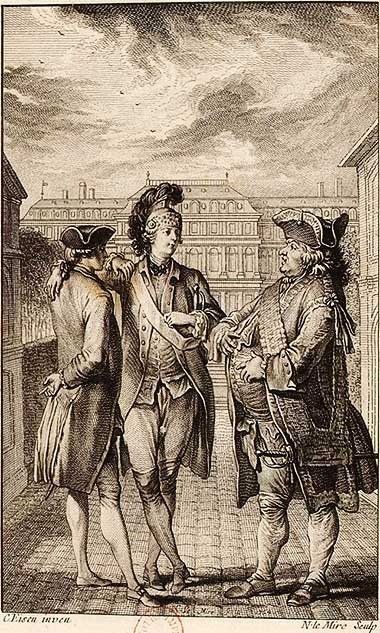
The Comtesse may well have been biased in this judgement as the Prince had made an unwelcome and rebuffed pass at her. But it may, of course, be an accurate description, though it would have been a strategic mistake on his part to give her cause for complaint due to her having the ear of the King. However, it is evident that Alexandre had managed to obtain for himself a position of influence and was used to moving in powerful circles.
One of Alexandre’s friends or acquaintances was the fellow King’s Musketeer, dramatist and writer Claude Joseph Dorat, a man who was considered to be ambitious well beyond his talent – to the extent that he published his own work illustrated at great expense to ensure sales, and produced shows where he bought up many of the seats in order to imply success of the performances.
This engraving, by Charles Dominique Joseph Eisen, shows Alexandre in the centre wearing his Dragoon’s uniform, with Dorat on the left, though I don’t know who the third person is. Dorat made enemies both with those supporting the Englightenment and those opposing it. This, perhaps, illustrates a little of the complexity in the atmosphere of intrigue of the times, and Dorat may not have been the best person for Alexandre to be associated with.
Alexandre became first a musketeer, then aide-de-camp to Prince de Rohan, Captain of Dragoons, but the positions which Alexandre obtained gave him access to many influential people and in the case of his mentor the Prince de Montbarrey, his wife – Mme de Montbarrey – who became his mistress. But it also gave him access to the Comte de Maillebois who took him under his wing and placed funds and information at his disposal. He was a Colonel by the age of thirty-two.
It appears that Alexandre, by design and in concert with his lover, Mme. de Montbarrey, made himself indispensible to many, even initiating and maintaining secret correspondence with the inexperienced young King Louis XVI himself with the hope of eventually obtaining advancement for them both. There is an amusing account of how he was able to advance himself secretly to the young King, stating he wished for no reward but, within the year having become known and accepted considerable benefit. What is particularly interesting is the manner in which he advertised himself as having competence and intelligence in a wide range of areas of potential interest to the King. In becoming known to the King the latter introduced him to his Prime Minister, Maurepas, suggesting they worked together to advise him. Maurepas, surprised by both the introduction and instruction, told the King he was Alexandre’s godfather. What he obviously didn’t tell the King was that he was extremely irritated by having to take advice from somebody he knew to be inexperienced in much other than poetry. To complicate matters I understand that Mme de Montbarrey was related to Maurepas.
Although it is difficult to apportion the extent to which each helped the other, some of Pezay’s early success was due to introductions and the manoeuverings of his sister, Angélique-Dorothée, Mme de Cassini, by now, following the Marquise de Polignac, the mistress of the marquis de Maillebois, thanks to whom Alexandre entered the army with an officer’s rank of Captain in the Dragoon Regiment de la Chabot. Maillebois took Alexandre under his wing and placed funds and his experience at Alexandre’s disposal, which he consequently wrote down as the ‘Campagnes de Maillebois’. Actually, it is more probable that Alexandre wrote only a part of the book, essentially giving his name to it and writing a few drafts, the preface and dedication.
It is thought that it was Alexandre who engineered the appointment of the future Comptroller-General, the Protestant Jacques Necker, to the Finance Ministry, and he is considered to have played a considerable part in the plot to dismiss Turgot, the economist and statesman in 1776 who had, only two years previously been appointed first as Minister of the Navy and then to Comptroller-General. In power from 1777 to 1781 as Director-General of the Royal treasury – as opposed to Comptroller-General, according to his daughter – Necker was succeded by Jean-François Joly de Fleury.
Recalled in 1789 the King nevertheless dismissed Necker on the 11th July 1789 only a few months after his having published the national budget, one of the factors leading to the storming of the Bastille. Within a few days he was again recalled by the King and the Assembly.
I’m unsure when, but Mme de Cassini attempted to obtain a pension of three thousand livres from Necker with the threat of publishing letters and documents illustrating the means by which her brother had assisted Necker to his appointment as Comptroller-General.
Alexandre was also on friendly terms with Voltaire and Rousseau but his character was such that he made powerful enemies, including La Harpe with whom he had been friends while both were at college at Harcourt though appears to have been responsible for the persisting rumour that Alexandre was not a gentleman, nor was his title proper. Perhaps understandably, the constant intrigues finally caused the weakening Maurepas, with whom he was now in direct conflict, to have Alexandre removed to provincial Brittany where he was given the Inspectorate of the Places Maritimes, a post he soon lost through mismanagement.
Alexandre Frédéric Jacques Masson, Marquis de Pezay, retired to his estate near Blois in the Loir-et-Cher département of Centre-Val de Loire and died soon after, on the 6th December 1777, only a year after he married Caroline de Murat, a beautiful young woman of a very good family, but with no fortune.
A little while before that it was noted in the Memoirs of the Duc de Lauzun (Armand Louis de Gontaut, duc de Biron), 1747-1783, that sometime between 1792 and 1794 Alexandre had visited the house of Lady Harland and ‘had spoken of marriage to the elder’ of her two daughters. On being turned down he ‘turned to the younger and was received no better’. The memoir notes that Alexandre spoke with Lady Harland, though has no record of the outcome other than that Alexandre immediately left to France…
Caroline de Murat
Caroline and Alexandre were married on the 24th November 1776 following the signing of the marriage contract by the King and Queen and Royal family though with the apparent indignation of a number of courtiers. On the 6th December the Gazette de France gave him the title of Marquis on the presentation of his wife to Court, again an event heavily resented. Incidentally, I note that in Letter 53 of ‘L’Espion Anglois’ she is referred to as ‘Murard’, and stated as being wealthy as well as beautiful.
Virtually nothing is recorded about Alexandre’s beautiful widow, Caroline de Murat, left on her own a year later. I don’t believe she had any children, though I have found a lead to papers for Henriette de Murat, comtesse de Pezay, but assume that the title passed on to another branch of the family to which she belongs.
It is known that Caroline frequented the salon of the painter, Elisabeth Louise Vigée le Brun, one of her paintings illustrating Caroline with a good friend of hers, also a widow by this time – ‘Caroline de Murat, Marquise de Pezay, and Nathalie-Victorienne de Mortemart, Marquise de Rougé, with Her Sons Alexis-Bonabes and Adrien de Rougé’ – the painting illustrated at the head of this page.
It is not known what happened to Caroline in 1789 and the fall of the Bastille, but it is known that her friend, Marquise de Rougé, left immediately to Switzerland though returned in 1790 to live quietly with Alexandre’s aunt, the Duchesse d’Elbeuf, at the Chateau de Moreuil.
But, in 1791, the Marquise de Rougé, together with her children, mother and Caroline de Murat emigrated to Germany, settling first in Heidelberg then, in 1796, moving to Neustadt, near Vienna and then on to Altoona and Munster, returning to Paris in 1798. I assume that Caroline de Murat travelled with them though rumours are that the pair quarrelled bitterly so it is quite possible that they parted company.
Like Mme de Cassini, the properties of Caroline de Murat, Marquise de Pezay were confiscated by the Revolution. She returned to Paris, living in straitened circumstances, first taking room and board in a home run by former nuns. Her sons joined her in France in 1800. She died on the 25th December 1828.
Angélique-Dorothée Cassini
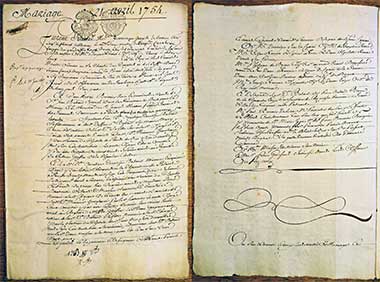
Meanwhile, Angélique-Dorothée Babaud became Mme de Cassini when, on the 21st April 1754 at the age of seventeen – an ‘emancipated minor’ as this contract of marriage states – she married maréchal de camp Dominique Joseph Cassini, a successful military officer who was twenty-two years older than her.
Dominique Joseph was the third of the five children of Jacques Cassini, known as the scientist Cassini II, and Suzanne Françoise Charpentier de Charmois, and the younger brother of César François Cassini – who became known as Cassini III.
Following her marriage, and in line with contemporary behaviours, Mme de Cassini embarked on a number of liaisons. One such liaison was a long and public association she enjoyed with the Prince de Condé and, later, with Yves-Marie Desmarets who, in turn, became marquis de Maillebois (1715-1791) on the death of his father, Jean-Baptiste-François Desmarets, marquis de Maillebois and baron de Châteauneuf-en-Thimerais (1682-1762), with whom it is possible she had also enjoyed a relationship.
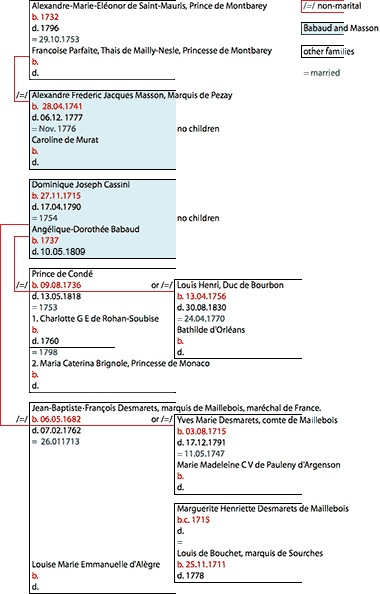
In that socio-cultural climate there certainly may have been other relationships; the Prince de Condé has already been mentioned and it is possible she may have had a close relationship with the Prussian Ambassador, Goltz, whose views she is said to have been responsible for introducing to both Maillebois and Vergennes, the Foreign Minister of King Louis XVI antipathetic to Britain and its interests.
This diagram illustrates two of these possible relationships, as well as that which her brother, the marquis de Pezay, enjoyed with Madame de Montbarrey, wife of the Prince de Montbarrey. But it is likely that the diagram misses other relationships. For instance, Montbarrey had an official mistress, Jeanne Catherine Delachaux, who was married to the painter François Casanova, brother of the more famous Giacomo Girolamo Casanova. In addition to his own two children, Montbarrey officially recognised his two illegitimate children by this relationship. Following the separation from his wife in 1780, Louis Henri, Duc de Bourbon also had another mistress, the opera singer, Marguerite Michelot by whom he had two illegitimate children.
This type of behaviour was not uncommon in the mid to latter part of the eighteenth century in France, but it was conduct attacked by the ancien régime who saw private and public behaviour as being closely related and corrupt. They saw that political intrigue depended to a large extent on personal relationships, a situation that encouraged liaisons and affaires as being necessary for social and public advancement, and which automatically created and maintained social divides.
There is a telling comment in a document discussing Alexandre Frédéric Jacques Masson, but also mentioning his sister, Angélique-Dorothée:
This enterprising personage was brother to the beautiful and famous madame de Cassini, who for some years past had left no means untried to attain celebrity. He was born without fortune, but, like his sister, possessed a kind of wit, an interesting figure, and a versatility of genius, adapted to acquire it. Madame de Cassini, towards the latter part of the reign of the late king, had made herself conspicuous as well by her intrigues as by her lovers. She was visited by ministers, generals, and people of fashion; she undertook to procure places, rail against ministers, and extol or blame the measure of government; she endeavoured even to aspire to greater importance by a presentation at court, and solicited favour, with all her interest; when Lewis XV, who possessed great politeness and respect, as well as weakness, for the sex, decided the affair in these terms; ‘There are but too many intrigues here already; madame de Cassini shall not be presented.’
During the remainder of the reign of the late king, madame de Cassini, by her licentious and coquettish manner of life, contrived to supply the deficiency of fortune. M…M…M…M…M…M… and de Maillebois, were her paramours, and in this distinguished society the marquis of Pezai acquired the elements of intrigue, which he knew how to disguise and adorn, by applying himself to literature, affairs of administration, and the polite arts.
Madame de Cassini had a beautiful voice and was an attractive woman by all accounts. It was written about her that young women can readily move in the society of ministers and the like and that, in older age, these connections maintain their usefulness – though the same document suggests that, at the age of forty-five (in 1782), she had no future. Despite this it is also recorded that Louis XV refused to have her presented at court due to her reputation for intrigue. However, following his death, she was, to some extent, able to ingratiate herself with the new court.
The world in which Mme de Cassini and her brother, the Marquis de Pezay, lived would have been an interesting one. Her relationships with at least the Prince de Condé and, later the Marquis de Maillebois place her in an important position with regard to the society of the time, though both she and her brother had mixed fortune in their relationships. Some of this may have been self-induced, some a result of the fortunes of those with whom they enjoyed a variety of relationships. This society must have provided a complex area to negotiate as, to an extent perhaps difficult for us to imagine today, this society was both heavily stratified and dependent on patronage.
Those who were, or who considered themselves to be, leaders in French society maintained salons at which the great and good regularly attended events and performances, met friends and others of their acquaintance, and exchanged news and gossip: this was a politically charged arena in which a number of issues might be discussed and matters arranged. Mme de Cassini maintained a salon at No. 14 Rue de Babylone in the 7th arrondissement which she is said to have shared with the Marquis de Maillebois. In fact a number of references suggested they lived together.
There is mention in the ‘Correspondance intime du Comte de Vaudeuil et du Comte d’Artois pendant L’Émigration’ of Comte de Maillebois having provided Mme de Cassini with a pretty house on the Rue de Babylone, though there is no record there of which number on the road it was. The reference to this is made in the footnote of page 182, referencing another book, ‘D’Allonville’s Mémoires secrets’ which can be found on page 170 where there is also mention of her involvement with the fortunes of Necker through the influence of her brother, the Marquis de Pezay.
I have also seen a reference to the Cassini family living at No. 10 Rue de Babylone in the middle of the eighteenth century. I have assumed this would have referred to the home of César François Cassini – Cassini III – and his family.
It is apparent from a number of accounts that political and literary intrigues were commonplace at these salons, and it was also notable that they were used by Royalists in attempts to help the Royal family escape France, a setting and operation which may have been only loosely monitored by the Revolution.
As an aside, Mme de Cassini was, at the time of her marriage, a relatively rich individual. Having brought to her marriage a considerable dowry as mentioned above it is understandable that her activities might have extended outside the arts. Apparently she had business interests not just in France but also abroad. For instance, in a letter from her friend the Comte de Maillebois to Benjamin Franklin of the 27th February 1782, he mentions that Mme de Cassini had business in America and attached documents apparently asking Franklin to help organise the legalising of her Powers of Attorney there. These authorised Jean Holker, a French merchant and Consular Agent, to obtain from Roulhac of Charleston (probably Joseph Blount Grégoire de Roulhac) her share of the proceeds from the ship ‘Discret’ in which she had, in 1778, invested 60,000 livres, equivalent to around 18,100 gms of gold at that time. Note that this is the same amount as was given to her by the King in the records of the ‘Livres Rouge’, suggesting the King was either lending it to her, giving it as a gift or reward, or that she was making an investment on his behalf in her name.
Apart from her own salon, Mme de Cassini frequented many other of the important salons where literary and political issues were discussed, notably that of Elisabeth Françoise Sophie Lalive de Bellegarde, comtesse d’Houdetot à Sannois, the lover of Jean-Jacques Rousseau and, for fifty years, the poet Jean François de Saint-Lambert. Mme Suard, the journalist Amélie Panckoucke who held her own literary salons on Tuesdays and Saturdays, in correspondence with the Marquis de Condorcet, the philosopher, mathematician, and political scientist, said of Mme de Cassini’s comedic performances that
after Mme Clairon, I know of nobody more perfect.
As might be surmised, Clair Josèphe Hippolyte Leris, 1723-1803 and known as La Clairon, was one of France’s most famous actresses, her company being sought out and her performances attended by the most fashionable courtiers and famous admirers. It may not be significant, but Mme Clairon was renowned for her tragedic performances.
There are records of Jean-François de la Harpe’s play, ‘Mélanie’, or ‘La Religieuse’ having its première there in July 1772, two years after it was written, and I understand that Mme de Cassini actually took a prominent part in it.
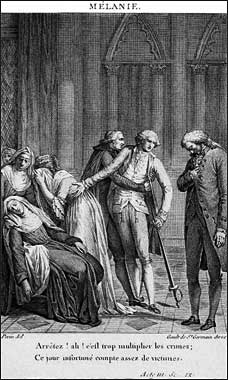
This contemporary illustration shows a scene from the play. The words below it are difficult to read but might be freely translated as:
Stop! Ah! There have been too many awful crimes; This unfortunate day has cost the lives of enough victims.
The performing of this play in her salon at the rue de Babylone is said to have brought Mme de Cassini considerable opprobrium due to its depiction of the suicide of a nun. A correspondent told me that it may also have harmed her in that she played the leading rôle in this first showing. Because of its subject matter both the duc de La Vrillière, apparently on behalf of the King, and the Archbishop of Paris forbade any further showing and it wasn’t performed again until the 7th December 1791 at the salon of comtesse d’Houdetot at her house in Sannois, Val d’Oise, just fifteen kilometres from the centre of Paris. Apparently the clergy had not the right to ban works; they might be read but might not be performed in public. While Mme de Cassini bore the brunt of criticism for the showing of the play at her house, it appears to have been more freely shown outside Paris, though Mme de Cassini is supposed to have continued to perform the play in secret.
The first overtly anti-religious play in France, it is likely to have been acclaimed by the self-appointed and frequently hypocritical intellectual and philosphical elements of society, though would have been considered impious not just to the General Assembly of Clergy but also to the majority of ordinary French men and women.
Bear in mind that this would have been a time of the burgeoning of romanticism with respect to democracy, equality and their influence on human rights – though it was soon to be dissipated in the 1793 excesses of the revolution and the outbreak of war with Britain, the latter temporarily being suspended by the Treaty of Amiens in 1802, but continuing a year later and not coming to an end until 1815.
The play seeks to infer that female convents were institutions in which neophytes were forced into taking religious vows. Presumably it was written either to reinforce the prejudices of those who already thought this, or to persuade others that this was a fact. But documentary evidence asserts that convents were virtually the only places where young women could obtain an education, and that the decision to take vows was, for the most part, a personal and free decision.
Although the peformance may have been a social gaffe on Mme de Cassini’s part, creating a significant stir at the time, the play later found favour in revolutionary Paris where it was performed eighty-seven times between 1791 and 1799. Perhaps because of this popularity, it is probable that several authors used it as a model for their own writings. These would include ‘Joseph Fiévée’s ‘Les Rigueurs du Cloître’, (Paris, 1790) and Mme Olympe de Gouges’ ‘Le Couvent ou Les Vœux Forcés’, (Paris, 1790). Nevertheless, Pierre Laujon’s splendid ‘Le Couvent ou Les Fruits du Caractère et de l’Éducation’ (Paris, 1790) and Jean Corsange’s et Jean Hapdé’s ‘Le Dernier Couvent de France ou l’Hospice’ (1796) are said to more accurately portray female convent life in 18th century France.
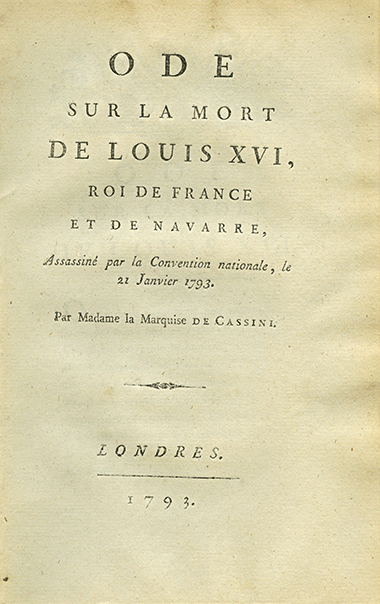
Mme de Cassini wrote and acted in a number of plays such as the previously mentioned ‘Mélanie’, or ‘La Religieuse’. Additionally she wrote poetry, as did many of her educated contemporaries, as a matter of course for those moving in her social circles, many also writing and performing music and painting. But this image illustrates the cover of a poem she wrote on the execution of Louis XVI by the Revolution suggesting, by characterising the execution as an assassination, a strong political condemnation. Apparently published in 1793 while she was said to be in exile in London, the poem certainly would have shown where her allegiancies were at the time and would have exacerbated any difficulties she might have been experiencing with the Revolution. Though it might be thought she would have felt relatively safe in London or the Low Countries, various sources suggest that she had returned, impoverished, to Paris in 1792 having spent only a relatively short time with the marquis de Maillebois in Breda where he died in December 1791, her husband Dominique-Joseph having died in Fillerval, near Thury in April 1790. I have been unable to trace her life accurately in the years between 1792 and its end, though I know she visited London in 1797.
While I have been unable to access that poem, following is a small example of her earlier style discovered in the philosophical and literary correspondence of Baron Friedrich Melchior Grimm from March 1777 – The Announcement of Spring:
L’Annonce du Printemps
par Mme La Marquise de Cassini
L’hiver a peine à fuir, mais il combat en vain;
Bientôt il va céder à la toute-puissance
De cet astre brillant dont la douce influence
Console la nature et réchauffe son sein.
Elle languit encor sans aucune parure;
L’arbuste dépouillé n’offre point de verdure.
Tout repose et tout dort; mais, malgré ce sommeil,
Tout semble pressentir le moment du réveil.
L’oiseau vole incertain, traverse la campagne,
Revient, chante, se tait, cherche et fuit sa compagne,
Rien ne s’anime encor, mais tout va s’animer;
Tout paraît sans amout, mais tout est près d’aimer.
A note below the poem states:
Soeur du Prétendu de Pezay. On trouve de curieux détails sur cette femme, présentée comme une intrigante, dans les Mémoires de Bezenval, édit. Baudouin, t. I, p. 157. (T.)
It can be seen that the author had his doubts about the origins of Mme de Cassini’s brother who died in December of that year.
But not only did Mme de Cassini write plays and poetry, she had admirers who wrote poetry to her such as Claude Joseph Dorat who wrote the following three poems. They are quoted from the third edition of ‘Mes Fantaisies’, published in Paris in 1770, and repeated in the ‘Collection complète des oeuvres de M. Dorat, Volume 2’, published at Neuchatel in 1776 when she would have been thirty-nine, and he forty-two:
A Madame de Cassini
Qui se plaignoit de ce qu’on bâtissoit chez elle.
Amphion, en touchant la lyre,
Vit des remparts mouvans s’élever sur ses pas:
Pour faire plus que lui, vous n’avez qu’à sourire.
Si ce charme ne suffit pas,
Chantez: chaque pierre docile
En colonne de fleurs va s’arrondir soudain.
Votre rival construisit une ville:
Mais à Vénus il ne faut qu’un jardin.
A Madame de Cassini
Qui demandoit des vers sur l’amitié.
Tu veux des vers pour l’amitié:
En chanson que lui dire?
C’est un sentiment oublié,
Dès qu’on te voit sourire.
On n’a point d’amis à vingt ans,
Flore, Hébé n’ont que des amans
C’est aux zéphirs
C’est aux plaisirs,
A tresser ta couronne,
Du printems goûtons les loisirs,
Avant ceux de l’automne.
A Madame de Cassini
En lui demandant le roman d’Almahide.
Vous me l’avez promis ce volume gothique,
Où tant de fabuleux amans,
De l’amour & des sentimens,
Èpuisent la métaphysique,
Dans leurs éternels complimens;
Parlent sans fin, jamais n’agissent,
Et d’inanition périssent
Dans la crise de leurs sermens.
Combien devoit être importune
L’ardeur de ces héros, moulés sur Céladon,
Ne pouvant faire une chanson,
Sans y fourrer le soleil ou la lune!
Ainsi que vous, je ne veux lire un mot
Des billets doux, des galans logogrifes,
De tous ces combats apocrifes
Où le plus brave est souvent le plus sot:
Mais s’il se trouve en ce recueil si fade,
Héroïne sensible & vive tour-á-tour,
Dont les yeux commandent l’amour,
Et dont la voix le persuade,
Qui réchauffe par la gaîté
L’air un peu froid de la décence,
De l’amitié sente la volupté,
Et suyant quelquefois le bruit & l’affluence,
Dépose avec simplicité
Dans le sein de la confiance
Les couronnes de la beauté:
Dans ce portrit alors reconnoissant le vôtre,
A loisir je suivrai chaque coup de pinçeau,
Surpris qu’en l’autre siecle on ait fait un tableau,
Dont le modele est dans le nôtre.
For those in need of a translation of these poems, I’m afraid they are going to have to look elsewhere. I just hope that I have written the old French correctly. If I have not, please correct me.
There is more written below on Angélique-Dorothée Cassini, as Mme de Cassini, but I should add a note here that I found a record of her death on the 10th May 1809, though I had previously believed she died on the 8th May 1805, as noted here.
The Livre Rouge
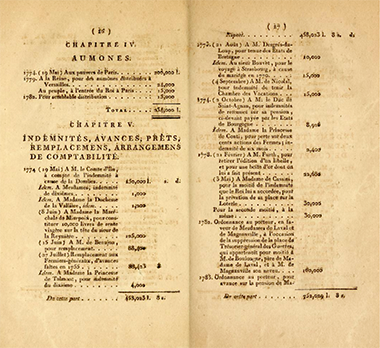
On a very different aspect of her life in France, this note has been added as there is a record of Angélique-Dorothée, on the 3rd May 1778, being awarded by Louis XVI 60,000 livres – around €680,00 or £580,000 in 2024 – paid in two tranches, the document appearing to suggest that the payments are in compensation for her not participating in the Lottery.
At this distance in time it is difficult to understand what might have impelled the King to give Mme de Cassini 60,000 livres; but as a correspondent has suggested, and bearing in mind that Angélique-Dorothée came to her marriage with a significant dowry, it is possible that she might have bought bonds or lent funds to the King, as did many of the upcoming bourgeoise in the hope of advancement, or beneficial parliamentary or financial offices, some of which came with new personal titles of nobility. Or, as noted above, this might have been a business transaction with her acting on behalf of the King.
Prior to 1776 there were a number of small lotteries held around France, these being generally popular. Inspired by these lotteries together with the success of the Genoese lottery, previous lotteries were cancelled and the Royal Lottery of France was instituted on the 30th June 1776 by Louis XVI. Despite criticism in some areas, it was generally argued to be morally and religiously defensible while improving the State’s ability to benefit by collecting funds and avoiding unpopular taxation. It has been estimated that, through this device, the King was able to collect between 5% and 7% of his income prior to the Revolution.
The above two pages are from what is known as the ‘Red Book’ or ‘Register’ which was derived from Louis XVI’s personal account book, but was published in 1790 by the National Assembly in order to show the public how profligate the King had been with his spending. Between the 19th May 1774 and the 16th August 1789, the Red Book records spending of 227,983,716 livres – the equivalent of around €2,571,053,400 or £2,198,387,400 in 2024. Approximately 5% of this was the personal spending of the King and Queen. The sums paid to Mme de Cassini are entered in the ‘advances, compensation and loans’ section below; on the document above, this appears to be translated as ‘Indemnities, advances, loans, replacements and accounting arrangements’, this section continuing on the following two pages of the book.
The sums of disbursement were roughly as follows:
- brothers of the King (the Count of Provence and Count of Artois), approximately 28 million pounds;
- donations and gratuities, 6 million;
- pensions and salaries, 2 million;
- alms, 254,000 pounds;
- advances, compensation and loans, 15 million;
- acquisitions, charges, 21 million;
- financial affairs, less than 6 million;
- foreign affairs and posts, 136 million;
- personal expenses of the king and queen, 11.5 million;
With total spending reaching just under 228 million.
Although the information in the Red Book was not previously secret, nor necessarily accurate, it contained descriptions of some of the individuals to whom payments were made together with suggestions as to why the funds had been given. Essentially, the Red Book seems to have been used to identify those who did not, or might not support the Revolution. Mme de Cassini was not included in the descriptions, though was obviously a Royalist.
The Princes de Condé
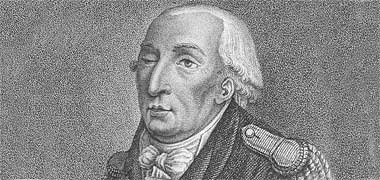
Perhaps more importantly, Angélique-Dorothée was, for a time, the mistress of Louis Joseph, Prince de Condé, (9 August 1736 - 13 May 1818). His son Louis Henri, Duke de Bourbon (13 April 1756 - 30 August 1830), who became the Prince de Condé in 1818 on the death of his father had accompanied his father into exile in 1789 when they fled the French Revolution. Following the storming of the Bastille on the 14th July 1789, the feudal system was abolished on the 4th August 1789 and titles abrogated between the 19th and 23rd June 1790.
The liaison is recorded as having begun in 1770, coincidentally the year in which Marie-Catherine de Brignole-Sale, the ex-wife of Honoré III, Prince of Monaco, obtained her legal separation from her husband, later becoming the mistress of Louis-Joseph whom she eventually married.
Louis-Joseph, having fought a distinguished campaign in the Seven Years’ War, established an army in association with, and funded by, the Austrians and fought until the Peace of Campo Formio, 1797, when he was being funded by the English. The army he raised was known as the ‘armée de Condé’ or the ‘corps de Condé’ and operated between 1792 and 1796.
It is possible that the Prince de Condé’s military career may have been marred by the intrigues of Mme de Cassini. It is recorded by Mme de la Ferté-Imbault, that in 1773 Mme de Cassini intrigued behind his back with the duc d’Aiguillon, while apparently suggesting he might be advanced to grand maître de l’artillerie, a significant, though honorary title that had been abolished militarily in 1755.
The history of Europe around the turn of the nineteenth century was extremely complex with countries aligning and realigning themselves as they sought to form political stability. Austria, Russia, the Ottoman Empire, Portugal and Naples formed a coalition against the French, with Britain joining the coalition on June 22nd 1799. Austrian and Russian forces were in action against the French in north Italy, The British navy was active in the Mediterranean, British and Russian were in action in Holland, and Napoleon returned to France in 1799, staging a coup d’état. It was perceived that British strategy was to safeguard its trade routes with the rest of the world, while Russian strategy was to control the land. Russia now withdrew from the coalition and attempted to form a coalition with Prussia and Denmark. In 1800 France controlled Italy, Switzerland, west Germany and the Netherlands as well as having Spain as her ally.
In 1796 Condé’s force was composed of a cavalry brigade and two battalions of infantry, apparently financed by the British since the 15th May 1795. The summer of 1797 saw him resting in Überlingen on Lake Constance following his successful attempt to establish a colony of French royalists on the north coast of the Black sea, either on the Crimea or on the Sea of Azov. Following an initiative by Catherine II, the Russian Tsar had agreed to this and the Imperial campaign began that year, but ended unsuccessfully at Dubno, in the Ukraine, 1802.
Hoping to have himself elected King of Poland, Louis-Joseph worked for the Russians in their Polish campaign before retiring with his son first to Germany and then to England in 1801. His first marriage to Charlotte Godefride de Rohan-Soubise on the 3rd May 1753 had ended with her death in 1760 at the age of 23. His second wife was Marie-Catherine de Brignole-Sale, the ex-wife of Honoré III, Prince of Monaco from whom she legally separated in 1770, living with Louis-Joseph openly as his mistress in the first instance, but marrying secretly on the 24th October 1798. The marriage was only made public on the 26th December 1808. The Restauration of the Bourbon dynasty saw Louis XVIII returned to power in 1814 and it is likely it was in that year Louis Joseph returned to Paris, dying there in 1818, five years after Maria-Catherine.
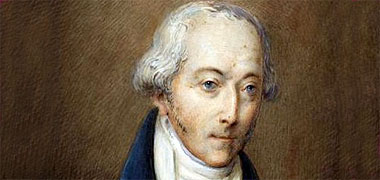
Louis Henri, his son, married in 1770 and, two years later his wife, Louise Marie Thérèse Mathilde, gave birth to their only child, the ill-fated Louis Antoine Henri, Duke of Enghien, the traditional title given to the eldest son of the Princes de Condé. Louis Henri’s marriage lasted only until 1780 when the couple separated. He did not marry again but scandalised society by taking a mistress in Paris, Marguerite Michelot, an opera singer by whom he had two illegitimate daughters. He seems to have cut this tie when he moved to England. There he took another mistress, Sophie Dawes who made herself indispensible to him. She, and members of her family followed him back to France where, in 1818, she married and became the Baronne de Feuchères.
On becoming the Prince de Condé Louis Henri was unable or unwilling to maintain the relationship she demanded and, it is said, by her behaviour and machinations, hastened his end. He was found hanged under very suspicious circumstances in 1830. His lover, the Baronne of Feuchères, perhaps a witness or participant, left the scene of the tragedy rather than call for help. The following enquiry was undecided and she consistently denied having assassinated Louis Henri. A beneficiary of Louis Henri’s will, she died ten years later in London, on the 15th December 1840.
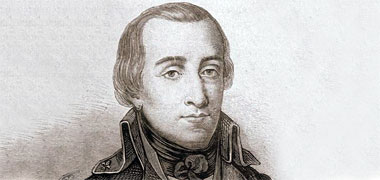
Louis Henri’s son, Louis Antoine Henri, the Duke of Enghien was alleged to be a participant in a plot against the Consulate and made the mistake of settling in Ettenheim, Baden-Baden, only just over the French border. Living on a British pension, and having had discussions with the British supporting them against what he saw to be the illegitimate rule of the Napoleon, he made little attempt to avoid capture. Having notified the Baden-Baden authorities of their intention, General Ordener was instructed to organise the arrest of the Duke. With a force of about a thousand he crossed the border at night and captured the Duke on Wednesday, the 14th March, at 5 a.m, carrying him back to France under the name of Plessis. A week later, following a summary trial, the Duke of Enghien was executed in the ditch of the fortress of Vincennes at 3 a.m. the 21st March 1804. Although his grandfather and father survived him, Louis Antoine Henri was the last of the line of Princes de Condé. This act of murder resounded around Europe, repulsing politicians and royalty and doing much to bring different interests together against Napoleon.
Jean-Baptiste-François Desmarets, comte de Maillebois
Jean-Baptiste-François Desmarets followed a military career being appointed, in 1708 a Brigadier, in 1718 Maréchal de camp, in 1731 Lieutenant Général, in 1730 Director of the Depot de la Guerre and, on the 11th February 1741, Maréchal de France.
The Depot de la Guerre was a resource of documents relating to war, and Maillebois was instrumental in beginning the process of classification and organisation which would make it a more valuable resource from which to derive information on military issues. This included the appointment and training of geographical and topographical engineers, another very valuable resource in war, reinforced by the acquisition of Cassini’s great map, begun in 1751. Regrettably for France, the cadre of engineers was suppressed in 1791.
A descendant of Colbert, principle minister to Louis XIV, Maillebois appears to have had skills more useful to a soldier than those of the politician and courtier. Married with four children he died at the age of eighty. I have seen a quotation that, ‘according to the Marquis d’Argenson – whose daughter married Maillebois’ son – he was a bad politician, a hard and sullen courtier, a great hunter, an excellent father to his family’… [Journal et Memoires du marquis d'Argenson. ed. E.J.B. Rathery (Paris 1859-67) 9 vols. iv.210.]
Yves-Marie Desmarets, marquis de Maillebois
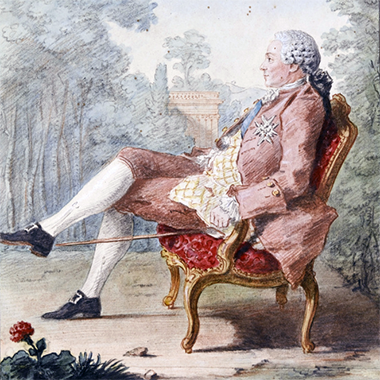
Yves-Marie Desmarets began his military life at an early age. He was nineteen when he served as Colonel of the First battalion La Sarre French infantry at the Battle of Parma, 29th June 1734, where he was wounded in the head. That battle, one of those relating to the War of Polish Succession (1733-1738), was indecisive, though it is considered that the Austrians beat the French and their allies, but later lost at the Battle of Luzzara, 19th September 1734. The War was fought by the French and their allies with the intent of countering Russian and Austrian interests.
Yves-Marie Desmarets, first count then marquis de Maillebois, had an active life of his own. Born the 3rd August 1715 – or the 13th August – following his father’s marriage in 1713, he was made an Honorary Academician on the 16th June 1749, Vice President of the Royal Academy of Science in 1750, 1770, 1775 and 1781, and its President in 1751, 1771, 1776, 1782 and 1786. He was also a soldier, again as his father had been.
On the 11th May 1745 he married Marie Madeleine Catherine de Voyer de Paulmy d’Argerson, born on the 25th May 1724, and daughter of the Marquis d’Argerson, Minister and Secretary of State of the Department of Foreign Affairs. They had only one child, Jean-Baptiste Yves Marie Desmarets de Maillebois, born on the 22nd June 1748 in Paris.
Angélique-Dorothée, now married to Dominique Joseph Cassini for sixteen years, is recorded as becoming the mistress of the Prince de Condé in 1770. It is not clear when, but she then moved on to become the mistress of the Marquis de Maillebois a few years later, a man who was twenty-two years older than her, but had
‘un bel esprit bien posé dans la société littéraire’.
As I must have mentioned a number of times, this century was marked by intrigue, with the fortunes of most of its important figures being constrained, directed and affected. With the support of Frederick the Great, the reputation of Vergennes with Louis XIV and the influence of Mme de Cassini, Maillebois was appointed to the command of the Dutch army in a ceremony at the Hague on 22nd March 1785, a characteristic of the Dutch army being that it was usually commanded by a foreigner, until 1783, the Duke Louis of Brunswick, his title being the General of Infantry. This appointment came against a concerted effort to prevent it, the argument being that Maillebois was too old to provide the King with the degree of expertise needed. And, despite his success in the Seven Years’ War (1756-1763) he had quarelled with his commander, the Maréchal d’Estrées following the battle of Hastenbeck in 1757, and attacked his ‘irresolution’ in a pamphlet resulting in his facing a Court Martial and subsequent imprisonment in the fortress of Doullens in the Somme département of Picardie.
However, for some time Maillebois had been providing Charles Gravier, Comte de Vergennes and Foreign Minister with advice on the reform of the army, the appointment having been achieved with the aid of a number of his supporters, notably Comte Charles de Polignac – whose wife had been the mistress of Maillebois, and Mme la Marquise de Monconseil. Sadly for Maillebois, the appointment exposed him to a degree of intrigue from which he never recovered. This included the accusation contained within an anonymous document from Turin to the Commune in Paris, that Maillebois was involved with and supported the Prussian position, it being argued that he was associated with Golz, the Prussian Ambassador in Paris through Mme de Cassini, apparently a friend of the Ambassador. It should be remembered that Marquise de Cassini was considered to have a strong influence with Maillebois.
It is evident that investigations must have obviously included his personal life. As well as his being thought to have counter-revolutionary tendencies, and plotting flight for the Royal family, information was given about his relationship with Mme de Cassini, these being noted in a publication in the Parliamentary Archives of the National Assembly of the 2nd August 1790.
Interestingly, in a paper in the French national archives, a note states that he was sent to Holland to support the Democratic party against Prussia. Following his denunciation in 1790 to the Comité des Reserches by his secretary, Thomas-Jean Grandmaison, and their being presented with evidence in support of this, Maillebois was indicted for plotting against it, and fled on the 22nd March – the leisurely indictment, in which there are a number of mentions of both the Marquis and Marquise de Cassini, being published on the 9th July – to Breda in the southern part of the Netherlands, where he subsequently died on the 14th December 1791. He was buried at night in Maëstricht on the 17th December 1791. The indictment states that Maillebois was living at Maëstricht with his mistress, Madame de Cassini. What is notable for the purposes of the notes on this page is that Maillebois was at the Chateau de Thury, the residence of the Marquise de Cassini, when he was denounced. Coincidentally, this was also the year that Dominique-Joseph Cassini, her husband, died.
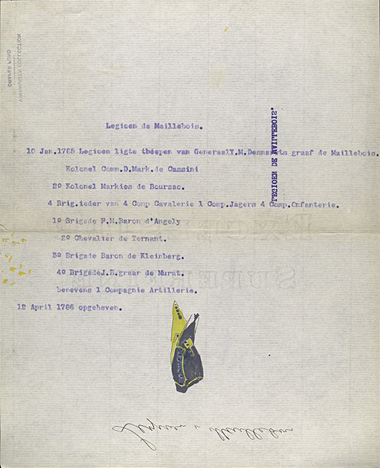
It was obviously a closely knit society so I should not have been surprised to discover a link between the Maillebois and Cassini families from the reverse side of a piece of paper on which there is a sketch of a Legion’s uniform. This typed note states that Yves-Marie Desmarets was the General in charge of the Maillebois Legion in the Low Countries, a part of the Fourth Battalion, and raised on the 12th April 1786 though you will see that there is, at the top of the page, the date of 10th January 1785. I believe this might be the date on which an Artillery Company was added to the Legion. I have also seen the date of the 17th April given as the date of the Legion being raised. The note goes on to state that the Legion was led by a Kolonel Comm. D. Mark. de Cassini who is Dominique Joseph, Marquis de Cassini, the husband of Madame de Cassini. Bear in mind that there were considerable movements in military organisations around France in these troubled times as individuals attempted to structure armies to support their different causes.
Maillebois wrote to His Serene Higness the Prince d’Orange and Nassau on the 18th April 1785 asking him to approve the appointment of Cassini to his army with the rank of, at least, General Major. Maillebois noted that, at the time of writing, Cassini was not only Colonel Commandant of Maillebois’ Legion, but Marechal de Camp in France since Letters Patent were published for that commission in 1767 by the French King. He also reminded the Prince that Cassini would be paid by himself, Maillebois. The Prince replied on the 22nd April 1785 essentially saying that he had no objection.
Consequently, the Council of State, in its resolution of the 22nd April 1785, elevated Cassini from the rank of Colonel Commandant to General Major of Cavalry with effect from 1767, Cassini having been Marshal de Camp of the French army from that date, apparently a compatible rank with the new command.
However it appeared that Maillebois was not able to retain the Marshall’s baton and, with permission, was allowed to move to the Netherlands and raise troops there against Austria.
In accordance with his contract with the Council of State, Maillebois raised a corps known as the Legion de Troupes Légeres or Ligte Troeppe Maillebois Legioen established as four independent brigades. Each comprised four companies of light cavalry, four companies of fusiliers, line infantry and a company of skirmishers – chasseurs-a-pied In addition the legion had a company of artillery. Although the legion was headed by Maillebois, his ill health and age required that much of his duties were carried out by his second in command, Dominique Joseph, Marquis de Cassini.
But it appears from a document printed in 1784 that not only was Cassini thought to be old and not up to the task by those dealing with him – it is said he was censured more than once for his incapabilities – but many, if not most of the officers were given their posts with the involvement of his wife, Mme de Cassini. It is recorded that Dominique Joseph received an annual salary for his service in the Low Countries of five thousand Guilders, the equivalent of around £320,000, three hundred odd years later.
In 1784 the Emperor Joseph II of Austria pressed the Dutch Republic over the free navigation of the Scheldt, and with war seeming possible, the Dutch turned to Maillebois who, with the consent of the French crown, raised a legion under his name. The corps formed in the early months of 1785 at Nijmegen, Arnhem, and Bois-le-Duc (s’-Hertogenbosch), under the title ‘Légion de Troupes Légères’, in Dutch, the ‘Ligte Troepen Maillebois Legioen’. It was intended to number some 3,100 men, organised into four mixed brigades and a company of artillery, with each brigade comprising four companies of cavalry, one company of chasseurs, and four companies of infantry.
The Legion was stationed at Hertogenbosch, in Brabant. Most of the officers of the Legion were French or had served in the Royal army, while the rank and file were mostly Dutch and Walloons with a small number of Germans.
The command structure placed Maillebois at the top as General commanding-in-chief, with Cassini immediately below him as Colonel Commandant, and a further officer, the Marquis de Bourzac, as second colonel. The four brigades were commanded respectively by the Baron d’Angely, the Chevalier de Ternant, the Baron de Kleinberg, and the Comte de Murat, each with his own lieutenant-colonel – Prez de Crassier, the Baron de Holzendorff, M. de Cornabé, and M. de Bombelles – and his own brigade major – Scherer, Burhol, Merlet de Saint-Landry, and Tinné. In practice, Maillebois’ age and declining health meant that running the legion fell largely to Cassini. This is borne out by surviving correspondence from April 1785, in which Maillebois wrote to the Prince of Orange and Nassau asking him to confirm Cassini’s standing with the rank of at least Général-Major, noting that Cassini already held the post of Colonel Commandant of the legion and the French rank of maréchal de camp since 1767. The Prince raised no objection, and the Dutch Council of State’s resolution of 22 April 1785 duly elevated Cassini to Général-Major of cavalry, backdated to his original 1767 seniority. Cassini was paid for this service directly by Maillebois, and is recorded as drawing an annual salary in the region of 5,000 guilders.
The legion never had the chance to prove itself in the field. The dispute between Austria and the Dutch Republic was settled by negotiation before any campaign became necessary, and once peace was concluded the Légion de Maillebois was disbanded on 12 April 1786, a little over a year after it had been raised.
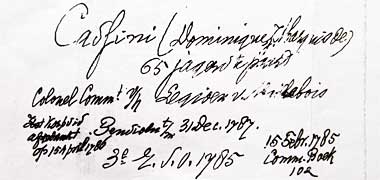
On another note that was kindly provided to me by the Central Bureau of Genealogy in the Netherlands, Dominique Joseph is recorded as retiring from the Regiment on the 31st December 1787, although I had previously understood that the regiment was only in existence from 1784-1786. However after the regiment was disbanded he remained in the Netherlands presumably because of his royalist leanings. But Maillebois appears to have been compromised by association with the revolt in Lyon against the National Convention, and he attempted to leave Belgium and enter the army of the Prince de Condé. The Marshall de Broglie, however, declared that if Maillebois turned up in Coblenz, he would return him to Trèves. So Maillebois remained in Maëstricht where he died on the 14th December 1791 and was buried.
In the Autumn of 1787, the alliance concluded in 1785 between France and the United Provinces was fractured by a Prussian invasion, the King of Prussia, Frederick William II being the brother-in-law of William V of Orange. France was unable to respond to the difficulties of its Dutch allies due to both a serious lack of finances as well as increasingly fragmented Royal foreign policies in this period immediately prior to the Revolution, two of the factors which were soon to precipitate the Revolution.
Dominique Joseph, Marquis de Cassini, died on the 17th April 1790 at his châon;teau at Fillerval, near Thury. At the time of his death, his wife’s lover, the comte de Maillebois, had been a guest at Fillerval, but on learning on 22nd March that his secretary had betrayed him to the authorities, Maillebois had fled the following day to Holland, taking with him, among others, a servant of M. de Cassini, and had been settled at Breda, where he held the position of governor, for nearly a month before the marquis died. Mme de Cassini joined him there after her husband’s death, eventually moving with him to Maëstricht. Sadly for her, Yves-Marie Desmarets died on the 14th December 1791, not at Maëstricht but at Liège.
Now presumably poor, and outside her native country, she did not return immediately to Paris, although it was recorded, she did almost immediately. It would have been dangerous for her to do so. Instead she made her way to London, where in 1793 she published an ‘Ode sur la Mort de Louis XVI Roi de France et de Navarre, Assassiné par la Convention nationale, le 21 Janvier 1793, Par Madame la Marquise de Cassini, Londres 1793’. Various sources suggest that she continued pro-royalist activities during this period.
In one of the letters written by Mme de Cassini to William Windham, discussed below, she mentions that her nephew will be leaving in a week’s time to join his parents in Holland. This was in 1797 and I wonder if there may be a link to a Cassini living in Holland at that time. I don’t yet know if this would have been a Cassini, a relation from her own side of the family, if the term ‘nephew’ was being used familiarly for somebody not related but well known to her, or even a simple code.
Madame de Cassini, the Marquise de Cassini
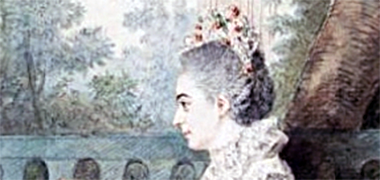
1797 was another interesting year in Europe. In September the British secret service’s counter-revolutionary plans in France collapsed. (Note that it was on the 18th Fructidor V – 4th September 1797 – that there was a coup d’état in France.) I believe that both Louis Joseph de Condé and his son, Louis Henri would still have been in England. Around this time Angélique-Dorothée, Madame de Cassini, the Marquise de Cassini, who was then around sixty, visited London apparently to meet William Windham, Secretary at War, 11th July 1794-1801, and the individual responsible for running spies for England, particularly in the French regions of Normandy and Brittany.
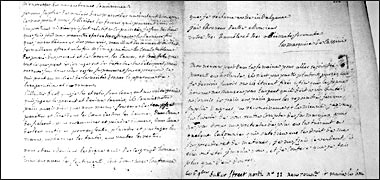
I had assumed that Madame de Cassini came to England from France specifically to see Windham. That may be so, however there is a note in the Departmental records of l’Oise that she emigrated in 1792, and that the State confiscated her goods. In fact her nephew, Jean-Domenique Cassini, known as Cassini IV, director of the Observatory of Paris, protested against this confiscation of goods which, according to him, did not belong to the widow but to the heirs of his uncle, Domenique-Joseph Cassini who had died in 1790. This suggests that Angélique-Dorothée and Domenique-Joseph had children though I have not been able to find any record of this. It might be, of course, that Jean-Domenique thought he might benefit through French inheritance laws of which I am not aware.
Jean-Dominique was the son of César-François Cassini III, the older brother of Dominique-Joseph. So Jean-Dominique was Dominique-Joseph’s nephew, not Mme de Cassini’s. The goods he was claiming had been confiscated as belonging to an émigrée, but his argument, that they actually belonged to the heirs of Dominique-Joseph who died in 1790, before the emigration and confiscation, was legally coherent, since he himself was one of those heirs. If the marriage produced no children, then Jean-Dominique and his sister Françoise-Élisabeth, wife of the vicomte de Riencourt, would have been the natural heirs to Dominique-Joseph’s estate. The confiscation of goods in Mme de Cassini’s name potentially absorbed what should already have passed to them on her husband’s death in 1790. His protest wasn’t necessarily self-serving opportunism, it may have reflected a genuine prior claim.
In the letters, written in the latter half of 1797, Mme de Cassini makes no mention of children but does write of both a nephew and niece. There is no clue as to whether they are brother and sister. She states that the niece had met William Windham, implying recently, and that the nephew was going to meet his parents in Holland. It is interesting to speculate who these might be.
I had found mention of a niece in the indictment made against Maillebois, her name being given as Mlle. Saint-Hilaire de Forceville. I had assumed her to be Elisabeth Françoise de Forceville who was arrested with her cousin Jean-Dominique Cassini, Cassini IV, on the 14th February 1794, but she was sent to the guillotine on the 6th June 1794, Cassini IV being released on the 5th August 1794. So it seems unlikely that this can be the same woman, though the niece Mme de Cassini writes of might be a sister of Elisabeth Françoise. There is also the possibility of her belonging to the Babaud or Masson families; but there is another contender.
Recently I discovered that the two younger sisters of Mme de Cassini’s husband, Dominique Joseph Cassini, were married. The sisters were Suzanne Françoise Cassini and Elisabeth Géneviève or Elisabeth Germain Cassini. The latter married Charles François de Forceville de Colembert in 1746 and had two sons, Louis Dominique de Forceville de Colembert, who married Madeleine Cesperon de Harcelaines, and Louis Antoine de Forceville de Colembert who married Marie Emilie de Vincens de Causans. This latter marriage also produced two sons, Gabriel de Forceville de Colembert, who married Louise de Forceville de Merlimont, and Charles André de Forceville de Colembert who married Marie Féicité de Mony. The marriage of Gabriel and Louise produced a son, Adolphe de Forceville de Colembert who married Isabelle de Serve.
Suzanne Françoise married a Philippe de Bréget or Brezet in 1712 and had two children, a son, Joseph Philippe and a daughter, Marie-Thérèse. It seems that Joseph Philippe and wife, formerly Marguerite Madeleine Herbert, are likely candidates for being the nephew and niece whom Mme de Cassini wrote about in her letter to Windham, but Marie-Thérèse and her husband, Louis Jules Duvaucel, were dead before 1797.
The husband of Angélique-Dorothée, Dominique-Joseph Cassini, also had a brother, César-Françoise Cassini – Cassini III – who married Charlotte-Jeanne Drouin de Vandeuil. They had two children, Jean-Dominique Cassini – Cassini IV – and Françoise-Elisabeth Cassini who, with those they married, respectively Claude-Marie Louise De La Myre-Mory and Louis-Henri de Riencourt are also nephews and nieces of Angélique-Dorothée. Claude-Marie Louise died in 1791 though her husband, Cassini IV, lived until 1845, and I have not yet discovered when Françoise-Elisabeth and Louis-Henri died. However, the reference to Mme de Cassini’s nephew going to meet his parents in Holland rules out Jean-Domique Cassini as his father, César-Françoise Cassini, died in 1784.
Of course there is also the possibility that Mme de Cassini might have been referring to younger and unrelated friends as this might have been a habit of the time; but I think it unlikely she would have referred to them as being her relations in a letter to Windham.
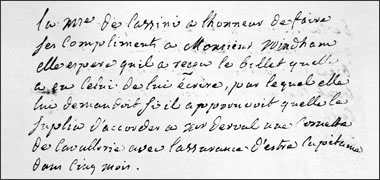
It might well have been that Windham was attempting to use her influence with the Prince de Condé whom the English wanted to use to lead a new army against Napoleon and in support of the restoration of the monarchy. Perhaps the more likely possibility is that she was operating as a go-between with Royalist forces in France as Windham was corresponding with others such as Georges Cadoudal, leader of the insurrectionary Royalists in Brittany, the Prince de Bouillon, the Comte de Puisaye and his lieutenant, Tinténiac the Breton Royalist. Regrettably the letters give no real clue as to why she was in England, and what she was doing on what I assume was a single stay.
She refers in her letters to her ‘dear baptiste’ and of his spending several days with ‘barthelemy and the arrested deputies’. I understand from a correspondent that these might be respectively General Pichegru with whom William Wickham – initiator of the British secret service activities during the French Revolution – the Prince de Condé and others were negotiating with the intent of his changing sides to the Royalists, and François-Marie Barthélemy, Member of the Executive Directory of the French Republic, who was arrested on the failure of the coup d’état of the 4th September 1797 and exiled to French Guiana, from where he subsequently made his way to England. Mme de Cassini writes that she corresponds with them and that she had arranged for funds – I assume from Windham – to be placed in Baptiste’s hands before his arrest.
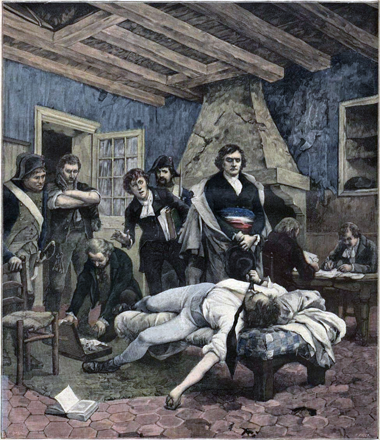
General Jean-Charles Pichegru had indeed moved to the Royalist cause and met William Windham following his escape with seven others to London via the United States, from his enforced exile to French Guiana for his part in the Coup of 18 Fructidor – the 4th September 1797.
In London he joined the staff of General Aleksandr Rimsky-Korsakov and was present in the Swiss campaign of 1799 which ended badly for Rimsky-Korsakov. Pichegru eventually returned to Paris in the summer of 1803 where, along with Georges Cadoudal and Jean Moreau, they intended to remove Napoleon from power and welcome the return of Louis XVIII as the King of France. Betrayed by a friend Pichegru was arrested on the 28th February 1804, and was later found strangled in prison on the morning of April 5th or 6th 1804, the government announcing a verdict of suicide, though others thought that he had been strangled on the orders of Napoleon. Moreau was given a two years sentence though asked for, and received, permission to exile himself in the United States but Cadoudal, refusing to ask for a pardon, along with eleven others was guillotined.
The opportunity for Napoleon to deal with the Duke of Enghien, grandson of the Prince de Condé, was taken at the same time. Enghien had previously been condemned in absentia for having fought against the French Republic and accepting British funds, and Napoleon ordered his arrest with the argument, but no proof, that he was associated with the three and their plot. At the age of 31 and having just married Princess Charlotte de Rohan on the 18th February 1804, he was captured at his home in Ettenheim in Baden, Germany on the 15th March 1804, brought via Strasbourg to the Château de Vincennes on the 20th March 1804, given a hasty trial and shot in its moat in the early hours of the 21st March 1804, provoking outrage around Europe.
Reading William Windham’s – the British Secretary at War 1794-1801 – diary it is difficult to obtain a good understanding of his attitude to the Prince de Condé due to the abbreviated character of his entries, but it appears that he was unhappy with Condé’s operation, noting ‘Bad opinions and feelings about the Condé army’ in an entry of the 28th April 1797. There is also no note in his diaries of any meeting he had with Mme de Cassini. However, there are mentions of meetings with Royalists from time to time as well as with William Windham, referring to him as being ‘English minister in Switzlerland’, the latter having taken a law degree in Geneva in 1786. Incidentally he refers to Windham as being the cousin of George Canning, the British Minister and, briefly, Prime Minister.
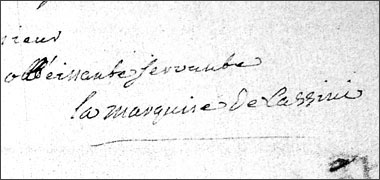
Whatever the reason might have been for her visit to England, she stayed at two separate addresses on the edge of north-west London – Nº.3 Lisson Grove and Nº.11 North Baker Street – writing four letters in a frail hand to Windham. In essence, the letters are formal notes in character referencing their meetings, but demonstrate that she was important enough for Windham to meet her a number of times. It seems entirely probable that there is a connection between her visit, the British interests in overturning the revolution in France and her political and personal connections. While it is not clear where she was living abroad, it is probable that it was in the Low Countries where her husband had been, Paris being too dangerous for her after the publication of her poem relating to the death of Louis XVI.
Looking into the movement of Mme de Cassini in England, I have only been able to find two relevent records. Firstly it is evident that she stayed at an address in Marylebone, north-west London when visiting and meeting Windham in the latter half of 1797 at a time when she was no longer the important figure in French society she had once been. However, it is evident that she maintained strong connections to the Royalist interests, if not acting as a spokesperson, messenger or go-between.
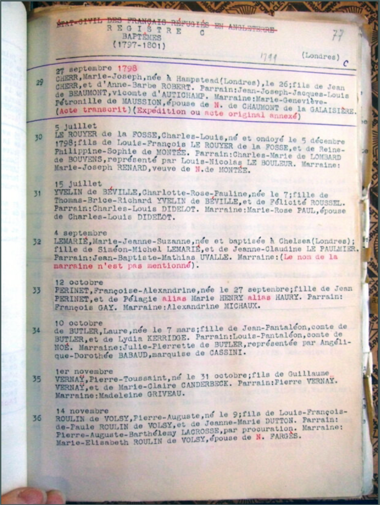
Secondly, Mme de Cassini is recorded in the Civil State baptism register of French refugees in England between 1797 and 1801 as representing the godmother of Laure de Butler who was born in London on the 7th March 1799, the baptism taking place on the 10th October. Laure de Butler was the daughter of Jean Pantaléon de Butler, comte de Butler, and Lydia Kerridge, originally Kerredge, who were married on the 17th June 1797 in London. Sadly, Laure only lived a short time, dying on the 2nd January 1801 in London where she was buried at a cemetery in St. Pancras.
Laure’s other godparent was Louis Pantaléon de Noé, marquis de Noé, 1728-1816. As noted above, the record states that Mme de Cassini is perhaps not the godmother but is representing Laure’s godmother, Julie-Pierrette de Butler. So far I have not been able to determine the relationship between Mme de Cassini and Laure de Butler’s parents; whether it was by marriage or, perhaps, a social relationship, nor to whom Julie-Pierrette de Butler was related. It is also curious that she would have been associated with the baptism of Laure.
Apparently English, Lydia Kerridge married Jean Pantaléon de Butler following the death of his first wife, Marie Alexandrine Reine de Jassaud at the age of twenty-seven with whom he had had a son, Charles Édouard, in 1791. Marie Alexandrine Reine was guillotined at a day’s notice on the 26th July 1794 at the Barrière du Trône, Paris though had tried to delay the execution claiming she was pregnant through an illicit association in prison. Lydia Kerridge had been the mistress of Jean Pantaléon de Butler from 1794 until their marriage in 1797 when he legitimised their two children, Marie Josèph and Louise, born out of wedlock in 1795 and 1796 respectively.
There is a probable record of their marriage at St Marylebone Parish church, London, on the 17th June 1797 when a John Butler, widow, and Lydia Kerredge, spinster, both of that parish, were married. This would have been an Anglican marriage which is surprising as John Butler is likely to have been a Catholic, though Catholicism was proscribed in England at that time. Also surprising is that there were no witnesses of family or friends, the two witnesses to the marriage appear to have been ordinary witnesses as they also signed at other weddings in the records.
A clue to this might be that he seems to have become suspected by the French émigrées. In London he had become a merchant and agent of the émigrées, but in 1805, as the result of an apparent scam, he left London for Hamburg later moving to Paris, now under the control of Napoleon Bonaparte, to work for Joseph Fouché’s police, and renouncing Royalists. In 1812 he volunteered to return to London to spy for the new French Empire, but was sent instead to Denmark. He died in obscurity in Gothenbourg, Sweden in 1815.
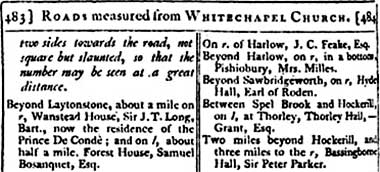
Although I believe the Prince de Condé came to England in 1795, so far I have been unable to uncover any information confirming Mme de Cassini liaising with him in England, having assumed that their meetings would have been on the continent or only when she was younger. However, looking for some other information I came across a record of the Prince de Condé living in England where he leased a large property, Wanstead House, situated between Laytonstone, now known as Leytonstone, and Woodford – located in East London – in February 1802. This would have been Louis Joseph de Bourbon, the ninth Prince de Condé who moved to Wanstead following the disbanding of his army in 1801, renting it from 1802 to 1810.

On the 24th October 1798 in London, and as a widower, the Prince married again, this time to his long-term mistress, Marie Catherine Brignole-Sale, the divorced wife of Prince Honoré III of Monaco. The marriage was kept a secret until the 26th December 1808 when it became public knowledge and they were living at Wanstead House. This enabled the King and Queen of France now to visit the couple with a propriety that was not possible previously. But the couple were not to remain at Wanstead House for more than a couple of years as they soon moved again, this time to Wimbledon House in the south-west of London.
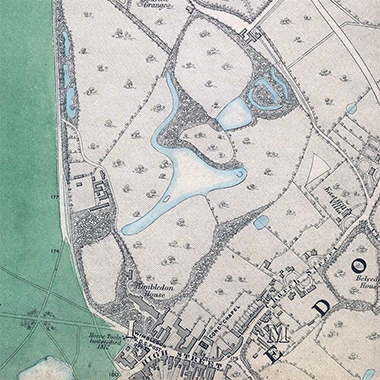
In the 1790s, Wimbledon House was the home of the exiled Vicomte de Calonne, Charles Alexandre de Calonne, who had served as Louis XVI’s Controller-General of Finances in the years leading up to the French revolution. Banished from France by Louis XVI in 1787, Napoleon Bonaparte permitted the Vicomte to return to Paris in 1802 where he died the same year.
The Prince de Condé and his wife moved from East London to Wimbledon House in south-west London in 1810 where Marie Catherine died on the 28th March 1813. She was buried at the Catholic Church of St Aloysius, Clarendon Square, in north-west London, the English Royal family funding the funeral – her fortune having been spent in support of opposition to the Revolution.
As noted above, on the restoration of the monarchy Louis-Joseph returned to France, entering Paris in the same coach as Louis XVIII on the 3rd May 1814. He was now the grand maître of the royal household of Louis XVIII, but died in Paris four years later on the 13th May 1818.
I have been unable to determine when Mme de Cassini returned permanently to France. Her meetings with William Windham are noted, as is her address at that time or times in London, but there seems to be no information on her length of time in England or, perhaps, in the Low Countries.
1800 saw the beginnings of a relaxation by Napoleon when he started to allow the less politically dangerous émigrés to return to France. In 1802 the l’amnistie des émigrés’ passed in France stating all émigrés who had not taken up arms against France were welcome to come home, including even those who had fought against France.
The situation would have been considerably more complicated for someone like Mme de Cassini. The amnesty required that returnees declare themselves before appointed commissaries, take an oath of fidelity to the government, and formally renounce any connections with enemies of the State. Those who had received places, titles, decorations or pensions from foreign powers were also bound to declare and renounce them.
For the Marquise this would have been a delicate moment given her documented meeting with Windham in 1797 on counter-revolutionary business and her publication of royalist pamphlets in London, she was potentially in a compromised category, Napoleon attempting to ensure the return was on his terms, particularly with his intent to create a secure State. The amnesty specifically excluded those who were known to have been movers or agents of civil or foreign war, as well as counter-revolutionary journalists, pamphleteers and plotters. Women who had abandoned their families to emigrate were also excluded, although whether this grouping might have included the Marquise, who I believe was childless, might have counted in her favour.
Yet she was clearly back in Paris by 1800 at the latest since Carcado-Molac moved into the house that year. This raises the question of whether she returned quietly before the formal amnesty process, perhaps relying on the general confusion of the period, or whether she successfully navigated the official process despite her counter-revolutionary history. The fact that she appears to have lived unmolested until 1809 suggests she managed it one way or another. As for resuming her salon, Napoleon made clear that any émigré properties seized and sold during the Revolution would not be returned, so there would have been no prospect of recovering her properties or the wealth needed to entertain formally. Any salon or social gathering would necessarily have had to be modest and private.
The most logical sequence would have been that she remained in London or possibly moved between London and the Low Countries until at least late 1797, and that her return to Paris would have been sometime between 1798 and 1800, perhaps taking advantage of the more pragmatic atmosphere of the late Directory or the early Consulate after Bonaparte’s coup in November 1799.
The first partial amnesty came in October 1800. That window between the coup and the formal amnesty was a period when many émigrés were quietly drifting back, testing the water before the official process caught up with them. It would fit both she and Caracado-Molac returning to Paris in that period. It is also worth noting that by 1800 she was in her mid-sixties, impoverished and probably exhausted from years of exile.
The Treaty of Campo Formio between France and Austria was signed on October 17, 1797, ending the War of the First Coalition and significantly altering territorial boundaries in Europe. Following this, the counter-revolutionary cause was effectively lost. Returning to Paris to live out her remaining years quietly, whatever the risk, may simply have been the most practical option left to the Marquise.
It is evident that Madame de Cassini was involved in the arts for much of her life and would have been on familiar terms with many artists in the salons which she held or visited. This connection is likely to have been the reason for her being godmother to the child prodigy and composer, Angélique-Dorothée-Louise Grétry – known as Lucile Grétry who, born on the 15th July 1772, tragically died of tuberculosis at the age of eighteen on the 25th August 1790. Incidentally, the other godparent was the distinguished Lieutenant in the Army of the King, Louis-Paul de Brancas.
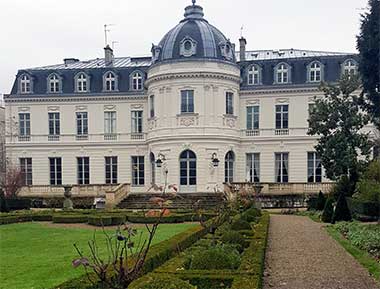
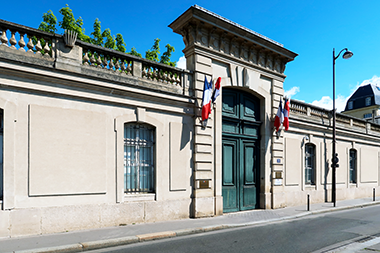
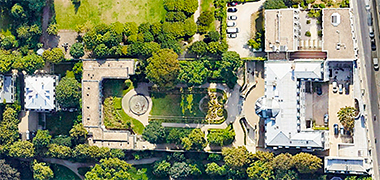
It is not clear to me where Dominique-Joseph Cassini and his wife lived immediately following their marriage on the 21st April 1754 but they later established themselves in Paris, living in a substantial building, the Hôtel de Cassini at 32 Rue de Babylone in the 7th Arondissment. Designed by the architect, Claude Billard de Bélisard and constructed by Louis-Pierre Lemonnier – both of them engaged in works for the Prince de Condé – with whom Mme de Cassini was now associated. The project was completed in 1768 but has had a number of alterations and additions with a sequence of owners.
The first of these three photographs shows its façade to the rear garden. This image shows it now, the mansard roof and dome on the garden façade having been added in 1863 when it was home to the Comtesse de Talleyrand-Périgord. Its frontage is hidden from the street by a substantial wall incorporating the entrance gate, as can be seen in the second photograph. Funds for the development had been borrowed by Dominique-Joseph from Antoine de Landrieffe to whom the hôtel was returned, presumably by the revolutionary government in 1794, Dominique-Joseph having failed to repay de Landrieffe. Nor do I understand why funds were borrowed bearing in mind the dowry which Mme de Cassini brought to the marriage. The development is now in the possession of the French government. There is a little more detail relating to the history of the building here and here.
This aerial plan of 32 Rue de Babylone shows the property as it now appears in 2024. Although the house and grounds were established on 5,525 sq.m. it is not certain where the boundary would have been established at the time of the Hôtel de Cassini’s construction. However, it appears by any measure that this would have been a substantial development.
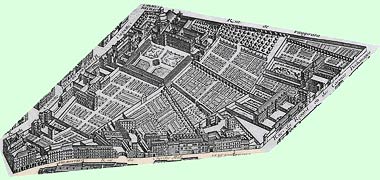
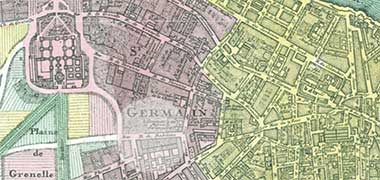
Around 1791 or 1792, Madame de Cassini must have been allowed by the Revolution to return to Paris, this being a time of the relatively safe romantic ideals of democracy and equality. However, it would not have been long before she left again. Prior to leaving Paris she had been an extremely wealthy woman, but her estates had been confiscated by the Revolution on her flight to join Maillebois. Her return to Paris saw her impoverished, her brother and husband both dead. Whether for political or social reasons it appears that Mme de Cassini was now largely forgotten, the circumstances of the State’s dramatic changes and her lack of funds must have considerably reduced her ability to live in the manner of her previous time in Paris. She now rented a small apartment, not far from her old home in Paris on the rue de Babylone – illustrated here in a map of 1750 – in a building which was at that time nº. 788, but is now nº. 19 rue du Cherche-Midi.
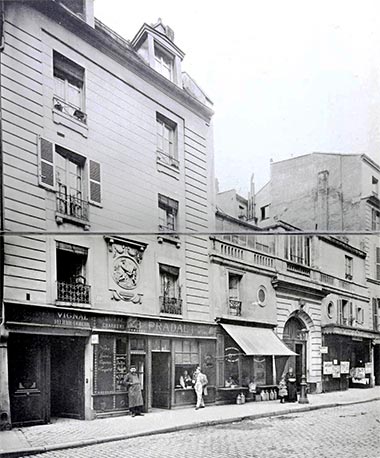
In 1786 the house was purchased from the Marquis Le Boucher de Martigny for the sum of 37,965 livres by the master carpenter Jean Duchesne, who was already established in the area and who appears in contemporary records as holding or occupying several properties in the neighbourhood, some of which were linked to the holdings of the Order of Canons Regular of Prémontré (the Premonstratensians or Norbertines). He thus belonged to a network of small property holders and tenants operating within this ecclesiastical property structure in the rue du Cherche-Midi district.
Duchesne’s acquisition appears to reflect both proximity and consolidation of local interests, and over time the property was associated with a range of occupants of differing social standing. Among these were individuals linked to Revolutionary-era military organisations, including three volunteers associated with the Prémontré battalion, one of the many local volunteer formations created during the Revolution for the defence of France.

The house also had connections with artistic circles, including Victor Peytavin, described as a student of the painter Davide, and Étienne Folie. These references suggest that, at least during this period, the property may have accommodated tenants or lodgers of differing professions rather than remaining a single unified bourgeois household.
With regard to Mme de Cassini and the question of her residence, Fromageot indicates that Mme de Cassini is associated with this address, and I previously interpreted this as implying that she may have lived here in or around 1792–1793, possibly seeking proximity to her former residence in the area following the disruptions of the Revolution. However, this association should be understood with caution, as Fromageot’s work often compresses long-term property memory and does not always distinguish clearly between ownership, residence, and later historical association.
It should be noted that Fromageot’s ‘La rue du Cherche-Midi et ses habitants depuis ses origines jusqu’à nos jours (1915)’ is a retrospective street-by-street compilation rather than a contemporaneous register of occupancy. It draws on a mixture of archival sources, death records, and local historical tradition, and frequently condenses successive occupants into single entries without fully distinguishing between overlapping residence, ownership, or later commemorative association.
And there are errors. I had previously understood Mme de Cassini to have died at this house at nº 19 rue du Cherche-Midi on 8 May 1805, aged sixty-eight, as stated by Fromageot with reference to the death registers of the Seine (volume 234). However, subsequent research has shown this to be incorrect.
Three documents provided by a French correspondent and held in the Archives de Paris indicate that Angélique-Dorothée Babaud died on 10 May 1809 at the age of seventy-five. The relevant document, entitled ‘Reconstitution des actes de l’état civil’, records both her name and date of death. This correction suggests that Fromageot’s date of 1805 should be treated as an earlier or mistaken archival attribution rather than a definitive record.
A third document records on the 23rd June 1809 that there is an inventory of her furniture following her death.
This is confirmed in a fourth document which is an official record of earlier documentation – this being an extract from the register of death certificates in the year 1809 for the 11th arrondissement. In a statement made at three in the afternoon, two young men, François Noël, the owner, and Etienne Marie Michel Leduc, a law student both living at nº. 10 rue de Condé reported that, at five o’clock in the morning, Angélique-Dorothée Babaud, widow of Dominique-Joseph de Cassini, Maréchal de camp, died at nº. 21 rue de Cherche-midi in the 11th arrondissement.
Note that the 11th arrondissement is now on the right or north bank of the river Seine, and that these addresses are now within the 6th arrondissement, the original twelve arrondissements having been defined on the 11th October 1795, but taking their present form as twenty arrondissements from the 3rd November 1859.
In the Official Gazette of the 7th November 1815, nº. 51, Orders of the King, Etienne Marie Michel Leduc
was appointed deputy judge at the court of first instance of Corbeil, department of Seine-et-Oise, replacing Mr. Deschouen, appointed to other functions; and we grant to said Mr. Leduc the exemptions from the representation of the diploma of law graduate.
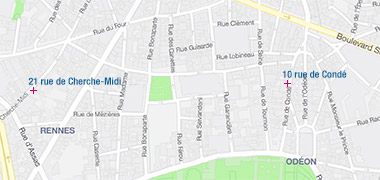
It is not clear how these two young men came to discover or learn of the death of Mme de Cassini, but it might be that at least Leduc had an official function in reporting the death of the seventy-five year old Mme de Cassini in that he had some legal training. Note that there was a considerable and indirect distance between their two addresses as well as the mairie at which they will have made their report. French civil registration at that period typically required two witnesses or declarants to report a death, and they were usually either relatives, neighbours, or the concierge of the building. The illustration here shows the locations of the three addresses today, including the mairie of the 11th arrondissement at 21 Rue de Vieux-Colombier.
The discrepancy of their addresses is interesting with their living at 10 rue de Condé but she dying at 21 rue de Cherche-Midi. They were not immediate neighbours or living together, so it can only be speculated as how they came to be at her apartment at that time.
François Noël, the ‘owner’, is potentially significant as he may have been her landlord, which would explain both his knowledge of her and his presence, though it does not explain why he was there at that hour. The law student Etienne Marie Michel Leduc is perhaps the more intriguing figure, a young law student living on the same street as the property owner suggests possibly a lodger or someone in the landlord’s household.
It may also be significant that she was living at the rue de Condé given her long association with the Prince de Condé, suggesting a possible link in her later years.
The fact that her death was reported at three in the afternoon suggests some hours passed between the discovery and the official declaration, which might have been normal, but the question of why they were at her address at five in the morning remains a mystery. The most prosaic explanation would be that there had been a servant or concierge who discovered her and immediately went to fetch the nearest available responsible person, the landlord being an obvious first call in such circumstances, and the law student perhaps simply being someone who was awake or easily roused at that hour – though why him, I have no idea.
A slightly more interesting possibility is that the landlord had some regular early morning reason to visit or check on her, perhaps because she was known to be in poor health and an arrangement had been made to look in on her on a regular or irregular basis.
The presence of the law student is the harder detail to explain conventionally. Young law students in that period were sometimes employed informally as secretaries or agents for elderly people managing legal or financial affairs. Given that the Marquise had lost her property to the Revolution and may have had ongoing claims or complications, such a relationship might not be impossible. He might have been involved in reporting to the mairie solely because a second party was needed, and he was available.
There is also the possibility that the rue de Condé address is genuinely significant, and that Noël’s household had some residual connection to the royalist network she and Carcado-Molac had inhabited, making them natural people to be called upon. If they were strangers or officials it might suggest she was more isolated than the Carcado-Molac connection implies.
Incidentally, I previously suggested that Angélique Dorothée Babaud’s age was based on her having been born in 1737; but this is not correct. It is most probable that she would have been born in 1734. This appears to be confirmed in a Register of Guardianships, AN Y4594A, dated the 1st December 1741, where it is stated that she was four-and-a-half in 1741:
dlle Marie Charlotte Jeanne Babaud agée de neuf ans et demy, et Angelique Dorothée Babaud agée de quatre ans et demy, seuls enfants mineurs de deffunt S. Jean Babaud fournisseur des bois de la marine, et de dame Marie Boesnier son epouse, leurs pere et mere.
As noted above, a number of sources – one of them Fromageot – state that it is not known why her nephews took so long before claiming and selling the assets of her estate in July 1809. This is incorrect but is likely to have been based on their erroneous belief she died in 1805 and not, as was the case, 1809.
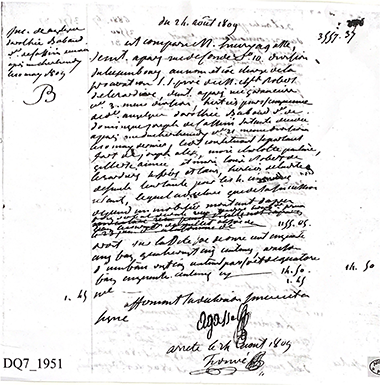
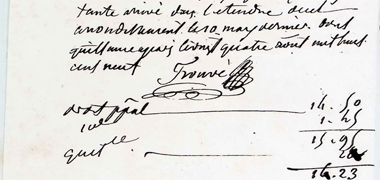
The correct date of Mme de Cassini’s death has been confirmed in a number of documents, of which these are two.
At the top of the margin on a single page, this first brief document dated the 24th August 1809 sets out the sale of her furniture following her death three months previously on the 10th May 1809. The second document is also dated the 24th August 1809.
The sale is recorded as producing the sum of 1,155.85 francs, on which the heirs paid transfer taxes of 14.50 francs – apparently 1.25% – if I have been able to understand what has the appearance of being a hurriedly written document. On the left of the first document is noted an additional 1.45 francs which, on another longer document, part of which is shown in the image below, is added to the 14.50 francs together with a further 0.28 francs for a total of 16.23 francs. The second document is one of a number a correspondent has kindly made available to me, and through which I am slowly attempting to read.
It should be noted that most of the documents are difficult to read due to the apparent speed with which they were written.
The first document mentions the names of four other people whom I assume were to benefit from the disposition of Mme de Cassini’s goods and chattels, and were four of her relations:
- Marie-Charlotte-Pauline Robert de Lézardière (25th March 1754 - 8th February 1835) was a daughter of Marie-Jeanne-Charlotte Babaud de la Chaussade, the sister of Angélique-Dorothée Babaud, Mme de Cassini. A French historian, she had emigrated with her family during the Terror, a number of members of her family having been executed. She returned to the Vendée Atlantic départment in 1801, and died on the 8th February 1835 at the Château de la Proustière (Poiroux). She remains best known for her multi-volume history of French law;
- Gilberte-Aimée Robert de Lézardière (1756-1829) was a sister of Marie-Louise Robert de Lézardière. Together they established the school for young girls at Notre-Dame de Bois-Grolland abbey, Poiroux;
- Marie-Louise Robert de Lézardière (1758-1834) was a sister of Gilberte-Aimée and Marie-Charlotte-Pauline Robert de Lézardière. In 1805 she returned to the religious order of Ursulines under the name of Sister Sainte-Angéle. In 1807 or 1808 she bought and founded a school for young girls at the Cistercian Notre-Dame de Bois-Grolland abbey, Poiroux in the Vendée. Later she became the mother-superior of the Ursulines of Luçon, also in the Vendée, in 1815; and
- Joseph Alexis Robert de Lézardière (20th August 1765 - 11th April 1858), who was a brother of the three sisters, and was a Captain in the Flanders’ regiment who emigrated during the Terror and served in the army of the Prince de Condé;
In the order of their being mentioned in the document, Joseph-Alexis, Marie-Charlotte-Pauline, Gilberte-Aimée and Marie-Louise were four of the sixteen children – of whom seven were daughters – of Baron Louis-Jacques-Gilbert Robert de Lézardière and Marie-Jeanne-Charlotte Babaud de la Chaussade; a nephew and three nieces of Angélique-Dorothée Babaud, Mme de Cassini.
Sadly for Mme de Cassini, and her inheritors, her dowry of around 6,290 ozs of gold had been reduced by her support of the monarchy to furniture worth the equivalent of less than 13 ozs.
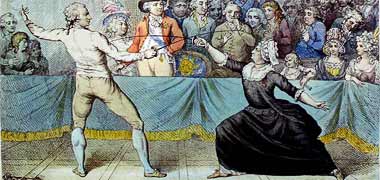
It was said that there may have been some comfort to her in having the Marquis Corentin-Joseph Le Sénéchal of Carcado-Molac living in the same house. Born on the 25th November 1710, twice married, and previously maréchal des camps et armées du Roi, he had divided his pre-Revolution time between his military camps and a mansion on the rue des Marais in Paris where he apparently enjoyed a full life. He moved to the house in rue du Cherche-Midi in 1800. Earlier, in 1792, he had experienced difficulties when the Revolution accused him of sending two of his sons under the pretence of delivering letters to the Count d’Artois and the Prince de Condé instead to visit the Prince of Wales in England who apparently owed monies to Carcado-Molac. His oldest son, Louis-Alexandre-Marie-Joseph, the Marquis de Kercado, died on the scaffold on the 24th July 1794.
Carcado-Molac had lost his estates in Britanny with the Revolution, feudal structures being abolished in 1789, and the buildings falling into disrepair and possibly appropriated by supporters of the Revolution, were most probably broken up or sold as biens nationaux. Returning would not have been possible and, like Mme de Cassini, he would have been unlikely to have the wealth needed to support a pre-Revolution lifestyle even if that was politically advisable. Settling into a reduced life in a quiet area of Paris would have been sensible.
He died in the house on rue du Cherche-Midi at the age of eighty-five on July 16, 1806, three years prior to the death of Madame de Cassini there. It is extremely probable that he and Madame de Cassini would have had similar interests. Two elderly, impoverished royalists with documented counter-revolutionary histories sharing a house in Napoleonic Paris is rather more than a coincidence.
In post-Revolution Paris, the rue du Cherche-Midi in the 6th arrondissement would have comprised large pre-Revolution houses split into apartments containing furnished rooms and, occasionally, small suites, appartements de rapport, in which tenants lived, perhaps supported by servants and owned by absentee landlords. This is what Noël’s relationship appears to have been. It is unlikely that Mme de Cassini would have been politically active but would have wanted to settle into a post-Revolution reliance on aristocratic networks with limited public visibility.
Known as the Marquis de Molac he had been, in 1748, colonel of the regiment of Périgord, when he married his cousin, the eldest daughter of the Comte of Carcado, an act that brought together the two branches of the Carcado. Very protective of his lineage, he had been involved in a sensational trial when he sued Charles Geneviève Louis Auguste André Timothée D’Éon de Beaumont, the chevalier d’Éon de Beaumont, another extraordinary character due to questions about the latter’s gender. A sometime Captain of Dragoons, wounded and decorated in the Seven Years’ War, as well as being a spy, he claimed to be female – in a writ issued on the 13th February 1779, for d’Éon de Beaumon’s claim of descent from the same family.
more to be written…
- The Cassini and Maraldi families
- Cassini family history
- Giovanni Domenico Cassini
- Jacques Cassini
- César François Cassini
- Jean Dominique Cassini
- Alexandre H G Cassini
- Maraldi family
- Giacomo Filippo Maraldi
- Giovanni Domenico Maraldi
- Giovanni Filippo Maraldi
- Giacomo Francisco Filippo Maraldi
- Astronomy
- Cartography
- The Babaud & Masson families
- France and England
- The Age of Enlightenment
- Joseph Cassini and Susanna Gill
- Cassini and Maraldi references